You Must Have Been A Beautiful Baby Sheet Music Preview

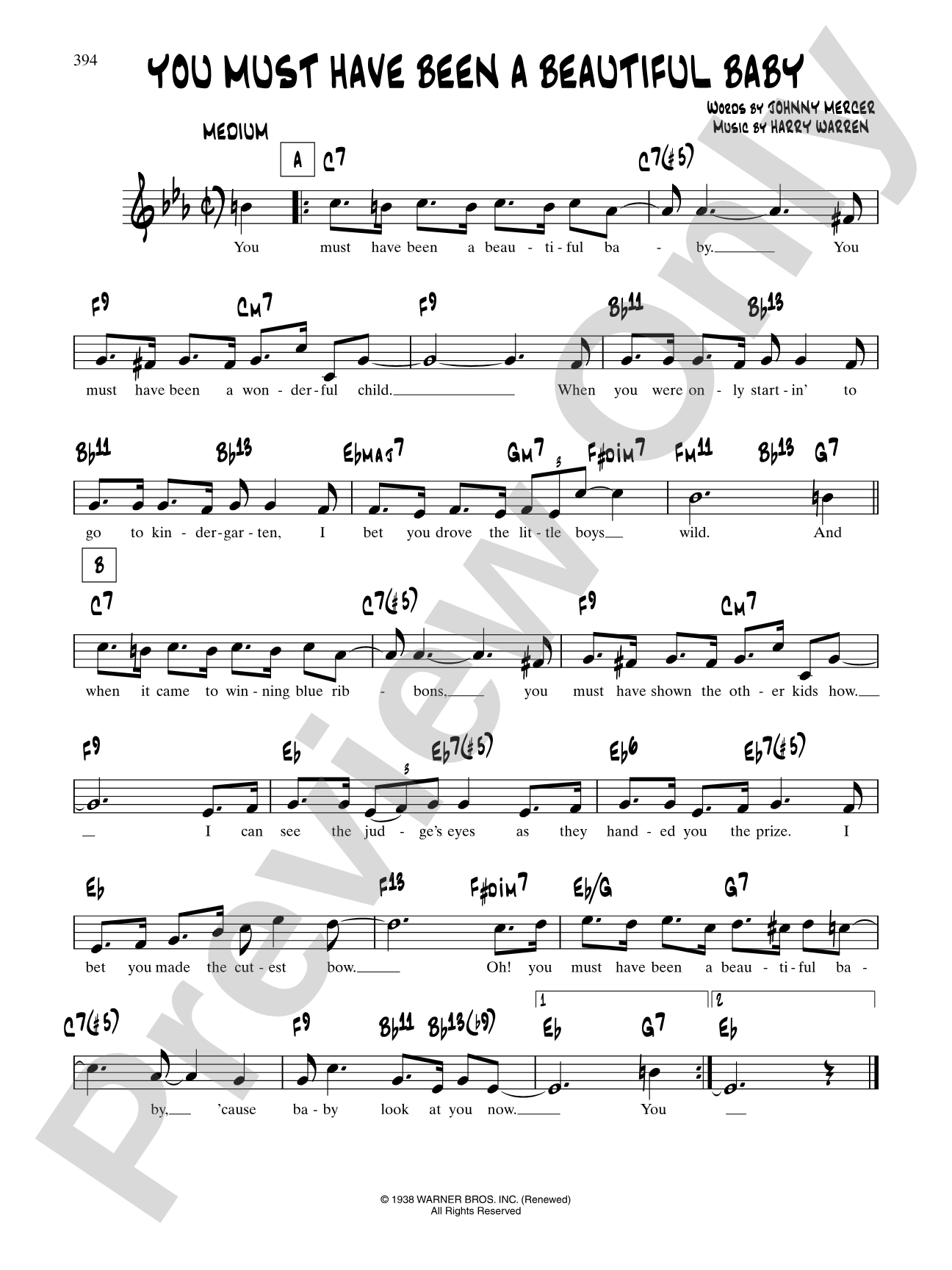
You Must Have Been A Beautiful Baby: Lead Sheet

Johnny Mercer

Item: 00-PSL-000281

Digital Download
$1.99

One moment…

Description
Titles include: Ac-Cent-Tchu-Ate the Positive * Blues in the Night * Bob White (Watcha Gonna Swing Tonight?) * Charade * Come Rain or Come Shine * Dream * Fools Rush In (Where Angels Fear to Tread) * The Glow Worm * Goody Goody * Hooray for Hollywood * I Wanna Be Around * I'm an Old Cowhand (from the Rio Grande) * Jeepers Creepers * Laura * On the Atchison, Topeka and the Santa Fe * Satin Doll * Skylark * Something's Gotta Give * Summer Wind * That Old Black Magic * Too Marvelous for Words * You Must Have Been a Beautiful Baby.

You Must Have Been A Beautiful Baby: Lead Sheet isn't in MakeMusic Cloud just yet...but it could be. Let us know you'd like to see it, and you'll help shape what comes next. In the meantime, start a free trial and dive into thousands of interactive titles your students can play along with today.

Sample Audio
No sample audio found.
Sample Video
Additional Details
Series: American Songwriters Series
Publisher: Alfred Music
Page Count: 76
SKU: 00-PSL-000281

More about this title

About the Artist: Johnny Mercer

Johnny Mercer (1909-1976) was an American lyricist whose gift for conversational, singable words shaped the Great American Songbook. He collaborated with composers including Harold Arlen, Henry Mancini, and Jerome Kern, crafting lyrics that balanced sophistication with accessibility. Mercer's work earned four Academy Awards and defined the vocal standard repertoire for generations of singers and pianists.

As a performer himself, Mercer understood how lyrics sit in the voice and how melody and words should feel inseparable. His approach to songwriting emphasized clarity and emotional directness, making his standards ideal for musicians learning to balance technical musicianship with interpretive storytelling.

Why we love this

This collection gathers 22 essential standards in one accessible format, eliminating the hunt through multiple fake books and anthologies. Every tune here rewards close attention to lyrical content and harmonic sophistication, making it an invaluable resource for jazz pianists, singers, and music theater students who need to understand how great American songwriting works.

What to expect

These songs embody the elegance and wit of mid-century American songwriting. You'll encounter clever internal rhymes, unexpected harmonic turns, and melodies that sit naturally in the voice yet offer rich territory for instrumental interpretation. The collection moves across moods, from the playful novelty of 'Bob White' to the sultry sophistication of 'That Old Black Magic' and the introspective beauty of 'Skylark.'

Who it's for

Jazz pianists and keyboardists building a standards repertoire, vocalists preparing audition material or concert programs, and music theater students learning the foundational literature of American musical song. Pianists accompanying singers will find the lead sheet format essential for flexibility in transposition and arrangement.

How to get the most out of it

  • Study the lyrical phrasing printed above the melody line; Mercer's words and melodic contours are inseparable, and honoring the natural speech rhythm strengthens both singing and accompaniment voicing.
  • Approach chord substitutions conservatively on first readings, then experiment with reharmonization only after you hear how the original progression supports the song's emotional arc.
  • Listen to multiple recorded versions of unfamiliar titles before performing; these standards exist in countless interpretations, and recognizing stylistic possibilities will deepen your own choices.

How to use it

Slot individual songs into jazz combo sets, piano recitals, or vocal performance classes where singers need accessible, professionally arranged standards without the orchestral weight of published vocal scores. This format also works beautifully for teaching jazz accompaniment technique, since lead sheets demand active listening and real-time harmonic decision-making rather than note-for-note reading.

Skills your students will build

  • Reading lead sheet notation and chord symbols
  • Interpreting lyrical phrasing and its relationship to melody
  • Developing harmonic reharmonization and substitution skills
  • Accompaniment voicing for jazz and popular song contexts
  • Transposing smoothly between keys for different vocal ranges
  • Understanding song form and sectional structure in 32-bar and modified standards

You May Also Like