You Must Believe in Spring: Piano Digital Sheet Music

You Must Believe in Spring: Piano Digital Sheet Music

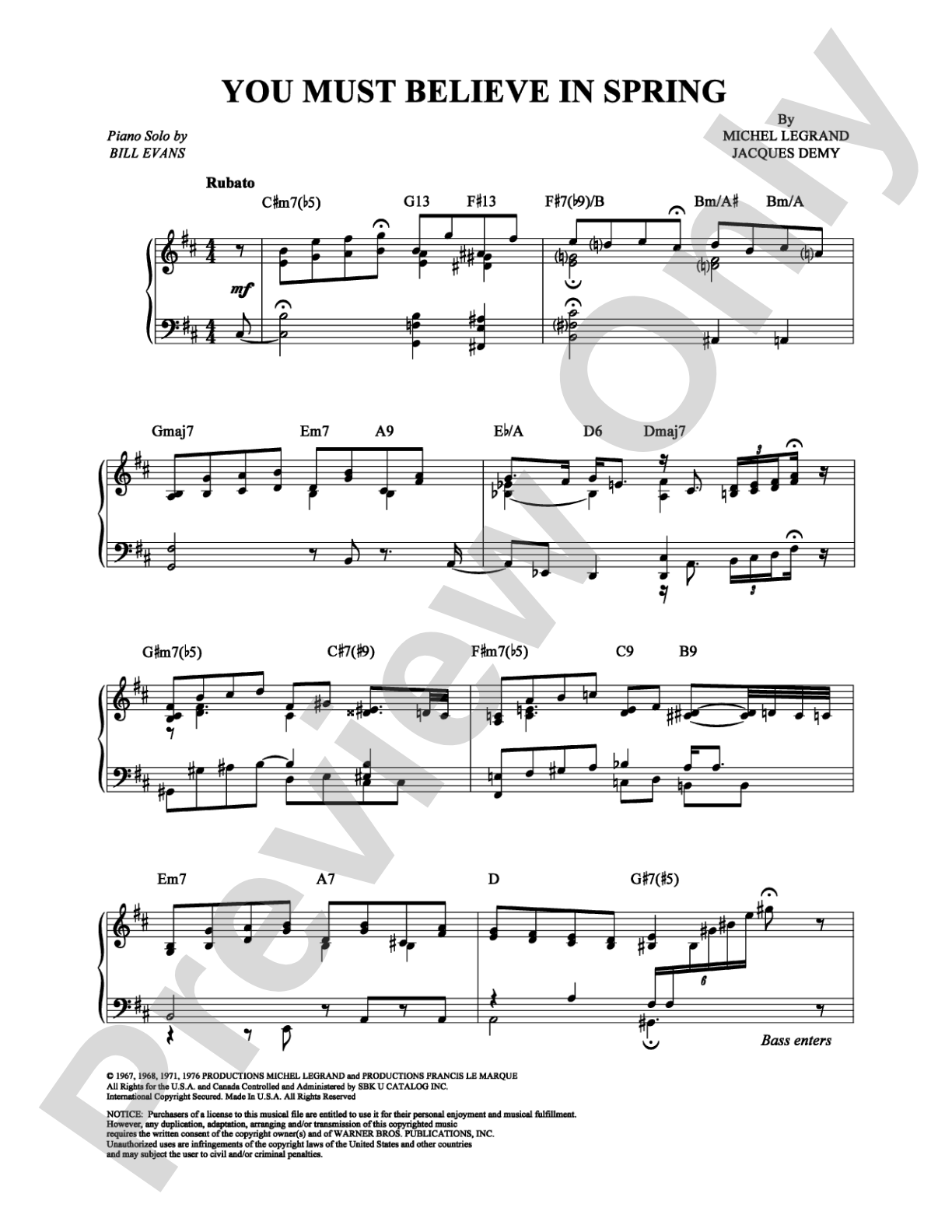
Bill Evans, Michel Legrand, Jacques Demy

Item: 00-PS-0002913

Digital Download
$3.99
Description

You Must Believe in Spring: Piano Digital Sheet Music isn't in MakeMusic Cloud just yet...but it could be. Let us know you'd like to see it, and you'll help shape what comes next. In the meantime, start a free trial and dive into thousands of interactive titles your students can play along with today.

Sample Audio
No sample audio found.
Sample Video
Additional Details
SKU: 00-PS-0002913

More about this title

About the Artist: Bill Evans

Bill Evans (1929-1980) was a pianist and composer whose harmonic sophistication and introspective approach fundamentally shaped modern jazz piano. His work bridged classical training with jazz idiom, creating a body of compositions and interpretations marked by melodic clarity, chromatic voice leading, and modal exploration.

Evans recorded prolifically across trio, solo, and ensemble settings, leaving behind a catalog that remains essential study material for jazz pianists. His influence extends across generations of musicians who continue to learn from his recordings and published scores.

Why we love this

Evans's harmonic language in this composition rewards careful study of chord voicings and substitutions that sound natural rather than theoretical. The melody sits perfectly under the hand while the accompaniment patterns challenge pianists to develop independence between voices and rhythmic flexibility.

What to expect

Contemplative and gently hopeful, with warm harmonic colors that invite both introspection and subtle joy. The piece unfolds without urgency, asking the performer to find beauty in harmonic nuance and restraint rather than virtuosity.

Who it's for

Jazz pianists developing intermediate to advanced harmonic sophistication and those building a personal repertoire of standards. This score opens conversations about Evans's compositional approach for students studying jazz history, improvisation, and arranging.

How to get the most out of it

  • Shape the melody with slight dynamic emphasis while keeping the harmonic underpinning conversational; resist the urge to make either hand dominate.
  • Explore the tension between stated harmonies and implied alterations by listening closely to how chord tones resolve and how passing tones create color.
  • Allow tempo and tempo feel to breathe naturally rather than metronomically; Evans's recordings demonstrate how subtle elasticity serves the music's introspection.
  • Articulate chord changes through touch and pedal control rather than relying on volume shifts; clarity in the left hand makes the composition's harmonic movement audible.

How to use it

Include this in jazz recitals or studio performances as a ballad that showcases musicianship over technique. Pair it with other Evans compositions to demonstrate his distinctive voice within the jazz standards repertoire.

Skills your students will build

  • Reading jazz chord charts and realizing voicings from lead sheet notation
  • Voice leading through chromatic and diatonic harmonic movement
  • Pedal technique for sustaining and blending jazz harmonies
  • Tempo flexibility and rhythmic phrasing within jazz melody
  • Left-hand independence and comping patterns that support melody

You May Also Like