(You Make Me Feel Like) A Natural Woman Sheet Music Preview

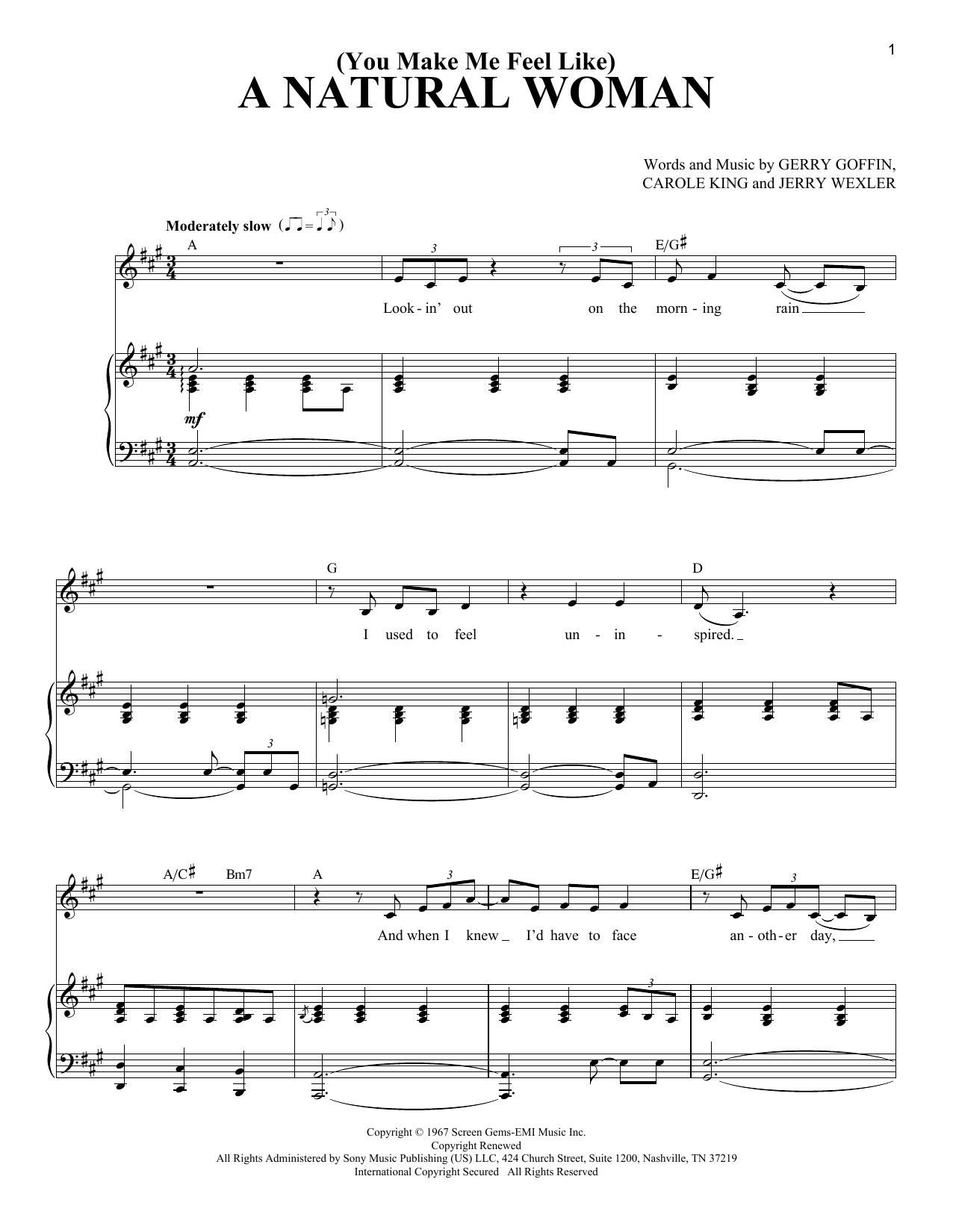
(You Make Me Feel Like) A Natural Woman: Piano Vocal

As performed by Carole King / As performed by Celine Dion / As performed by Mary J. Blige / As performed by Aretha Franklin

Item: 35-DS01464982

Digital Download
$5.99
Description

(You Make Me Feel Like) A Natural Woman: Piano Vocal isn't in MakeMusic Cloud just yet...but it could be. Let us know you'd like to see it, and you'll help shape what comes next. In the meantime, start a free trial and dive into thousands of interactive titles your students can play along with today.

Sample Audio
No sample audio found.
Sample Video
Additional Details
Publisher: Hal Leonard
Page Count: 7
SKU: 35-DS01464982

More about this title

About the Artist: Carole King

Carole King stands as one of the most consequential songwriters in American popular music, crafting hits that defined the 1960s and 70s with both technical sophistication and emotional directness. Before she became a recording artist in her own right, King wrote and produced countless chart standards, including "(You Make Me Feel Like) A Natural Woman" with Gerry Goffin, songs that remain central to the Great American Songbook and continue to teach musicians about melody, harmony, and lyrical storytelling.

Her work demonstrates how strong compositional fundamentals support memorable hooks and how a song can sustain multiple interpretations across genres and generations without losing its core power. For music educators, King's catalog offers accessible yet substantive material that rewards careful study of song structure, harmonic movement, and the relationship between text and music.

Why we love this

This arrangement gives students and performers access to one of pop music's most resilient anthems, a song built on achingly beautiful harmonic progressions and a melody that sits naturally for voices across multiple ranges. The seven-page score captures the song's warmth without oversimplifying it, making it equally useful for a vocal jazz student learning interpretation or a contemporary music ensemble exploring how a single composition functions across different stylistic contexts.

What to expect

This is a song about recognition and worth, and the arrangement honors that emotional directness. The piano part unfolds with the openness of a confidence shared with someone you trust, while the vocal line sits in a conversational register that feels both intimate and powerful, inviting the performer to discover why this particular words matter so much.

Who it's for

This works for vocal students building a standard repertoire, jazz singers developing their interpretation skills, and contemporary music groups mining the pop songbook for substantive material. It also serves accompanists looking for well-crafted vocal writing that showcases strong piano work without overpowering the vocalist.

How to get the most out of it

  • Honor the song's legit roots by sustaining phrases through the changes rather than punctuating them; the strength of this tune lives in its long melodic lines.
  • Let the piano voicings breathe. Too much pedal clouds the harmonic clarity that makes each chord change land with intention.
  • Explore the emotional temperature of different verses. The arrangement can accommodate both the vulnerability of an intimate reading and the confidence of a fuller interpretation.

How to use it

Include this in a vocal recital pairing contemporary pop standards with classic art song, or use it as a solo feature within a jazz or contemporary music concert. It also anchors a thematic program exploring women songwriters and their influence across genres, spanning from the Brill Building to contemporary interpretations.

Skills your students will build

  • Sustaining long melodic phrases across harmonic motion
  • Interpreting pop standard conventions (phrasing, rhythmic flexibility, dynamic shape)
  • Reading and realizing a piano/vocal score with attention to both parts
  • Understanding how a single composition functions across multiple stylistic contexts and vocal approaches

You May Also Like