
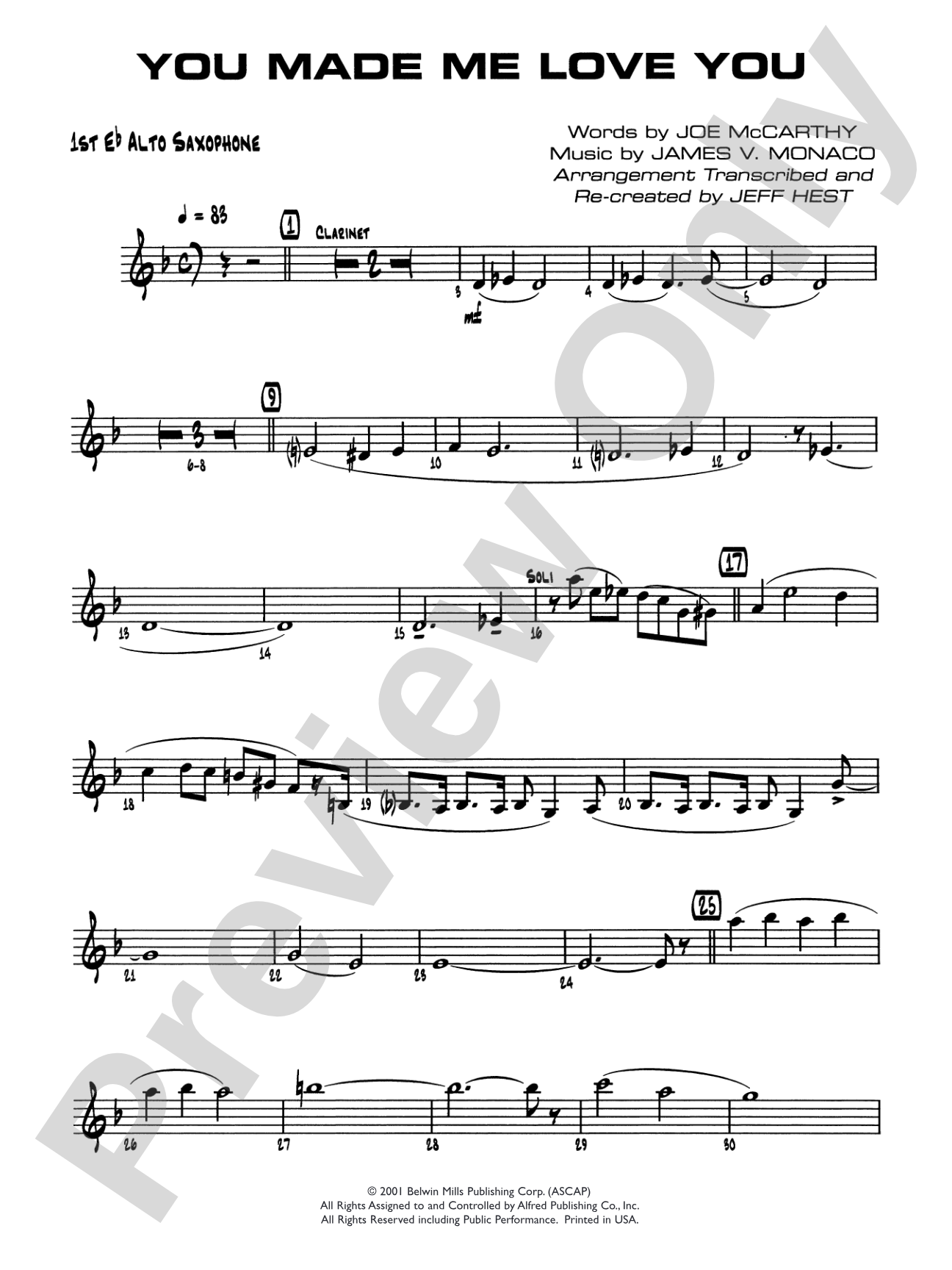

You Made Me Love You (I Didn't Want to Do It): E-flat Alto Saxophone
Music by James V. Monaco, words by Joe McCarthy / arr. Jeff Hest
Grade: 4.5 (Medium Advanced / Difficult)
Item: 00-PC-0002439_AX1
$3.00
Pickup currently not available
Description
Here is a musical salute to one of the greatest trumpeters of all time, Harry James. Jeff Hest transcribed and reconstructed this chestnut to showcase your trumpeter just as Harry James recorded it. What a wonderful change of pace for any concert---a showstopper with tremendous audience appeal, with stylistic flair, and a beautiful melody that will show off the band and the soloist. This trumpet solo is part of big band history---Harry James put this song on the map. Clarinet doubles.


Don't just read it, hear it, play along with it, and watch your students grow with it. In MakeMusic Cloud, You Made Me Love You (I Didn't Want to Do It): E-flat Alto Saxophone comes alive with professional accompaniment, adjustable tempo, and built-in practice tools that turn solo practice into real progress.
Open in the Player
Jump straight in and assign it today.
Start Your Free Trial
Open this title and explore the full library in minutes.
Sample Audio
1
Audio File
--:--
0:00
0:00
Sample Video
No sample videos found.
Additional Details
Series:
Premier Jazz Series
Publisher:
Alfred Music
Page Count:
86
SKU:
00-PC-0002439_AX1
More about this title
About the Composer: James V. Monaco
James V. Monaco (1885-1945) was a prolific songwriter and composer during the golden age of American popular music. Active in vaudeville, Broadway, and early film, Monaco wrote or co-wrote hundreds of songs that became standards of their era, many of them recorded by the leading entertainers of the 1920s and 1930s. His melodies were consistently memorable and singable, qualities that made his work ideal for both theatrical production and instrumental arrangement.
'You Made Me Love You' stands as one of Monaco's most enduring compositions. Written early in his career, the song gained legendary status when Harry James recorded his definitive trumpet interpretation, cementing it as a jazz standard and a showcase vehicle for virtuosic brass playing. The piece remains a staple of jazz repertoire and a test of a trumpeter's technical skill and musicality.
Why we love this
Jeff Hest's transcription preserves the essence of Harry James's iconic recording while adapting it skillfully for ensemble context. The arrangement gives your lead trumpet a genuine feature moment, complete with solo space and accompaniment that stays true to big band tradition. Directors choosing this piece get a crowd-pleaser with real substance and style—not filler, but a legitimate showcase that sits comfortably on any jazz or concert program.
What to expect
Sophisticated and swinging, with the warmth and elegance that defined big band era standards. The melody is instantly recognizable and emotionally engaging, supported by ensemble writing that moves with ease and style. The trumpet solo space invites both technical display and genuine musicianship, creating moments that feel both celebratory and intimate.
Who it's for
Jazz ensembles with a solid lead trumpet player who is ready for a featured solo role. The Grade 4.5 difficulty and 86-page score and parts package indicate a high school or college ensemble that has developed ensemble cohesion and can support a strong soloist. This is an ideal showcase when you have the personnel and want to highlight one of your strongest players.
How to get the most out of it
- Balance the trumpet solo against the ensemble by allowing the rhythm section to drive without overpowering the melody line; the soloist should feel supported, not buried.
- Work the clarinet doublings carefully so they enhance rather than muddy the trumpet's primary voice; light articulation and controlled dynamics preserve clarity.
- Establish a relaxed, swinging feel from the opening; this is not a march or a classical ballad, but a groove rooted in big band swing sensibility.
- Give the trumpet soloist space to breathe and phrase musically; marked passages should guide tempo and articulation, but individual musicianship and phrasing make this arrangement sing.
How to use it
Program this as a change of pace on a concert that leans toward classical wind band repertoire or original jazz compositions. It works particularly well as a concert finale or as a feature within a jazz-themed set, where the audience's familiarity with the melody and the Harry James legacy will amplify its impact. It's also an excellent choice for showcasing your ensemble's jazz capabilities at a festival or community concert where broad appeal matters.
Skills your students will build
- Swinging rhythmic feel and articulation within a big band context
- Ensemble balance and accompaniment technique supporting a featured soloist
- Interpretation of jazz standards and stylistic fidelity to the big band tradition
- Trumpet solo construction, phrasing, and improvisation space navigation
- Reading and executing clarinet doublings while maintaining ensemble integrity