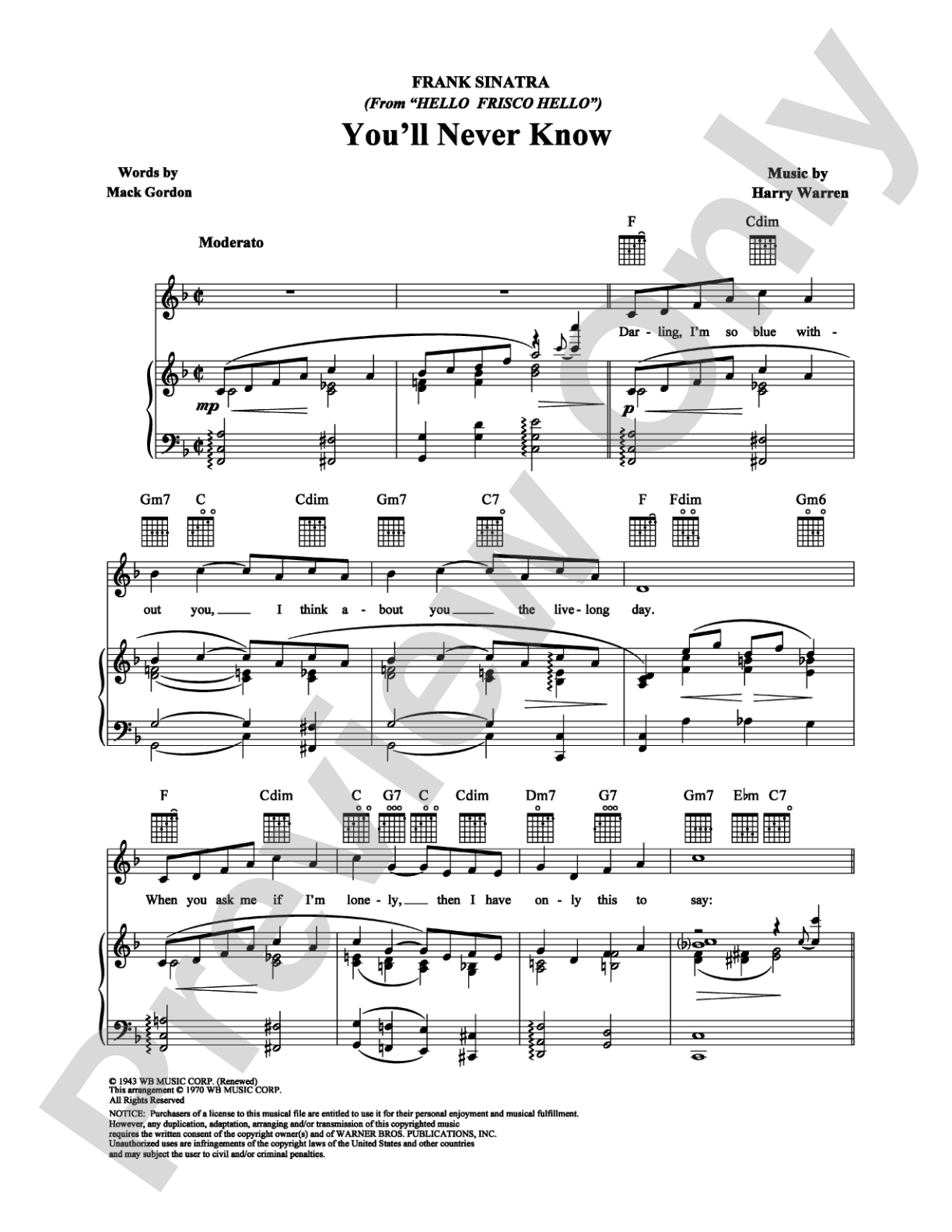
You'll Never Know: Piano/Vocal/Chords Digital Sheet Music

You'll Never Know: Piano/Vocal/Chords Digital Sheet Music

Harry Warren, Frank Sinatra

Item: 00-PS-0004260

Digital Download
$3.99
Description

You'll Never Know: Piano/Vocal/Chords Digital Sheet Music isn't in MakeMusic Cloud just yet...but it could be. Let us know you'd like to see it, and you'll help shape what comes next. In the meantime, start a free trial and dive into thousands of interactive titles your students can play along with today.

Sample Audio
No sample audio found.
Sample Video
Additional Details
SKU: 00-PS-0004260

More about this title

About the Artist: Frank Sinatra

Frank Sinatra (1915–1998) was an American singer and actor whose interpretive approach to popular song fundamentally shaped how standards are performed and taught. His phrasing, breath control, and ability to convey emotional nuance through subtle vocal choices became a model for vocal study across jazz, musical theatre, and classical crossover contexts.

Why we love this

This standard sits at the intersection of swing-era sophistication and accessible lyricism, making it ideal for vocalists learning how to balance technical control with storytelling. The chord progression offers pianists real harmonic language without unnecessary complexity, and the pairing of melody, harmony, and chord symbols supports singers at multiple levels of music-reading ability.

What to expect

Wistful and urbane, with a melody that sits naturally in the voice and lyrics that invite intimate delivery. The harmonic language has a gentle sophistication; it moves without rushing, allowing space for the singer to breathe and for the accompanist to color the chords with period-appropriate voicings.

Who it's for

Vocalists studying jazz standards, musical theatre repertoire, or American songbook material will find this a cornerstone piece. Piano accompanists preparing for vocal coaching or performance will appreciate the chord-symbol layout that supports both literal reading and creative comping.

How to get the most out of it

  • Study Sinatra's recorded versions to hear how he shapes the lyric across phrases; note where he holds back dynamically and where he leans into emphasis.
  • Balance the vocal line with the piano comping; the accompaniment should support the singer's phrasing, not compete with it.
  • Use the chord symbols to explore reharmonization at the piano, but ensure any variation enhances rather than obscures the singer's line.
  • Pay attention to the rhythmic placement of lyrics against the piano's harmonic rhythm; jazz phrasing often sits slightly ahead of or behind the beat.

How to use it

Program this alongside other wartime-era standards in a jazz or American songbook recital, or use it in a vocal methods class to teach how singers approach rubato and phrasing within a swing idiom. It also works well in musical theatre contexts where students are building a foundation in classic song interpretation.

Skills your students will build

  • Phrasing and lyrical interpretation within a swing-era idiom
  • Jazz comping and reharmonization on piano
  • Reading chord symbols and building voicings from a lead sheet
  • Breath placement and legit vocal production in a popular context
  • Coordinating singer-accompanist communication across rubato and metric flexibility

You May Also Like