
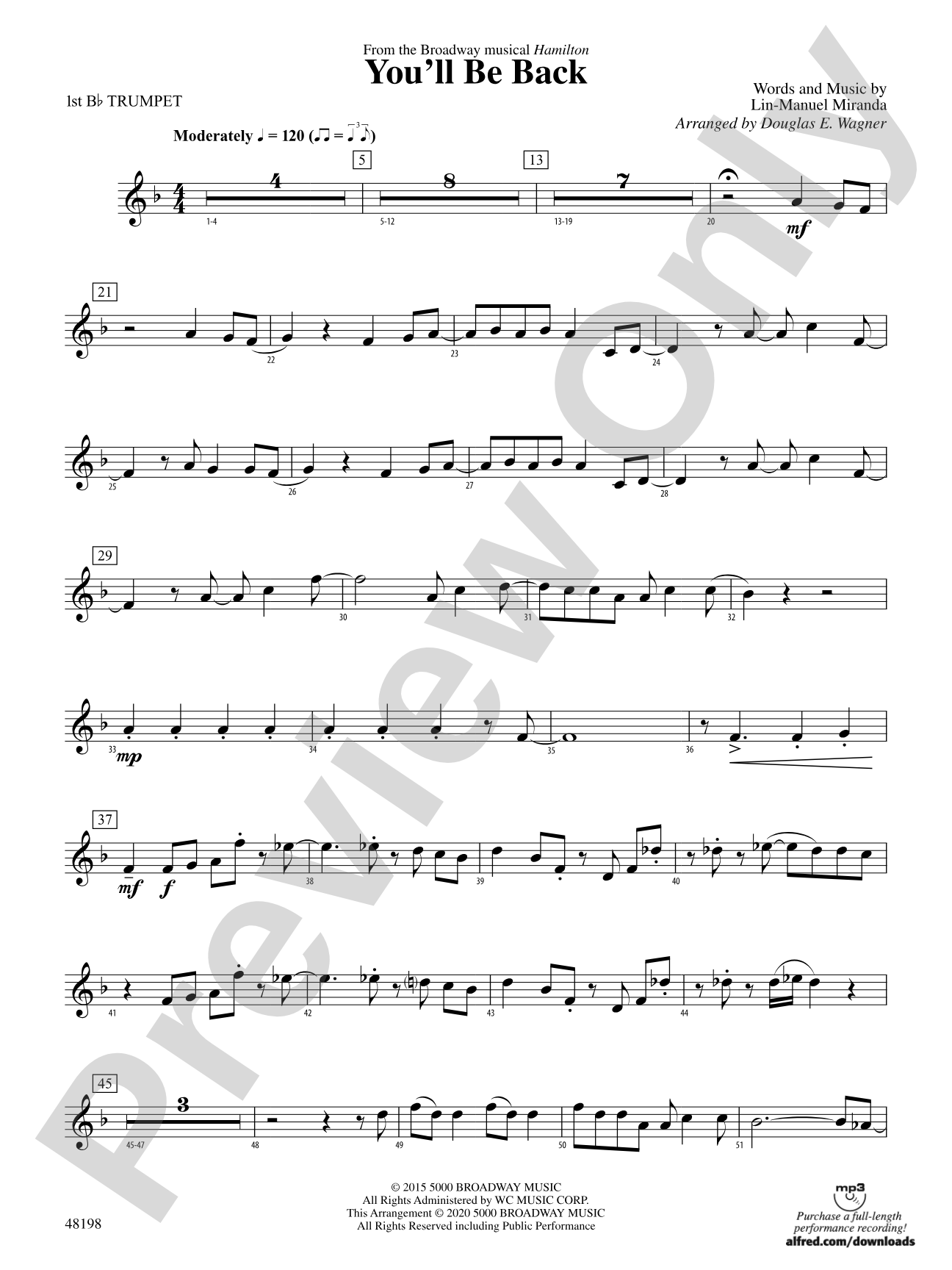

You'll Be Back: 1st B-flat Trumpet
From the Broadway Musical Hamilton
Words and music by Lin-Manuel Miranda / arr. Douglas E. Wagner
Grade: 2 (Medium-Easy)
Item: 00-PC-0018410_T1
$5.99
Pickup currently not available
Description
The familiar favorite tune from the award-winning Broadway musical is set in a laid-back, light rock style with clever melodic nuances and richly conceived harmony, perfectly scored for developing band. Easy to play, this one is a winner! This title is available in MakeMusic Cloud. (3:15)


Don't just read it, hear it, play along with it, and watch your students grow with it. In MakeMusic Cloud, You'll Be Back: 1st B-flat Trumpet comes alive with professional accompaniment, adjustable tempo, and built-in practice tools that turn solo practice into real progress.
Open in the Player
Jump straight in and assign it today.
Start Your Free Trial
Open this title and explore the full library in minutes.
Sample Audio
1
Audio File
--:--
0:00
0:00
Sample Video
Additional Details
Series:
Pop Young Band
Publisher:
Alfred Music
Page Count:
242
SKU:
00-PC-0018410_T1
More about this title
About the Composer: Lin-Manuel Miranda
Lin-Manuel Miranda is a composer and lyricist whose work has redefined contemporary musical theater. His breakthrough musical Hamilton won eleven Tony Awards and a Pulitzer Prize, establishing him as a major force in modern Broadway. Miranda's gift for blending contemporary musical styles—hip-hop, R&B, pop, and traditional theater music—with sophisticated storytelling has made his work accessible to audiences far beyond traditional theater communities.
In the classroom, Miranda's music offers students a bridge between popular music they know and the discipline of ensemble performance. His compositions reward careful listening and rhythmic precision while remaining engaging and immediately appealing to young musicians.
Why we love this
This arrangement captures everything that made the original memorable while scaling it thoughtfully for developing musicians. Wagner's scoring preserves the swagger and wit of the source material without sacrificing playability, giving your band a contemporary piece that sounds sophisticated and polished even at Grade 2. Your students will recognize it instantly, stay engaged throughout rehearsals, and feel genuinely proud performing it in concert.
What to expect
The piece carries the theatrical confidence and smooth sophistication of its source while settling into a comfortable rock pocket that feels natural for band. There's humor in the harmony and character in every section, inviting musicians to play with personality rather than merely executing notes on a page.
Who it's for
Concert bands at the Grade 2 level will find this accessible and immediately rewarding to learn. The arrangement works equally well for developing high school bands and upper-middle school ensembles seeking contemporary repertoire that connects with student interests. Directors building a program with Broadway selections or pop music will value its straightforward playability and genuine appeal.
How to get the most out of it
- Keep the rock groove steady and relaxed rather than driving it hard. The "laid-back" character depends on a groove that feels comfortable and conversational, not aggressive.
- Watch the balance between melody and accompaniment closely. With a piece this well-known, audiences will hear every rhythmic nuance, so lock in the harmonic support so the melodic lines sing clearly.
- Pay attention to the "clever melodic nuances" by shaping phrases with intentional breath points and subtle dynamic contours rather than playing them straight through.
How to use it
Program this as a concert centerpiece that bridges musical theater and contemporary band repertoire, particularly effective on a program mixing classical and pop styles. It works well as a spring or end-of-year concert selection when students have developed enough ensemble maturity to balance technical ease with musical interpretation. Consider pairing it with other contemporary works or Broadway arrangements to create a thematic concert.
Skills your students will build
- Reading and executing consistent rock grooves and steady eighth-note patterns
- Balancing melody and harmonic accompaniment with clear textural awareness
- Interpreting contemporary music idioms with appropriate style and articulation
- Maintaining ensemble precision in light, conversational tempos