
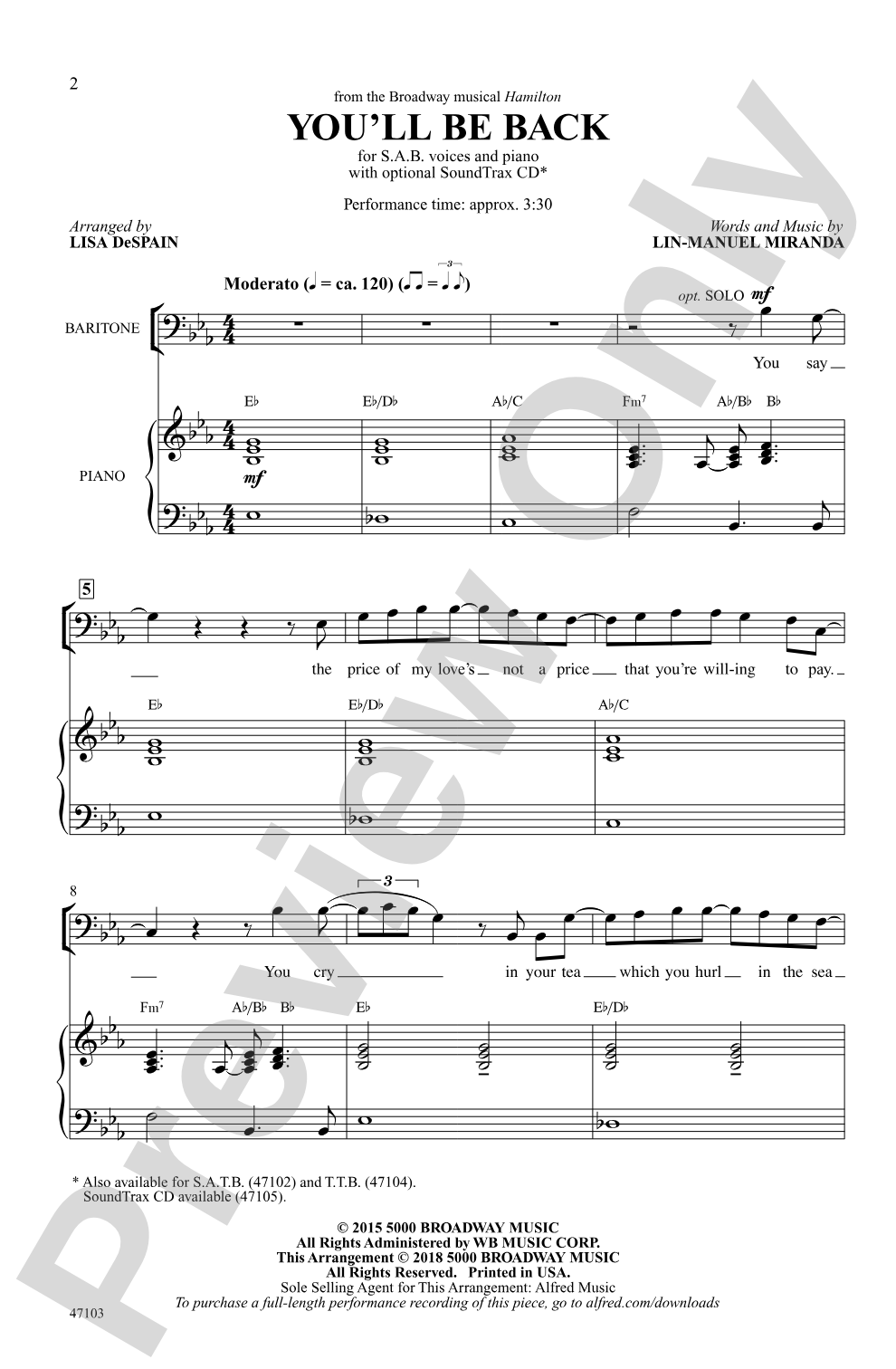
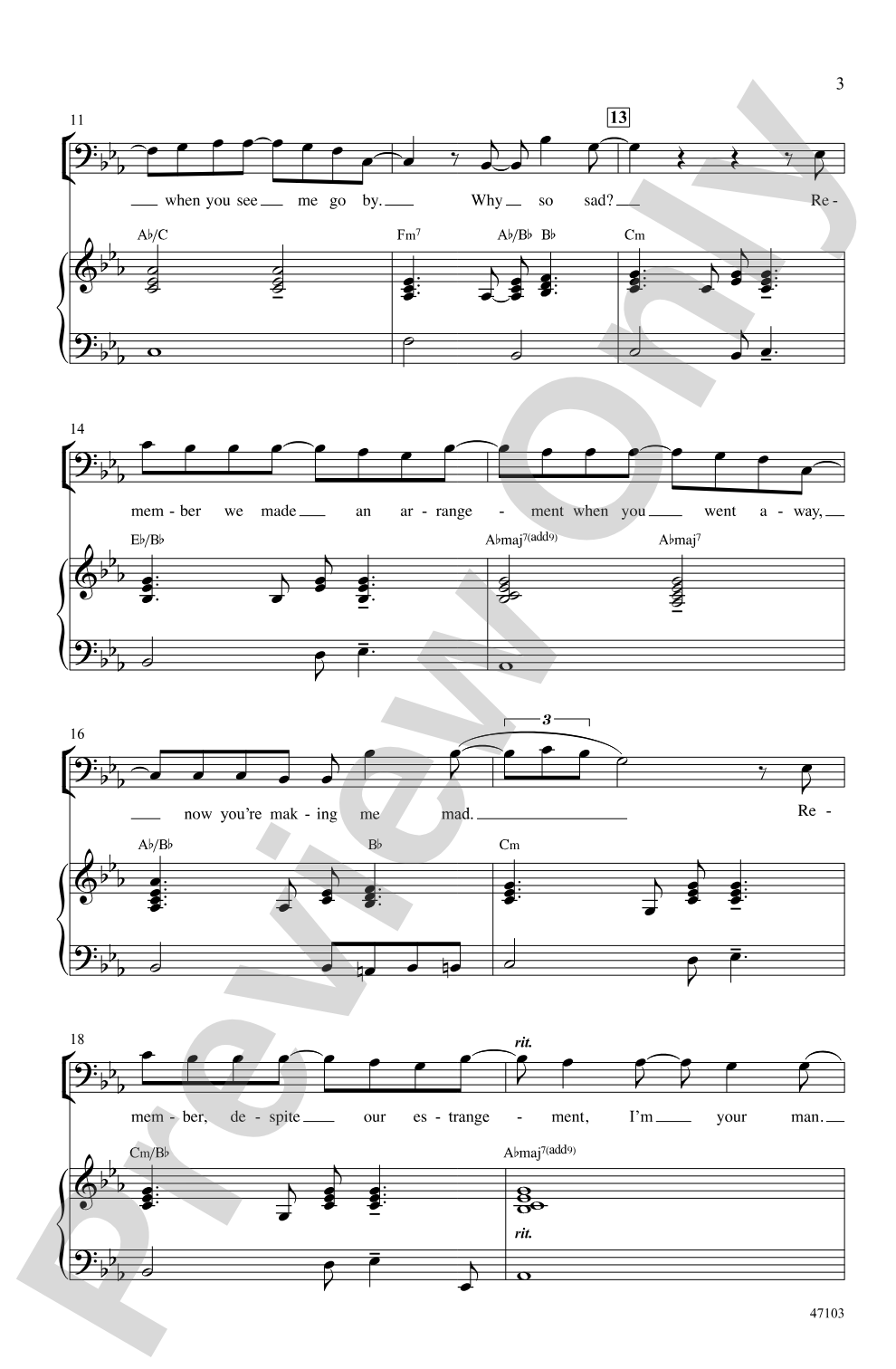
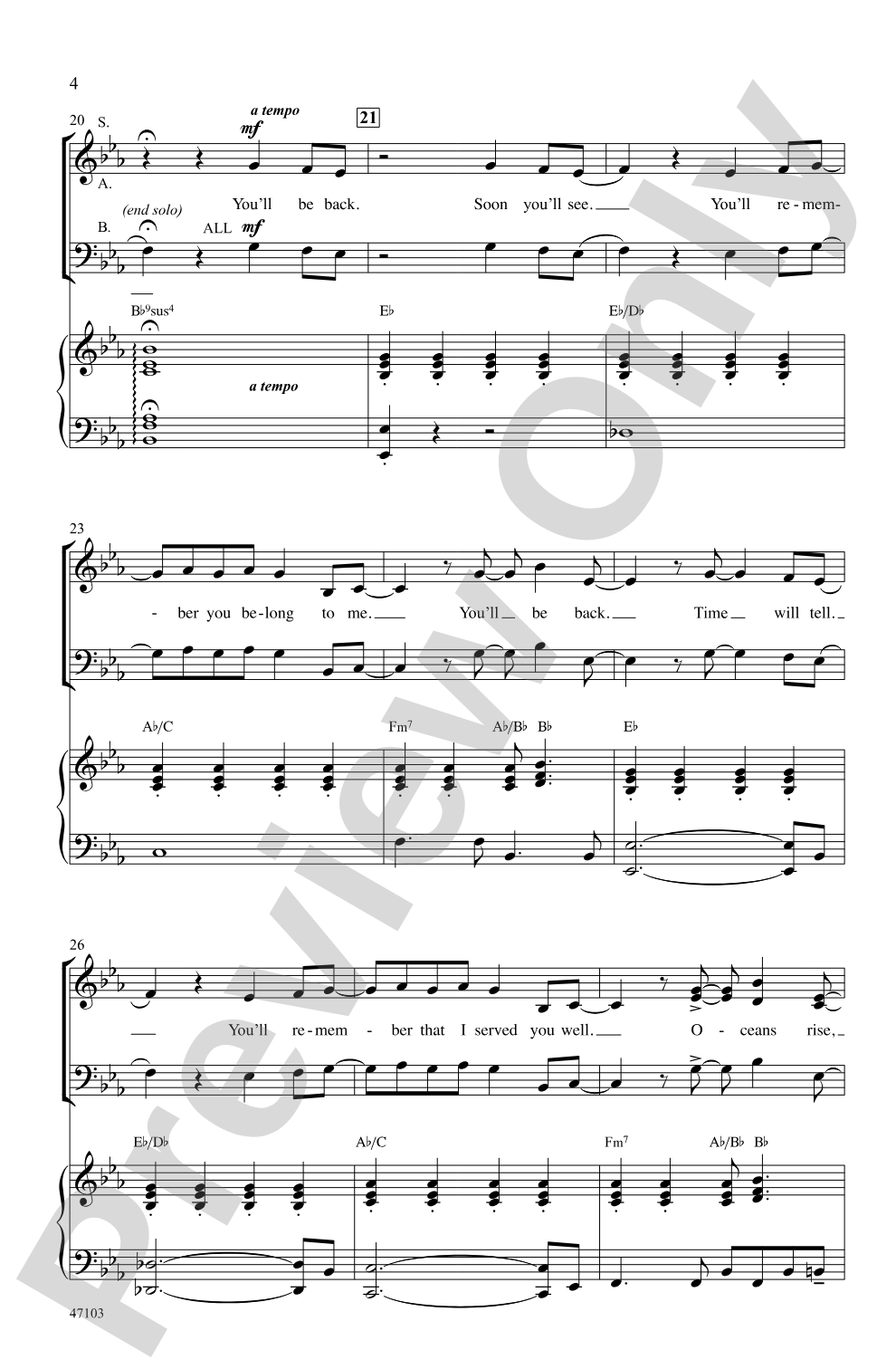

You'll Be Back: SAB Choral Octavo
From Hamilton
Words and music by Lin-Manuel Miranda / arr. Lisa DeSpain
Item: 00-PO-0005874
$2.10
Minimum order quantity: 20 copies
One moment…
Related Items
You'll Be Back: SoundTrax Digital Audio Download |
$27.99
|
View | |
You'll Be Back: SATB Choral Octavo |
$2.10
|
View | |
You'll Be Back: TTB Choral Octavo |
$2.10
|
View | |
You'll Be Back: SATB Choral Octavo |
$2.10
|
View | |
You'll Be Back: SAB Choral Octavo |
$2.10
|
View | |
You'll Be Back: TTB Choral Octavo |
$2.10
|
View | |
You'll Be Back: Choral Octavo SoundTrax CD |
$29.99
|
View |
Description
King George laments England's "breakup" with a young America in one of the most charismatic and surprising numbers from smash Broadway hit Hamilton. Fans note that this song is a departure from the mostly hip-hop and R&B style of the score, taking its inspiration more from breezy Britpop tunes. Lisa DeSpain's choral arrangement preserves the playful, coy spirit of the original, with its infectious "Da da da dat da" chorus. Not to be missed!


You'll Be Back: SAB Choral Octavo isn't in MakeMusic Cloud just yet...but it could be. Let us know you'd like to see it, and you'll help shape what comes next. In the meantime, start a free trial and dive into thousands of interactive titles your students can play along with today.
Request This Title
Tell us you want it.
Start Your Free Trial
Explore everything that's ready to play right now.
Sample Audio
1
Audio File
--:--
0:00
0:00
Sample Video
No sample videos found.
Additional Details
Series:
Alfred Pop Choral Series
Publisher:
Alfred Music
Page Count:
12
SKU:
00-PO-0005874
More about this title
About the Composer: Lin-Manuel Miranda
Lin-Manuel Miranda is a composer, lyricist, and performer whose work has fundamentally reshaped contemporary musical theater. His 2015 Broadway musical Hamilton won 11 Tony Awards and became a cultural phenomenon by blending hip-hop, R&B, and traditional show music to tell the story of American history.
Beyond Hamilton, Miranda has composed for In the Heights (Tony Award winner), worked on Disney's Moana and Encanto, and continues to develop new theatrical work. His arrangements and compositions for educational ensembles reflect his commitment to making contemporary musical theater accessible to student performers.
Why we love this
This arrangement captures something that makes Hamilton distinctive in the choral repertoire: a pop sensibility that sits comfortably alongside traditional choral literature without feeling lightweight. DeSpain's adaptation keeps the song's charm and humor intact, giving your singers a contemporary piece they'll actually want to perform.
What to expect
Playful and conspiratorial. The piece pulses with the comedic frustration of a jilted lover framed as a geopolitical breakup, wrapped in a catchy, almost vaudeville-like melody. Beneath the theatrical wink sits genuine musicality and ensemble work that feels rewarding to pull off.
Who it's for
Singers in middle school through high school choral programs and community choirs looking for a modern, Broadway-based piece that energizes audiences. The SAB voicing makes it accessible to ensembles with developing soprano and alto sections while remaining engaging to sing.
How to get the most out of it
- Nail the rhythmic precision of the "Da da da dat da" refrain. This earworm sits at the heart of the piece, so lock the ensemble on the exact same syllable placement and articulation.
- Honor the theatrical intent. King George is petulant and dramatic; the chorus should reflect that attitude through tone and phrasing rather than singing it as a straightforward pop tune.
- Balance the melody in the soprano line while keeping the SAB blend tight underneath. The arrangement's effectiveness depends on clarity without any part overwhelmed by another.
- Use the recorded accompaniment to secure the harmonic foundation, especially the rhythmic groove that sits behind the verses.
How to use it
This works beautifully in a concert exploring pop and musical theater styles, especially if you're programming other contemporary choral arrangements or Broadway selections. It also lands well as an audience-engagement moment mid-concert, given its immediate recognizability to Hamilton fans. Consider the tone of your program; this piece thrives when it can be both a musical highlight and a playful interlude.
Skills your students will build
- Rhythmic precision in syncopated pop idioms
- Theatrical interpretation of comedic text and character voice
- Blend and balance in three-part mixed voicing
- Stylistic awareness of contemporary musical theater versus classical choral traditions
- Ensemble cohesion on repetitive, catchy melodic material