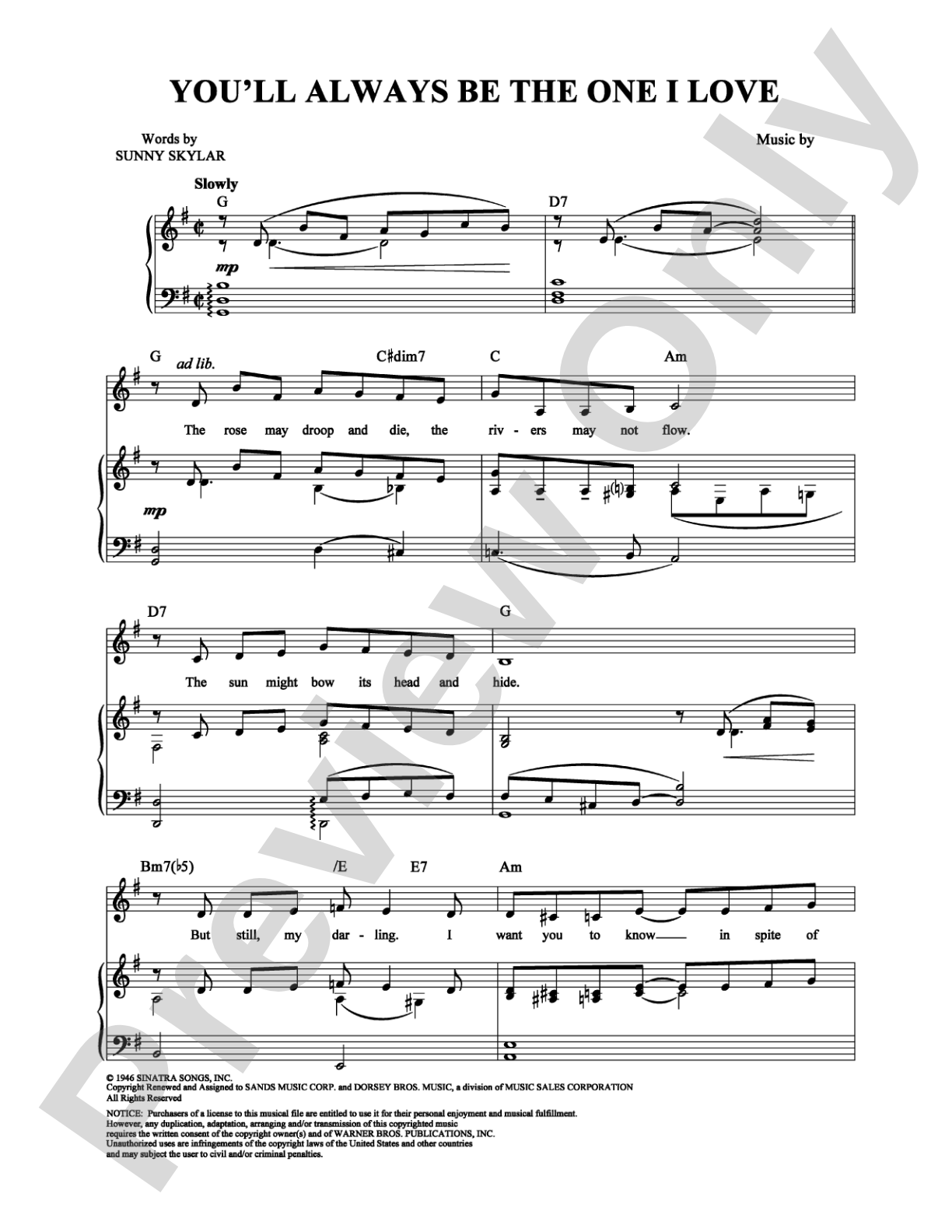
You'll Always Be the One I Love: Piano/Vocal/Chords Digital Sheet Music

You'll Always Be the One I Love: Piano/Vocal/Chords Digital Sheet Music

Frank Sinatra, Ticker Freeman

Item: 00-PS-0009835

Digital Download
$2.95
Description

You'll Always Be the One I Love: Piano/Vocal/Chords Digital Sheet Music isn't in MakeMusic Cloud just yet...but it could be. Let us know you'd like to see it, and you'll help shape what comes next. In the meantime, start a free trial and dive into thousands of interactive titles your students can play along with today.

Sample Audio
No sample audio found.
Sample Video
Additional Details
SKU: 00-PS-0009835

More about this title

About the Artist: Frank Sinatra

Frank Sinatra (1915-1998) shaped American popular song through decades of recording and performance, becoming the standard bearer for jazz-influenced vocal interpretation. His approach to phrasing, swing timing, and emotional directness established a model that generations of singers and pianists still study and emulate.

Why we love this

This standard offers singers a masterclass in interpretive restraint and pianists a partnership where accompaniment matters as much as melody. The piano/vocal/chords format works equally well for a recital soloist preparing material, a jazz ensemble building a vocalist's book, or a student learning how swing phrasing transforms a straightforward melody.

What to expect

Warm and deliberate, with an emotional honesty that resists sentimentality. The melody unfolds with space for genuine expression; the harmonic language sits comfortably in mid-century jazz vocabulary, accessible but never simplistic.

Who it's for

Jazz singers building a sophisticated repertoire, pianists seeking standards suitable for recital or accompaniment work, and voice students exploring the vocal literature that defines American popular song. This is equally useful for private voice instructors teaching jazz styling and for singers in jazz combos or vocal ensembles.

How to get the most out of it

  • Treat the vocal line as a conversation between singer and pianist rather than accompaniment and melody; the chord voicings should anticipate and complement the singer's phrasing choices.
  • Lean into the swing feel even if the notation doesn't explicitly mark it; let triplet subdivisions breathe naturally rather than mechanically.
  • Study recordings to hear how Sinatra handles rubato in the verses and locks into time during the chorus; this balance is the heart of the standard.

How to use it

Feature this in a recital exploring American standards, pair it with other Sinatra-era material for a themed evening, or use it as a repertoire-building assignment in a jazz vocals or accompaniment course. It also works as a duet pairing opportunity when vocalist and pianist are equally developed musicians.

Skills your students will build

  • Swing phrasing and rhythmic flexibility within a steady tempo
  • Reading and interpreting lead sheet chord symbols
  • Balancing accompanimental support with independent musical presence (pianist)
  • Shaping a lyrical line with emotional intention rather than merely hitting notes (vocalist)
  • Understanding the relationship between harmonic language and melodic phrasing

You May Also Like