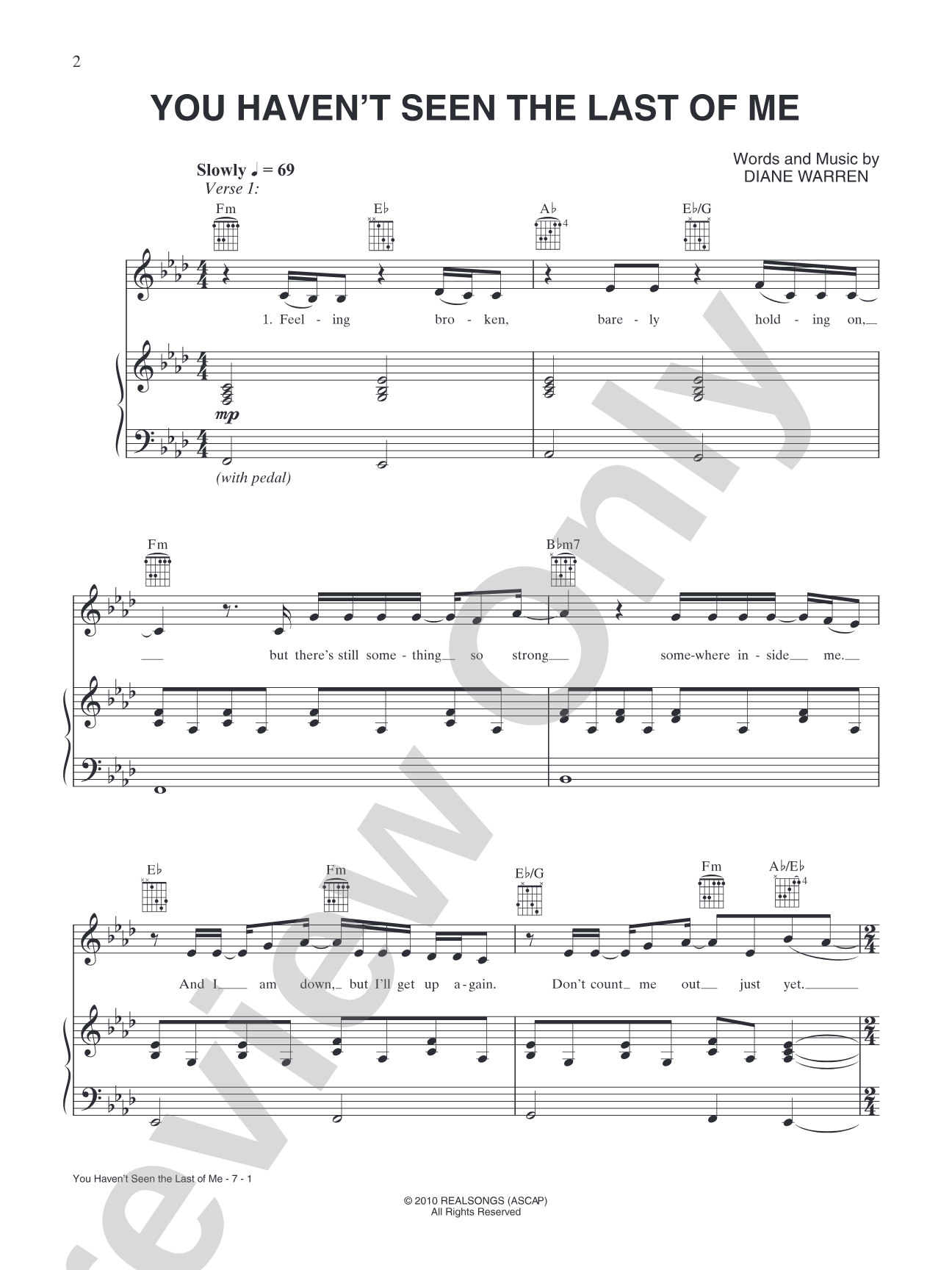
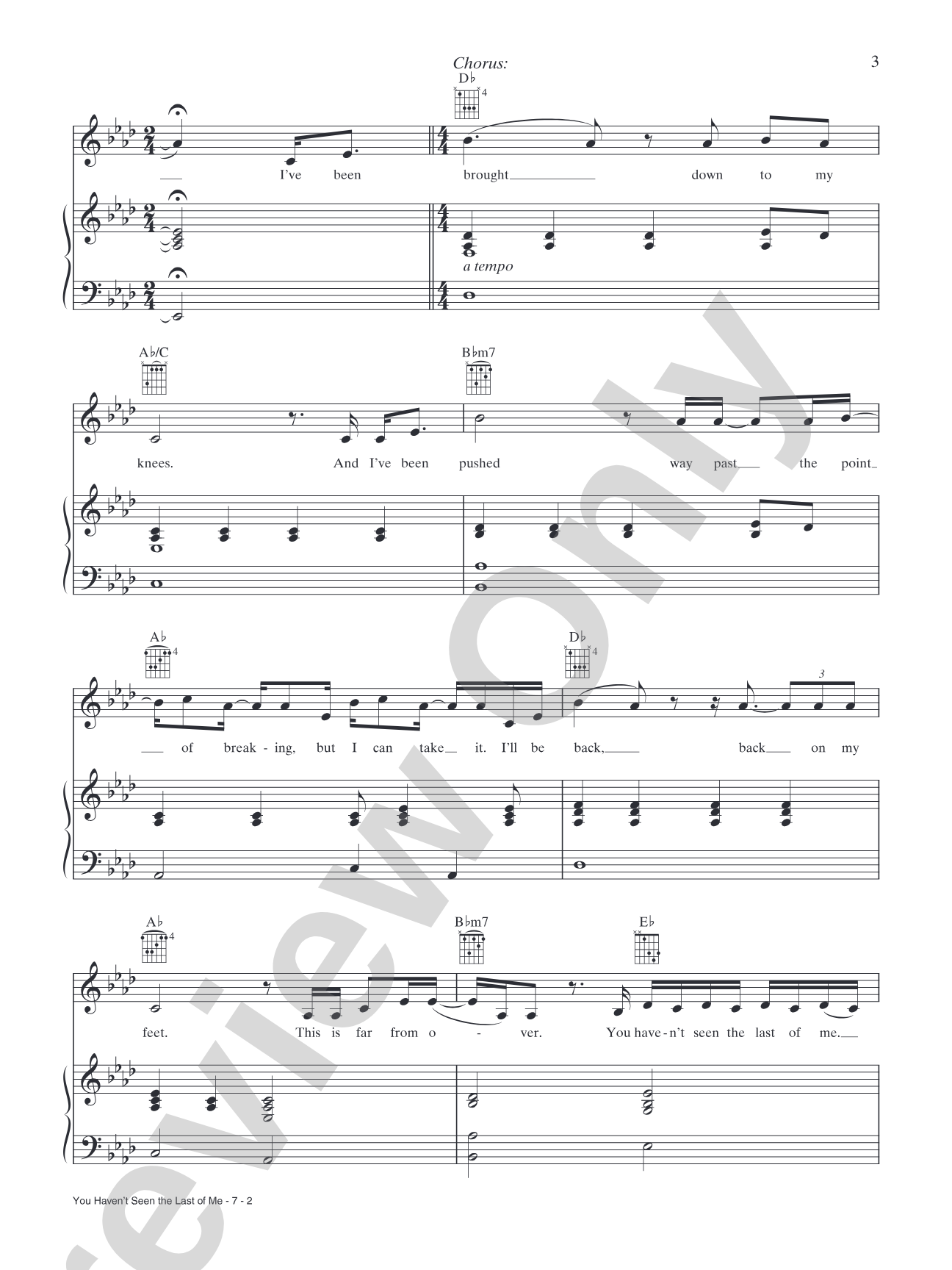
You Haven't Seen the Last of Me Sheet Music Preview

You Haven't Seen the Last of Me: Piano/Vocal/Chords

Words and music by Diane Warren / recorded by Cher

Item: 00-XS-0000211

Digital Download
$3.99
Description
Exclusively from Alfred, the Golden Globe-winning song penned by the iconic Diane Warren, as performed by Cher.

You Haven't Seen the Last of Me: Piano/Vocal/Chords isn't in MakeMusic Cloud just yet...but it could be. Let us know you'd like to see it, and you'll help shape what comes next. In the meantime, start a free trial and dive into thousands of interactive titles your students can play along with today.

Sample Audio
No sample audio found.
Sample Video
Additional Details
Series: Original Sheet Music Edition
Publisher: Alfred Music
Page Count: 8
SKU: 00-XS-0000211

More about this title

About the Composer: Diane Warren

Diane Warren is one of the most prolific and honored songwriters in contemporary music, with a catalog spanning film, television, and recording artists across multiple genres. She has received numerous Grammy, Golden Globe, and Academy Award nominations, and her ability to craft emotionally resonant melodies that resonate across diverse audiences has made her a cornerstone of popular songwriting since the 1980s.

Why we love this

This is a Golden Globe-winning song that demands serious vocal and pianistic maturity, making it an excellent choice for advanced students who are ready to tackle contemporary material with real emotional depth. The arrangement balances accessibility with sophistication, allowing singers to focus on dynamic control and narrative storytelling rather than navigating excessive technical complexity. Programming a song this recognizable alongside classical or jazz standards signals to audiences that your students command contemporary music with the same care and artistry as traditional repertoire.

What to expect

The song carries the weight of defiance and resilience, building from quiet determination to powerful assertion. There's a cinematic quality to the arrangement, with the piano establishing both harmonic sophistication and emotional vulnerability that invites listeners into the narrator's internal struggle and ultimate triumph.

Who it's for

This is ideal for advanced high school vocalists, college singers preparing for auditions, and community theater or cabaret performers who want a contemporary showstopper with emotional authenticity. Pianists accompanying this piece should be comfortable with pop harmony and responsive to a vocalist's interpretive choices. Guitar players can use the chord chart to create alternative accompaniment styles suited to smaller venues or informal settings.

How to get the most out of it

  • Shape the melody through subtle dynamics rather than relying on a wide vibrato; the song's power comes from lyrical control and breath placement that honors the story being told.
  • Lock the piano's rhythmic foundation with the vocalist's phrasing from rehearsal one; even small rubato works only when the accompanist and singer are genuinely listening to each other.
  • Approach the bridge with particular attention to how the harmonic tension builds; resist the urge to rush through it, and let the chords breathe.
  • Experiment with how much space exists between the vocal line and the piano's supporting figures; sometimes less is more, and transparency can amplify emotional impact.

How to use it

This works beautifully as a closer in a pop or contemporary music showcase, or as a statement piece in a mixed recital where it can stand apart from classical material. It's also an effective audition song for musical theater programs or contemporary voice studies, as it demonstrates a student's ability to interpret modern songwriting with nuance and control.

Skills your students will build

  • Sustaining emotional narrative across an 8-page arrangement without vocal fatigue
  • Dynamic contrast and breath control in contemporary popular music
  • Piano accompaniment that responds to vocal phrasing and interpretive choices
  • Understanding of pop harmony and chord-melody relationships
  • Balancing technical accuracy with authentic emotional delivery

You May Also Like