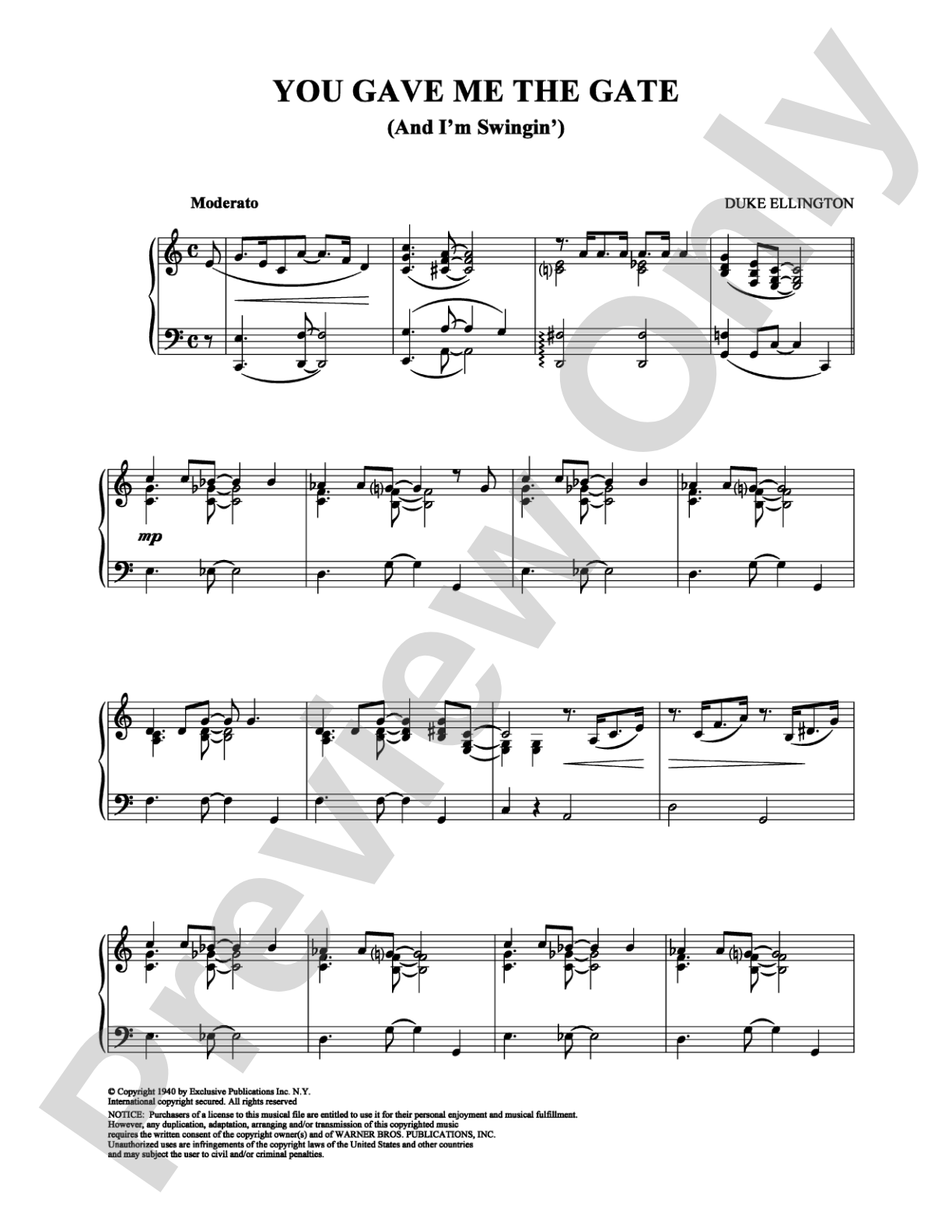
You Gave Me the Gate (And I'm Swingin'): Piano Digital Sheet Music

You Gave Me the Gate (And I'm Swingin'): Piano Digital Sheet Music

Duke Ellington

Item: 00-PS-0009895

Digital Download
$3.99
Description

You Gave Me the Gate (And I'm Swingin'): Piano Digital Sheet Music isn't in MakeMusic Cloud just yet...but it could be. Let us know you'd like to see it, and you'll help shape what comes next. In the meantime, start a free trial and dive into thousands of interactive titles your students can play along with today.

Sample Audio
No sample audio found.
Sample Video
Additional Details
SKU: 00-PS-0009895

More about this title

About the Artist: Duke Ellington

Duke Ellington (1899–1974) was a composer, bandleader, and pianist whose innovations shaped American jazz and popular music for over five decades. His compositional voice blended ragtime, blues, and orchestral sophistication into a body of work that earned him recognition as one of the twentieth century's most prolific and influential musicians. Ellington's pieces remain central to jazz education and performance because they demand genuine musical literacy alongside interpretive freedom, making them ideal for students ready to engage with jazz as a serious compositional tradition.

Why we love this

Ellington's stride-piano style and harmonic sophistication make this piece a rewarding study in jazz piano technique without the heavy accompaniment demands of his orchestral works. Solo pianists gain direct access to his compositional voice: the syncopation, chromatic movement, and blues inflection that define his sound.

What to expect

Rhythmically playful and harmonically sophisticated, this piece captures the elegant wit of Ellington's songwriting. The stride piano carries you forward with energy and buoyancy while the harmonic twists keep both performer and listener engaged.

Who it's for

Jazz pianists at the intermediate level and above who are building fluency in swing-era repertoire and want to study Ellington's compositional language directly at the keyboard. This is also suitable for music students exploring jazz standards through primary sources rather than simplified arrangements.

How to get the most out of it

  • Let the swing feel emerge from the rhythm section foundation rather than imposed on top of it; lock the eighth-note pulse internally before embellishing.
  • Approach the stride left hand as conversation with the melody, not mere accompaniment; Ellington's bass lines sing.
  • Balance clarity with the compressed dynamic range of the recording era; avoid overplaying dynamic contrasts that obscure harmonic movement.
  • Listen to multiple recorded versions before finalizing interpretive choices; Ellington's pieces reward study of how different pianists negotiate the written notation.

How to use it

Feature this in a jazz piano recital or as part of a program celebrating American songwriting standards. It also works well in an educational context where students study the evolution of jazz piano from stride to swing idioms.

Skills your students will build

  • Swing rhythm and eighth-note placement in a jazz context
  • Stride-piano left-hand independence and bass-line musicality
  • Reading and interpreting jazz chord changes and harmonic substitutions
  • Stylistic interpretation of Ellington-era jazz piano idiom

You May Also Like