You Done Lost Your Good Thing Now Sheet Music Preview

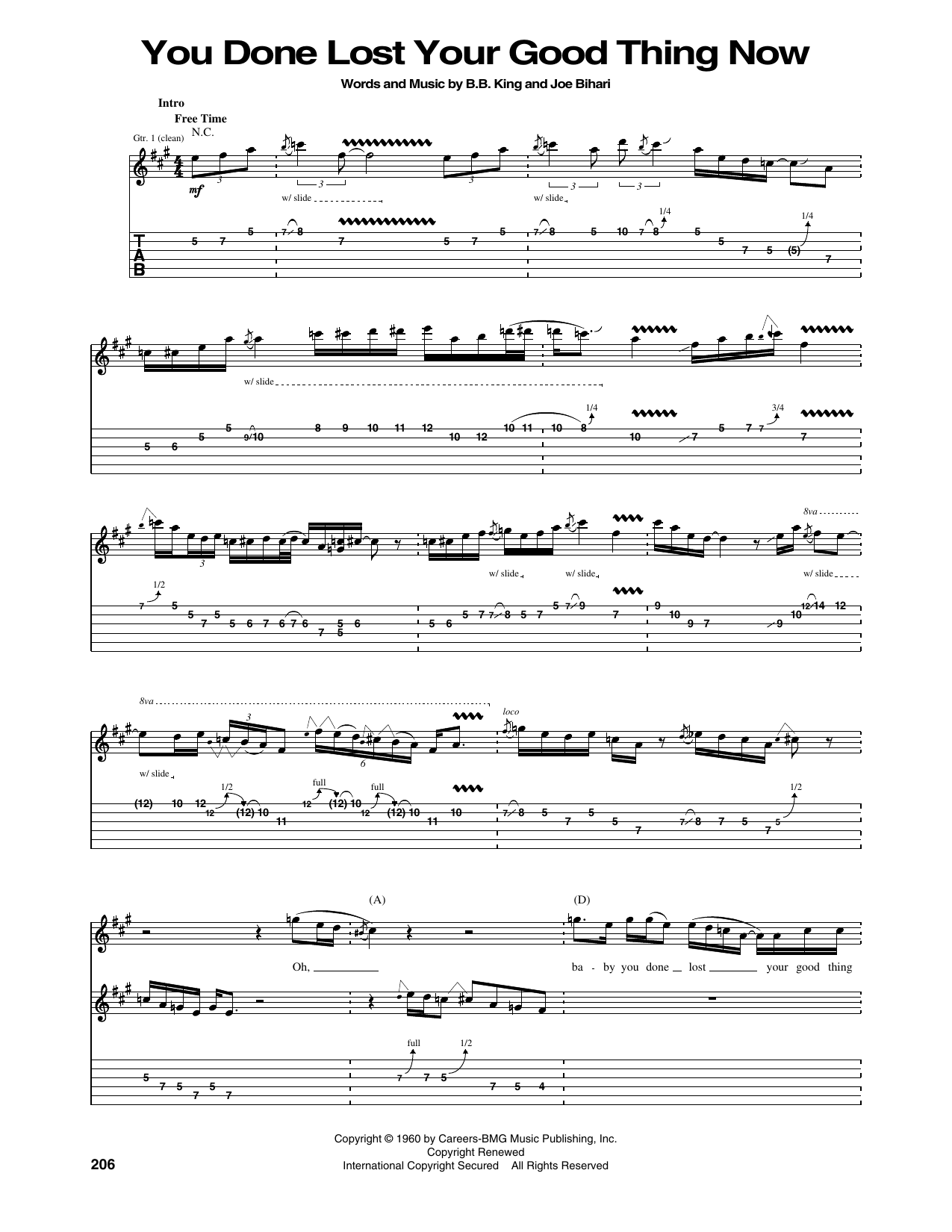
You Done Lost Your Good Thing Now: Guitar Tab

As performed by B.B. King

Item: 35-DS01964062

Digital Download
$5.99
Description

Discover MakeMusic Cloud: thousands of interactive titles your students can play along with today.

Sample Audio
No sample audio found.
Sample Video
Additional Details
Publisher: Hal Leonard
Page Count: 7
SKU: 35-DS01964062

More about this title

About the Artist: B.B. King

B.B. King stands as one of the most influential blues guitarists and vocalists in American music history. Born Riley B. King in Mississippi in 1925, he developed a signature style that blended traditional Delta blues with sophisticated jazz harmonies and a distinctly personal approach to string bending and vibrato. His work shaped not just blues but rock and soul music broadly, and he performed professionally for over seven decades with remarkable consistency and innovation.

King's impact on music education extends beyond his recordings. His fearless approach to soloing, his use of the guitar as a voice capable of expression beyond melody, and his willingness to evolve within the blues tradition offer students a masterclass in how to be both rooted in a tradition and creatively independent within it.

Why we love this

This tab opens the door to one of blues' most essential guitarists without requiring classical training or unfamiliar harmonic frameworks. Students encounter King's signature bending and vibrato techniques in context; they're not abstract concepts but integral to how the melody breathes and communicates emotion. Learning this song gives players immediate access to authentic blues language.

What to expect

There's a controlled urgency underneath the relaxed phrasing. The tune has the feeling of a conversation with genuine stakes, a musician reflecting on loss and regret while refusing to sink into despair. Technically, every note feels inevitable; emotionally, there's space and breath between them.

Who it's for

Guitar students ready to move beyond major pentatonic shapes into nuanced expression within the blues scale. This works especially well for intermediate players who understand basic blues progressions but want to learn how a master builds emotion and individuality on that foundation.

How to get the most out of it

  • Pay attention to where King places vibrato on held notes; it's rarely mechanical. The pitch should waver with intention and then settle, creating a sense of emotional release rather than decoration.
  • The bent notes need time to sing. Resist rushing into the next phrase; let listeners hear the full arc of each bend, especially the ones that resolve into melody lines.
  • Reference the original recording to understand the vocal phrasing, then mirror that phrasing in your guitar lines. King's vocal and instrumental voices trade off naturally; your timing should reflect that conversational quality.
  • Work dynamics carefully around the fingered versus bent notes. Bent notes often sit slightly louder in the original; let them have presence.

How to use it

This belongs in any blues unit, particularly when teaching students to listen for the difference between mechanically playing the blues and truly inhabiting it. Use it alongside recordings and analysis of how King's approach differs from more abstract or academic blues studies. It also works as a solo feature for a guitarist ready to step forward in an ensemble context.

Skills your students will build

  • Controlled string bending with targeted vibrato
  • Phrasing that mirrors vocal delivery and rhythm section timing
  • Navigating the blues scale with individuality and restraint
  • Using space and silence as compositional elements
  • Translating recorded performance nuance into practice goals

You May Also Like