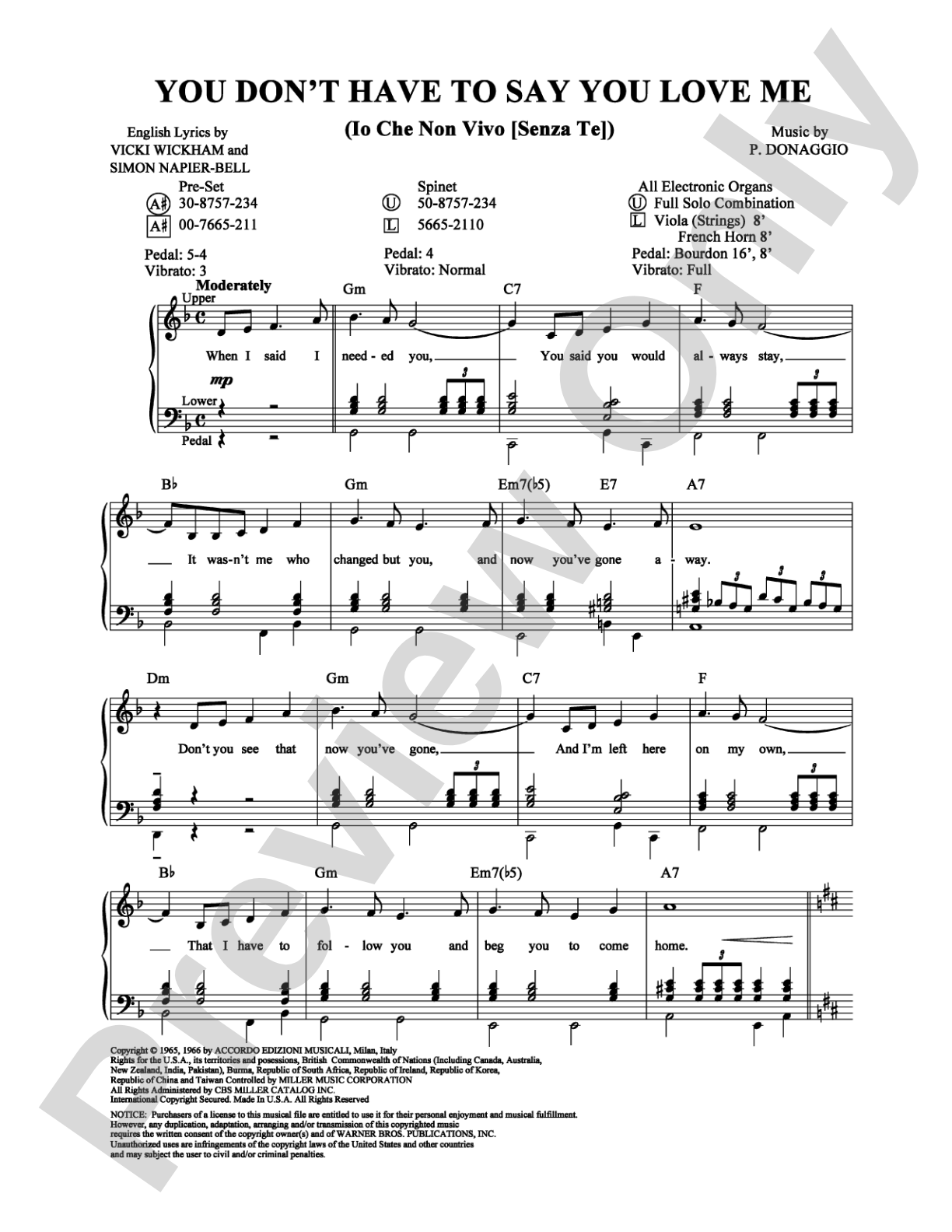
You Don't Have To Say You Love Me: Organ Digital Sheet Music

You Don't Have To Say You Love Me: Organ Digital Sheet Music

Elvis Presley, P. Donaggio

Item: 00-PS-0004305

Digital Download
$2.95
Description

You Don't Have To Say You Love Me: Organ Digital Sheet Music isn't in MakeMusic Cloud just yet...but it could be. Let us know you'd like to see it, and you'll help shape what comes next. In the meantime, start a free trial and dive into thousands of interactive titles your students can play along with today.

Sample Audio
No sample audio found.
Sample Video
Additional Details
SKU: 00-PS-0004305

More about this title

About the Artist: Elvis Presley

Elvis Presley (1935-1977) remains one of the most influential recording artists in popular music history. His impact on music education extends beyond his iconic vocal recordings; his interpretations of pop and rock standards demonstrate sophisticated musicality, phrasing, and emotional delivery that students can study regardless of their instrument.

Why we love this

This arrangement gives organists access to a pop standard with genuine cultural weight and immediate student recognition. The organ voice suits the song's emotional depth while offering a fresh perspective on material students already know, making it ideal for recitals or informal performance settings.

What to expect

Tender and introspective, this arrangement captures the ballad's emotional vulnerability while the organ's warmth adds an unexpected richness to the familiar melody. The piece invites a contemplative approach rather than showiness, rewarding careful listening and nuanced control.

Who it's for

Organists at the intermediate to advanced level who want to expand their pop and rock repertoire will find this accessible yet musically satisfying. It works equally well for students exploring secular music in a classical instrument context and for musicians seeking recognizable material for recitals or casual performances.

How to get the most out of it

  • Balance the melody with supporting harmonies; the organ's ability to layer voices means clarity of the primary line requires intentional registration choices.
  • Shape phrases by varying dynamics and articulation rather than relying on volume alone; the organ's sustain makes this particularly important.
  • Listen closely to the original recording to understand the song's pacing and emotional arc, then adapt it to the organ's unique tonal characteristics.

How to use it

Include this as a lighter, more contemporary element in a recital dominated by classical or liturgical organ works, or program it alongside other pop standards arranged for organ to demonstrate the instrument's versatility. It also serves well as an encore or closing piece in a varied recital format.

Skills your students will build

  • Pedal independence while maintaining a singing melody line
  • Registration choices that support musical phrasing
  • Interpretation of non-liturgical, popular music on the organ
  • Balancing melody against harmonic accompaniment

You May Also Like