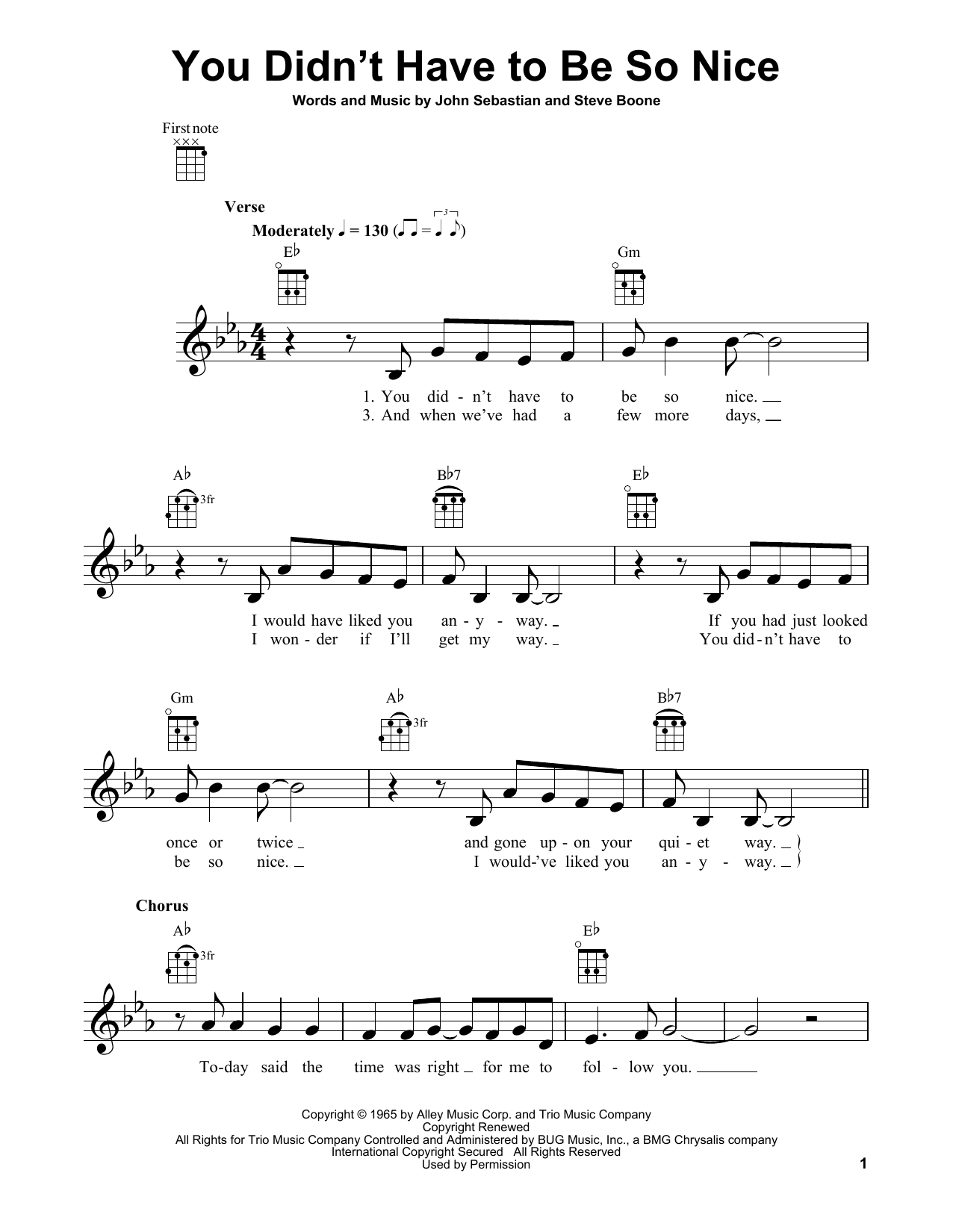
You Didn't Have To Be So Nice Sheet Music Preview

You Didn't Have To Be So Nice: Ukulele

As performed by Lovin' Spoonful / As performed by John Sebastian

Item: 35-DS00295909

Digital Download
$3.99
Description

You Didn't Have To Be So Nice: Ukulele isn't in MakeMusic Cloud just yet...but it could be. Let us know you'd like to see it, and you'll help shape what comes next. In the meantime, start a free trial and dive into thousands of interactive titles your students can play along with today.

Sample Audio
No sample audio found.
Sample Video
Additional Details
Publisher: Hal Leonard
Page Count: 2
SKU: 35-DS00295909

More about this title

About the Artist: Lovin' Spoonful

The Lovin' Spoonful emerged from New York's folk and pop scene in the mid-1960s, led by songwriter John Sebastian. The band became known for their jug band influences, infectious melodies, and clever songwriting that bridged folk sensibilities with mainstream pop accessibility. Sebastian's gift for crafting memorable hooks and relatable lyrics made the group one of the era's most commercially successful acts.

John Sebastian brought a distinctly American warmth to popular music, drawing from blues, folk, and early rock and roll traditions. His work with the Lovin' Spoonful showcased an ability to write songs that sounded effortless yet were carefully constructed, a quality that has kept their music relevant for classroom and performance contexts across generations.

Why we love this

This arrangement captures everything that makes the original so infectious: the bright, buoyant melody and the conversational ease of Sebastian's writing. The ukulele is the perfect vehicle for this song's charm, and learners will find themselves genuinely enjoying both the playing experience and the finished product rather than merely working through it.

What to expect

Warm, good-natured, and effervescent. The song practically bounces, carrying an undercurrent of genuine affection and wry humor. There's a lightness here that doesn't undercut the emotional sincerity of the lyric.

Who it's for

Ukulele students who have solid fundamental skills and enjoy pop and rock repertoire from the 1960s will connect immediately with this song. It works equally well for classroom ensembles, informal performance settings, or individual study.

How to get the most out of it

  • Keep the strumming light and conversational; resist the urge to drive rhythm into the ground. The song's appeal rests on its conversational tone, which translates to a relaxed, almost conversational touch on the strings.
  • Pay attention to lyrical phrasing even in instrumental sections. The melody naturally suggests speech patterns, and honoring those rhythmic/melodic gestures will make the performance feel authentic.
  • The two-page length means you'll likely have time to explore dynamics within a single performance; experiment with strip-down passages versus fuller moments to create shape and listener engagement.

How to use it

Consider programming this alongside other 1960s pop and folk-influenced pieces to create a thematic concert set that showcases the era's melodic sophistication. It also serves well as a confidence-building solo for an intermediate student in a larger recital.

Skills your students will build

  • Interpreting conversational phrasing in melody
  • Managing dynamic subtlety across a complete song
  • Balancing rhythmic precision with a relaxed, natural feel
  • Connecting lyrical content to instrumental expression

You May Also Like