
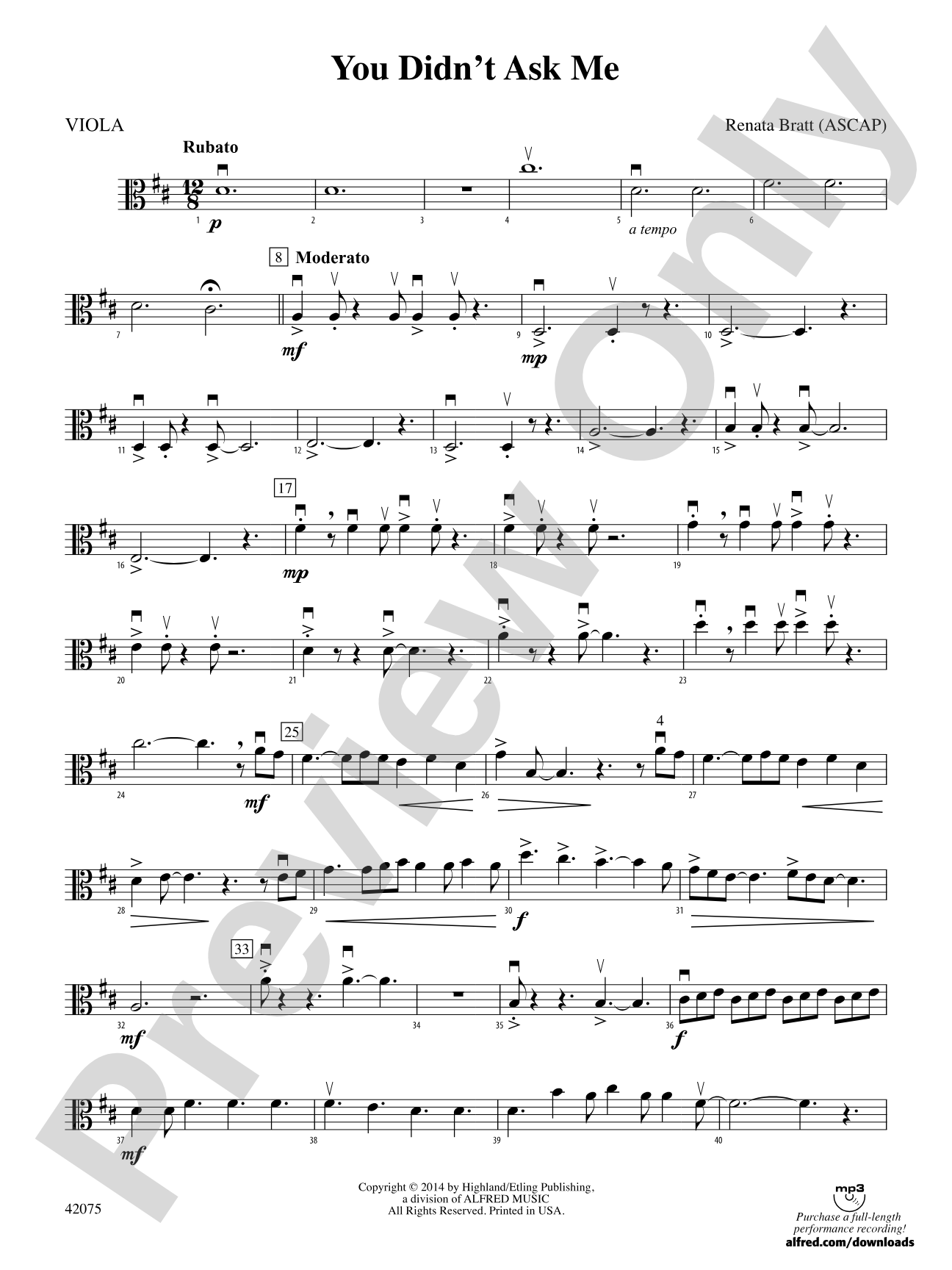

You Didn't Ask Me: Viola
By Renata Bratt
Grade: 3
Item: 00-PC-0016467_VA1
$5.99
Pickup currently not available
Description
This blast to the past will motivate, captivate, and elevate your students with old school '60s soul sound, an infectious, danceable rhythm, and a triumphant finish. Written in 12/8, the tune begins with a ballad-like introduction for solo cello and then moves around the sections. Each instrument has a chance to improvise or solo in the written-out solo section. Authentic sounding riffs, complete with grace notes and a shout chorus, add to the fun of compound meter rock. A sure audience pleaser and a terrific end to a concert or first half! (1:10)


Don't just read it, hear it, play along with it, and watch your students grow with it. In MakeMusic Cloud, You Didn't Ask Me: Viola comes alive with professional accompaniment, adjustable tempo, and built-in practice tools that turn solo practice into real progress.
Open in the Player
Jump straight in and assign it today.
Start Your Free Trial
Open this title and explore the full library in minutes.
Sample Audio
1
Audio File
--:--
0:00
0:00
Sample Video
No sample videos found.
Additional Details
Series:
Highland/Etling String Alternatives
Publisher:
Alfred Music
Page Count:
124
SKU:
00-PC-0016467_VA1
More about this title
About the Composer: Renata Bratt

Renata Bratt brings decades of experience across classical, jazz, and folk idioms to her work as a composer and educator. A cellist and clinician deeply involved in the alternative string styles community, she serves on the American String Teachers Association Advisory Committee and has taught improvisation, jazz, and fiddling at major conferences including the Mark O'Connor String Conference, ASTA, IAJE, and numerous Suzuki institutes. Her performance credits span from traditional classical venues to touring with alternative rockers and established artists; Rolling Stone recognized her as an "ace performer" for her studio and touring work with Cindy Lee Berryhill's Garage Orchestra.
Based in California, Bratt teaches cello at multiple schools and directs the Cabrillo Youth Strings program while maintaining an active composing and publishing career. She holds a Ph.D. in Music from the University of California at San Diego and has authored several instructional books for Mel Bay Publications, including The Modern Cello Method and Celtic Grooves for Two Cellists. Her orchestral works published through Alfred reflect her deep understanding of how to make ensemble music engaging, accessible, and rhythmically alive for young players.
Why we love this
Bratt writes with genuine affection for what makes string orchestras move; the 12/8 compound meter gives this piece a naturally bouncy, irresistible groove that students actually want to play. Every section gets a moment to shine through a written-out solo or improvisation opportunity, which means your ensemble stays engaged from the ballad-like opening through that triumphant final shout chorus. The authentic soul riffs and grace note figures feel period-specific without being precious, giving your students a genuine taste of how rhythm and phrasing work in a style far removed from classical technique.
What to expect
The opening solo cello sets an intimate, soulful tone before the full ensemble enters with an infectious, undeniable groove. The 12/8 meter gives the whole piece a loping, slightly off-center feel that makes you want to move, and the passing solos keep the energy personal and connected rather than purely virtuosic. By the final shout chorus, strings are playing the kind of tight, unified rhythmic figures typically heard in a horn section, creating a surprisingly powerful and joyful finish.
Who it's for
String orchestras at Grade 3 level, particularly those ready to explore contemporary styles and rhythmic complexity beyond traditional classical repertoire. This works well for groups that have solid rhythmic foundation and are curious about how strings can function in a rock or soul context, whether they've studied improvisation before or not.
How to get the most out of it
- Nail the compound meter feel in 12/8 by thinking in four beats per measure rather than twelve; this keeps the pulse moving as a loping rock groove instead of a plodding eighths feel.
- Let each section's solo passages breathe with stylistic freedom. The written-out improvisations are frameworks, not strict reading exercises; encourage articulation and dynamics that match a soul singer's phrasing.
- Shape the grace notes crisply but not stiffly. They should fall into the beat as ornamentation, the way a '60s horn section would voice them, not as classical embellishments.
- Build momentum through the shout chorus by layering dynamics and having each section enter with confidence rather than waiting for a conductor cue; the energy should feel like it's coming from the band.
How to use it
Close out a concert or first half with this. The combination of novelty factor and genuine musical substance makes it a crowd pleaser without sacrificing artistry, and the upbeat finish leaves audiences energized rather than reflective. It also pairs well in a program that mixes classical and contemporary styles, signaling to listeners that your ensemble is comfortable working across multiple musical languages.
Skills your students will build
- Reading and playing in 12/8 compound meter with a rock/soul rhythmic pocket
- Improvisation or solo interpretation within written-out melodic and rhythmic frameworks
- Grace note articulation and ornamentation in a contemporary style context
- Section cohesion and rhythmic precision in riff-based passages
- Stylistic differentiation between classical and soul/rock idioms