
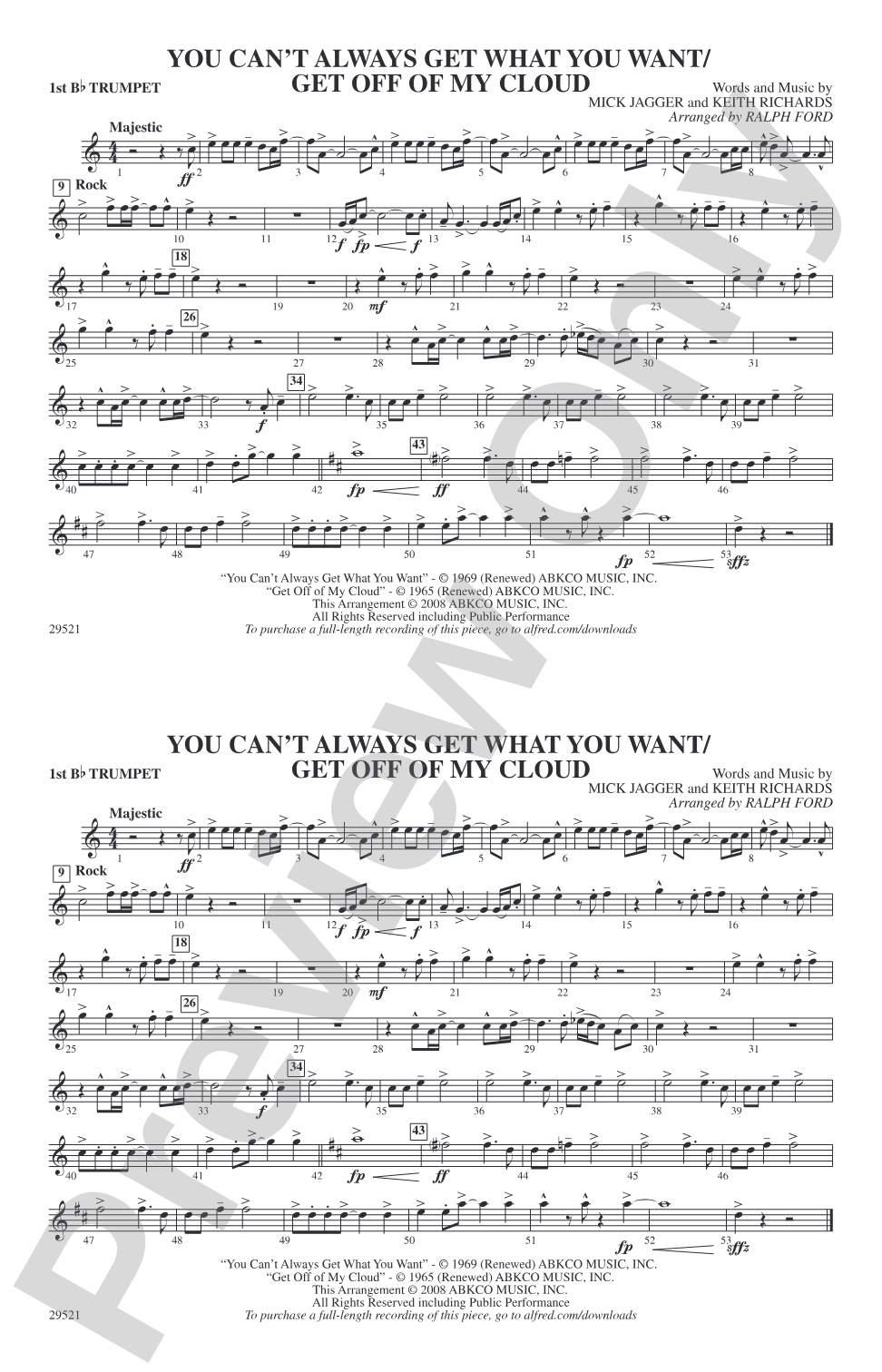

You Can't Always Get What You Want / Get Off of My Cloud: 1st B-flat Trumpet
Words and music by Mick Jagger and Keith Richards / arr. Ralph Ford
Grade: 3 (Medium)
Item: 00-PC-0018158_T1
$3.00
Pickup currently not available
Description
We are proud to present the music of The Rolling Stones in a complete halftime show. You Can't Always Get What You Want and Get Off of My Cloud get the special Ralph Ford treatment in an opener worthy of any show. Drills are available through Marching Show Concepts. (1:45)


Don't just read it, hear it, play along with it, and watch your students grow with it. In MakeMusic Cloud, You Can't Always Get What You Want / Get Off of My Cloud: 1st B-flat Trumpet comes alive with professional accompaniment, adjustable tempo, and built-in practice tools that turn solo practice into real progress.
Open in the Player
Jump straight in and assign it today.
Start Your Free Trial
Open this title and explore the full library in minutes.
Sample Audio
1
Audio File
--:--
0:00
0:00
Sample Video
No sample videos found.
Additional Details
Series:
Mega Sounds for Marching Band
Publisher:
Alfred Music
Page Count:
108
SKU:
00-PC-0018158_T1
More about this title
About the Composer: Mick Jagger
Mick Jagger emerged as one of rock music's most iconic frontmen, defining the sound and attitude of The Rolling Stones since their formation in 1962. His songwriting partnership with Keith Richards produced some of the most enduring rock compositions of the 20th century, blending blues influences with a raw, defiant energy that shaped popular music for generations.
Jagger's compositions have proven remarkably durable in educational settings. Their melodic strength, rhythmic drive, and cultural significance make them ideal vehicles for teaching contemporary music in ensemble contexts. Arrangers like Ralph Ford have recognized that these songs contain the structural clarity and harmonic foundation needed for successful marching band adaptations.
Why we love this
Ralph Ford's arrangement captures the swagger and precision that makes The Rolling Stones instantly recognizable while building in the kind of visual-musical synchronization that halftime shows demand. The pairing of two iconic tracks gives you enough musical substance to sustain a full opener without feeling like a medley stretched too thin. Students connect immediately to this material because they know the songs, which transforms rehearsal from learning unfamiliar idioms into mastering authentic rock arranging.
What to expect
You get the unmistakable groove of two Stones classics translated into marching band idiom: blues-rooted, attitude-driven, and built on rhythm section swagger. The arrangement respects the original songs' character while embracing the specific demands of field performance, creating something that feels both authentic to the source material and purposeful as an ensemble work.
Who it's for
This score and parts package serves marching bands ready to program recognizable contemporary rock material at a level that balances accessibility with musical substance. It works for directors building a halftime show that connects with audiences through familiar songs while maintaining educational value for Grade 3 ensembles.
How to get the most out of it
- Balance the blues-inflected phrasing against the marching band's natural tendency toward straight articulation; let the rhythm section (basses, snare, kicks) establish the shuffle feel before sections lock in.
- Address the vocal melody counterparts in the upper voices with attention to the original recordings' attitude; these lines need confidence and slight swagger without losing precision.
- Map out the drill transitions between the two songs early so students understand how the musical shifts connect to their field movement.
- Use a click track that emphasizes the backbeat, especially during sections that lean into the swagger of the original rather than strict metronomic feel.
How to use it
This functions as a complete halftime show opener on its own, giving you a full, satisfying musical statement in 1:45. The two-song structure lets you build dramatic arc within a single segment, and the contemporary context makes it particularly effective for showcasing your band's versatility in a modern repertoire alongside traditional marching band literature.
Skills your students will build
- Executing shuffle rhythm and syncopation specific to blues-based rock
- Balancing articulation and phrasing between metronomic ensemble precision and stylistic groove
- Reading multi-song conductor score with tempo and style transitions
- Coordinating field movement with distinct musical sections and key changes
- Responding to dynamics and style shifts that reflect original vocal arrangements