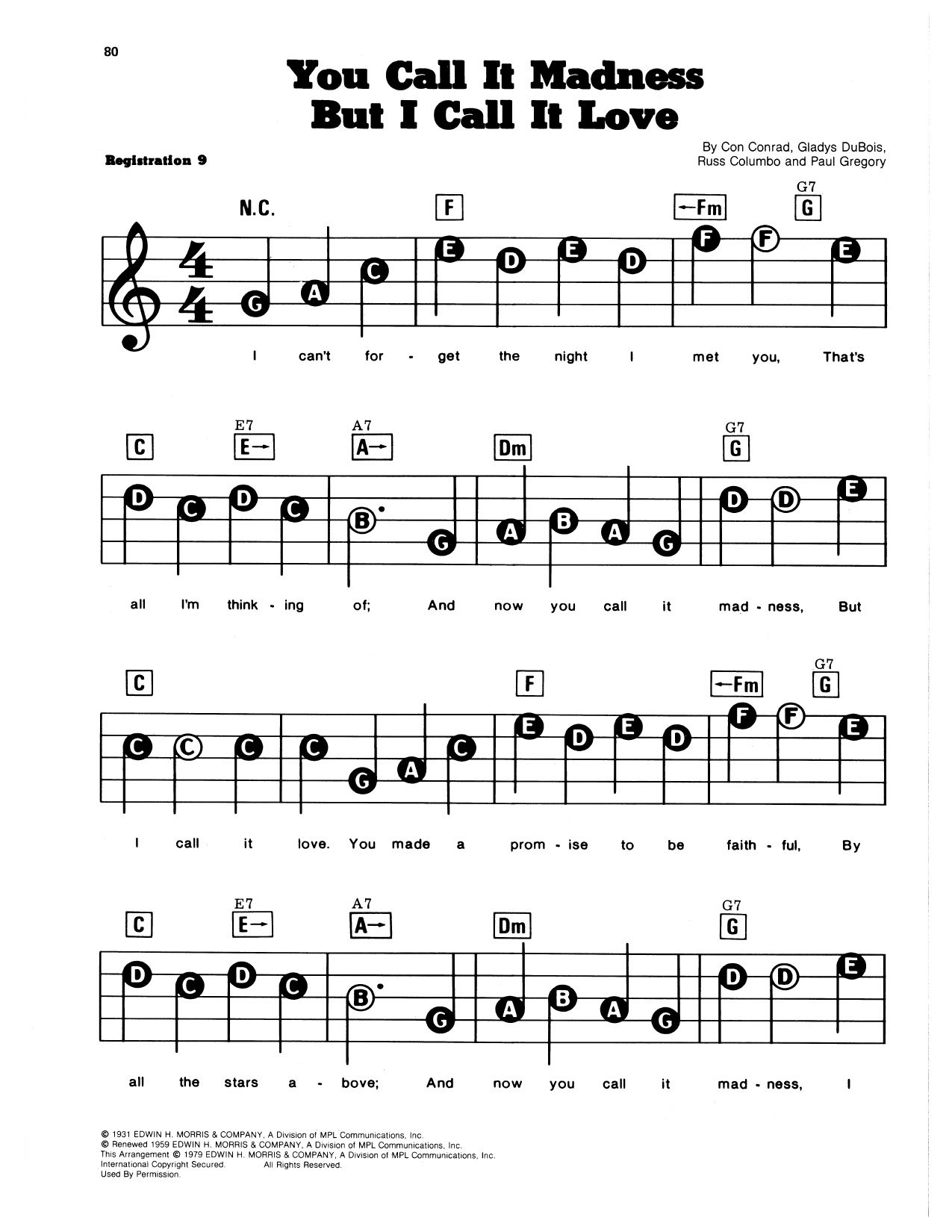
You Call It Madness (But I Call It Love): E-Z Play Today

As performed by Con Conrad

Item: 35-DS01915072

Digital Download
$4.99
Description

You Call It Madness (But I Call It Love): E-Z Play Today isn't in MakeMusic Cloud just yet...but it could be. Let us know you'd like to see it, and you'll help shape what comes next. In the meantime, start a free trial and dive into thousands of interactive titles your students can play along with today.

Sample Audio
No sample audio found.
Sample Video
Additional Details
Publisher: Hal Leonard
Page Count: 2
SKU: 35-DS01915072

More about this title

About the Artist: Con Conrad

Con Conrad was a prolific composer and songwriter active in the 1920s and 1930s, a period when jazz idioms were reshaping American popular music. His compositions captured the sophistication and energy of the Jazz Age, blending ragtime patterns with the harmonic language emerging from dance bands and Broadway. Conrad's work remains valuable for students exploring the intersection of classical training and vernacular styles that defined early twentieth-century American music.

Why we love this

Conrad's melody sits perfectly under the hands and breathes with genuine jazz phrasing rather than feeling like a classical piece dressed in jazz clothes. The harmonic progression invites natural rubato and dynamic shaping, making it an excellent choice for pianists developing expressive control within a structured form.

What to expect

The piece captures the witty charm and playful romanticism of the Jazz Age. You'll hear syncopated rhythms dancing above warm, walking bass patterns, creating an atmosphere that feels both nostalgic and energetic. There's a lightness and humor in the melody that makes it feel like an inside joke told with genuine affection.

Who it's for

Pianists at the intermediate level who are beginning to explore jazz and ragtime idioms will find this piece accessible without being simplistic. It works equally well for students strengthening their ability to read and interpret jazz notation, or for performance in programs that include early twentieth-century American repertoire.

How to get the most out of it

  • Shape the melodic line through dynamic contrast rather than tempo fluctuation; let the harmony support subtle pushes and pulls without disrupting the underlying pulse
  • Voice the jazz chords clearly by separating the melody layer from accompaniment textures, which keeps the piece sophisticated rather than muddied
  • Feel the ragtime rhythms as swing rather than as strictly metronomic patterns; this distinction transforms the piece from academic to authentic
  • Balance tempo consistency in the ensemble context while allowing rubato in the melody, particularly around phrase endings

How to use it

Feature this in a jazz history or American music unit where students study the 1920s and 1930s. It pairs naturally with other Conrad compositions or works by his contemporaries, and its modest length makes it useful as an encore or as part of a themed set on early jazz standards.

Skills your students will build

  • Reading jazz chord symbols and realizing voicings
  • Distinguishing swing rhythm from straight eighth-note rhythm
  • Balancing ragtime syncopation with smooth melodic phrasing
  • Interpreting slash notation and jazz articulation markings
  • Developing sensitivity to dynamics and rubato within jazz forms

You May Also Like