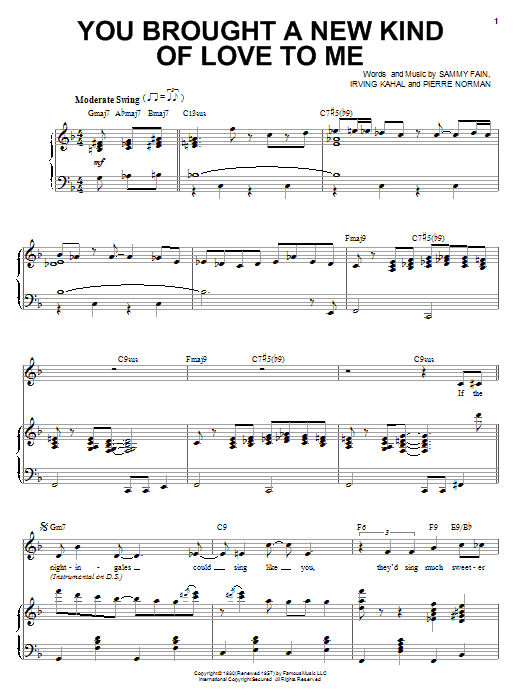
You Brought A New Kind Of Love To Me Sheet Music Preview

You Brought A New Kind Of Love To Me: Piano Vocal

As performed by Frank Sinatra

Item: 35-DS00027581

Digital Download
$5.99
Description

You Brought A New Kind Of Love To Me: Piano Vocal isn't in MakeMusic Cloud just yet...but it could be. Let us know you'd like to see it, and you'll help shape what comes next. In the meantime, start a free trial and dive into thousands of interactive titles your students can play along with today.

Sample Audio
No sample audio found.
Sample Video
Additional Details
Publisher: Hal Leonard
Page Count: 5
SKU: 35-DS00027581

More about this title

About the Artist: Frank Sinatra

Frank Sinatra (1915–1998) shaped American popular song through an unmatched combination of technical mastery and emotional directness. His phrasing revolutionized how singers approached melody and text; he treated the melody line as a conversation rather than a ornamental line, bending pitches and rhythms to serve the lyric's meaning. For music educators, Sinatra's recordings offer a masterclass in legit singing technique, interpretive maturity, and the marriage of jazz sensibility with classical training.

Sinatra's influence extends far beyond his era. His approach to accompanying oneself or collaborating with pianists established a standard for jazz vocal pedagogy. Students who study his interpretations of standards gain insight into how informed choices about tempo, dynamic shaping, and rubato can transform a simple melody into something profound.

Why we love this

This standard sits at the heart of the jazz vocal repertoire, and having it in piano/vocal format opens doors for solo study, student performances, and collaborative exploration. The melody's shape rewards genuine interpretive choices; it refuses to sound good on autopilot, making it an ideal vehicle for teaching singers how phrasing and breath placement affect meaning.

What to expect

Romantic without sentimentality, the melody unfolds with an easy grace that belies its harmonic sophistication. The piano arrangement invites the singer into a conversation; the accompaniment breathes when the voice breathes, creating space for genuine expression rather than filling every silence.

Who it's for

Intermediate to advanced jazz singers preparing audition material or deepening their understanding of the standards canon. Piano students and collaborative pianists will find this a rewarding text for developing the specific skill of accompanying a vocalist while maintaining musical independence.

How to get the most out of it

  • Listen to Sinatra's original recording with close attention to where he sits slightly behind the beat; replicating that rhythmic freedom requires knowing where the pulse lives, not just where the notes sit on the staff.
  • Shape the phrase endings without rushing. The lyric's sentiment depends on the pianist and vocalist moving together through the final bars with intention rather than simply reaching the final note.
  • Work the left hand of the piano as accompaniment, not decoration. The harmonic movement beneath the vocal line should support and respond to the singer's interpretation, not compete with it.

How to use it

Position this as a solo feature in a jazz standards concert or as part of a vocal recital exploring American songbook classics. It also works well as a teaching model in ensemble rehearsals where singers and accompanists are learning to balance vocal melody with harmonic support.

Skills your students will build

  • Interpreting rubato and phrase rhythm in jazz vocal music
  • Shaping melodic lines through dynamic control and breath placement
  • Collaborative listening between vocalist and pianist
  • Understanding harmonic movement beneath a lead melody
  • Reading and realizing chord changes in a piano/vocal score

You May Also Like