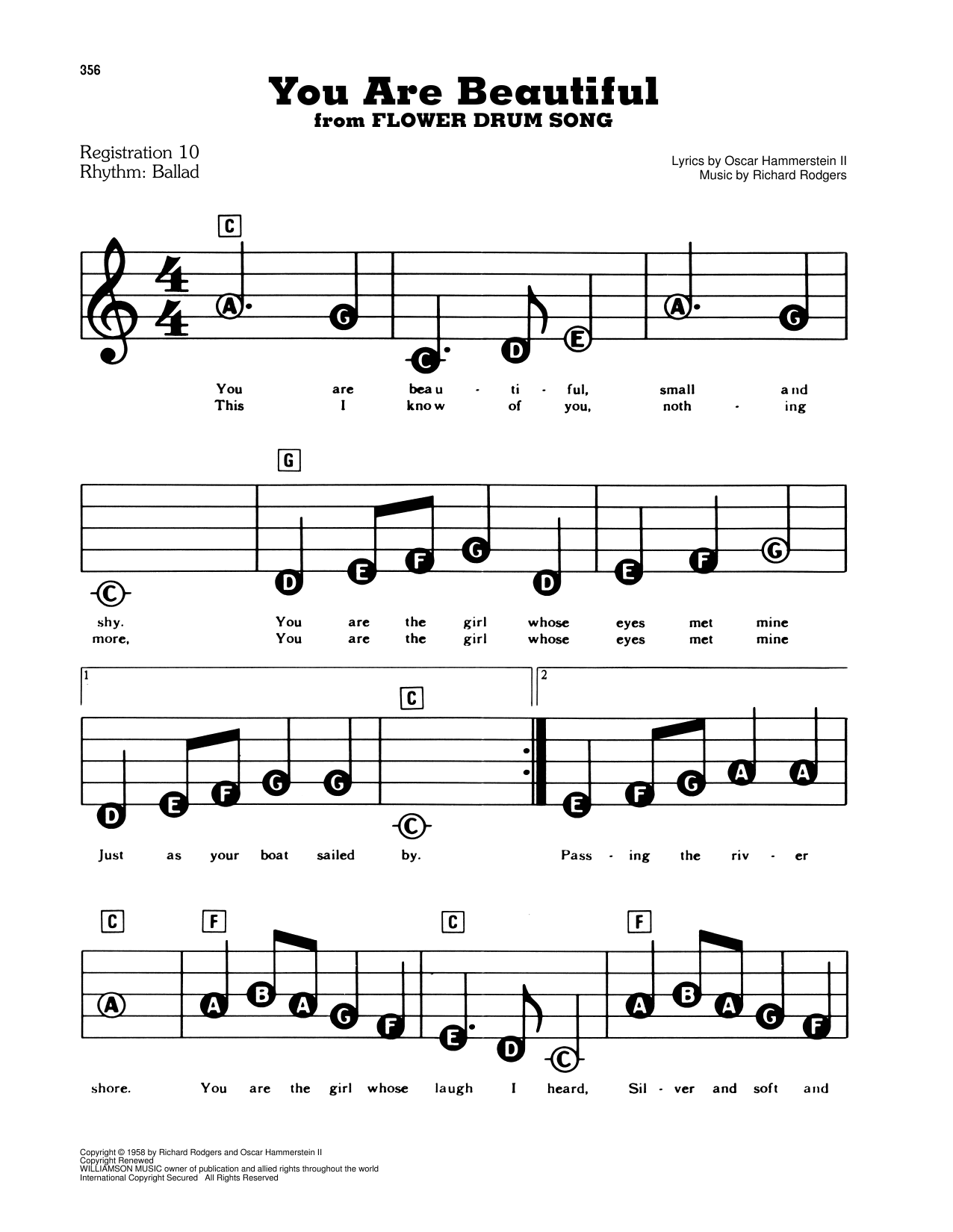
You Are Beautiful (from Flower Drum Song) Sheet Music Preview

You Are Beautiful (from Flower Drum Song): E-Z Play Today

Item: 35-DS00454201

Digital Download
$4.99
Description

You Are Beautiful (from Flower Drum Song): E-Z Play Today isn't in MakeMusic Cloud just yet...but it could be. Let us know you'd like to see it, and you'll help shape what comes next. In the meantime, start a free trial and dive into thousands of interactive titles your students can play along with today.

Sample Audio
No sample audio found.
Sample Video
Additional Details
Publisher: Hal Leonard
Page Count: 2
SKU: 35-DS00454201

More about this title

About the Creator

Richard Rodgers and Oscar Hammerstein II created "Flower Drum Song" in 1958, a landmark musical that brought Asian American stories and characters to Broadway with unprecedented nuance and care. Rodgers' gift for melody and Hammerstein's sophisticated lyricism combined to produce one of their most elegant scores, including this tender ballad that has become a standard in vocal and instrumental repertoire alike.

Why we love this

This E-Z Play arrangement captures the song's lyrical sophistication without demanding advanced technique, making it accessible for developing pianists who deserve to play genuine Broadway standards. The two-page format respects the emotional arc of the piece while keeping practice and performance manageable.

What to expect

Warm and intimate, with the quality of someone sharing a sincere compliment in a quiet moment. The melody carries a gentle elegance rooted in classic song craft; there's nothing showy about it, just honest musical expression.

Who it's for

Student pianists working at early intermediate levels who want to explore Broadway repertoire beyond simplified lead sheets. This is also valuable for teachers seeking material that honors genuine songwriting while remaining developmentally appropriate.

How to get the most out of it

  • Shape the melody with consistent phrase breathing; each musical statement should feel complete before moving forward.
  • Let the accompaniment sit quietly in the background so the tune can sing without competition.
  • Sustain a gentle, conversational tempo that allows the harmonies to bloom naturally rather than rushing through the emotional moments.
  • Balance chord voicings carefully so inner voices support rather than obscure the main line.

How to use it

Consider pairing this with other Rodgers and Hammerstein selections for a focused recital segment exploring the standards era. It works equally well as a solo showcase or as accompaniment for a vocalist exploring classic Broadway material.

Skills your students will build

  • Reading simple chord symbols and basic lead sheet notation
  • Maintaining legato phrasing across phrase boundaries
  • Balancing melody with accompaniment textures
  • Interpreting rubato and tempo flexibility in romantic song styles

You May Also Like