
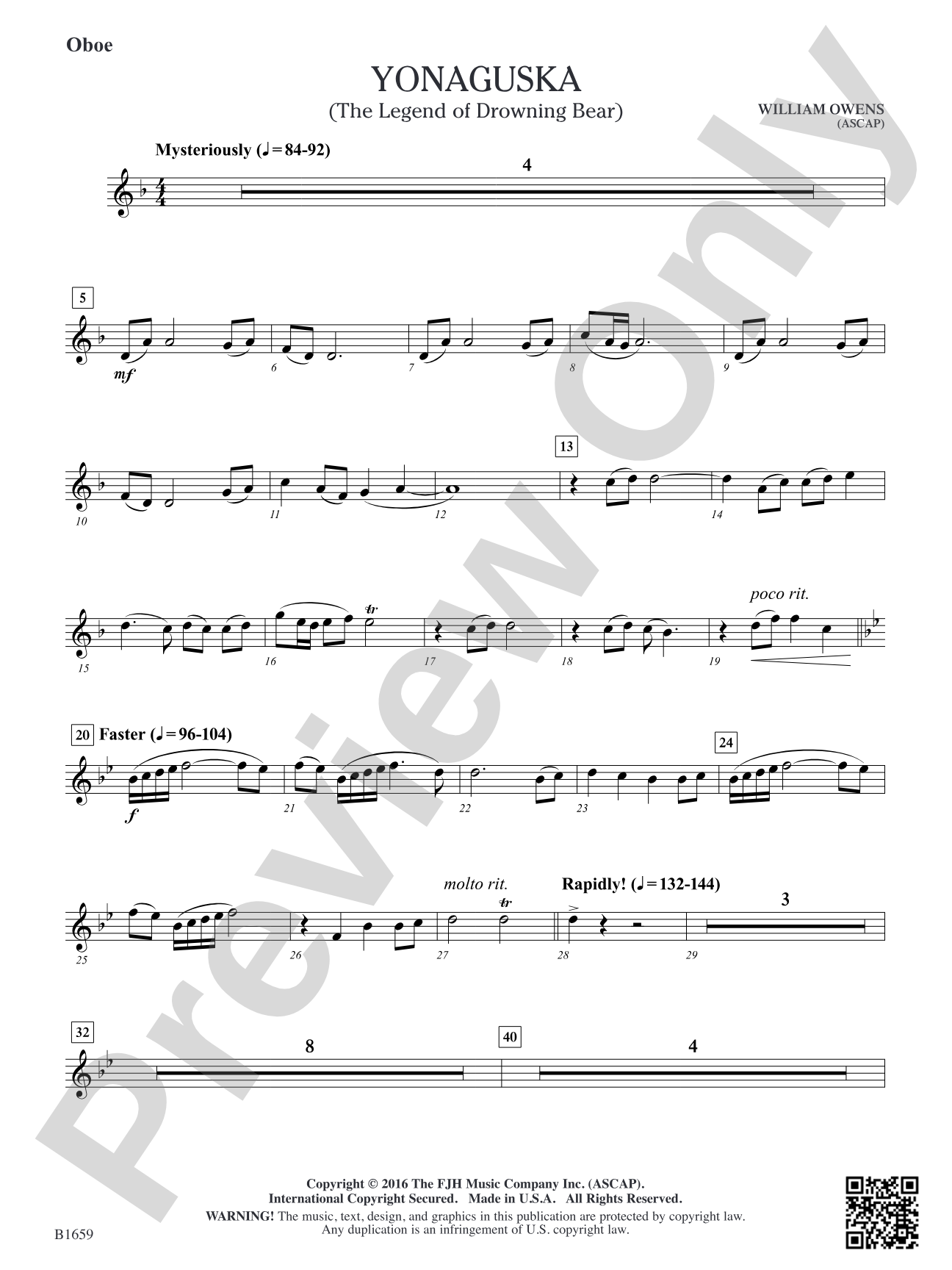

Yonaguska: Oboe
By William Owens
Grade: 2.5
Item: 98-PC-DB1659_O1
$7.00
Pickup currently not available
Description
The stalwart leadership of Chief Yonaguska and the integrity of a proud people come alive in this brilliant programmatic work! The bold, harmonically-rich opening statement begins the drama. A driving allegro section features spectacular woodwind features with bold, heroic brass statements. Add a large battery of percussion and you have all the ingredients for a fantastic piece!


Yonaguska: Oboe isn't in MakeMusic Cloud just yet...but it could be. Let us know you'd like to see it, and you'll help shape what comes next. In the meantime, start a free trial and dive into thousands of interactive titles your students can play along with today.
Request This Title
Tell us you want it.
Start Your Free Trial
Explore everything that's ready to play right now.
Sample Audio
1
Audio File
--:--
0:00
0:00
Sample Video
No sample videos found.
Additional Details
Series:
FJH Young Band
Publisher:
The FJH Music Company, Inc.
SKU:
98-PC-DB1659_O1
More about this title
About the Composer: William Owens
William Owens has composed over 300 works for young ensembles since 1993, establishing himself as a central figure in accessible band repertoire. A VanderCook College of Music graduate and former band director with 30 years of classroom experience, Owens writes with a composer's sophistication paired with a teacher's practical understanding of what works in rehearsal and performance.
His compositions appear on required music lists across North America and have been featured in educational texts as models of effective young band writing. Recognition of his contributions includes ASCAP membership, commissions from the American Bandmasters Association and regional institutions, and a Distinguished Alumnus award from his college. Owens currently resides in Fort Worth, Texas.
Why we love this
Owens crafts a genuinely theatrical narrative arc here, opening with a statement that immediately signals importance and then sustaining momentum through contrasting sections. The woodwind writing showcases young players without isolating them, while the brass and percussion parts deliver the heroic character the program demands. This is the kind of piece that sounds ambitious without requiring an advanced ensemble.
What to expect
This piece captures the dignity and strength of its historical subject through bold harmonic gestures and orchestral color. The opening commands attention with quiet intensity, then unfolds into driving energy that never sacrifices musical coherence for excitement. The sound is contemporary without being unfamiliar, heroic without bombast.
Who it's for
Concert bands at the 2.5 grade level who want to perform a piece with real narrative weight and character development. Directors seeking programmatic literature that engages students in storytelling while building musicianship in realistic, achievable ways.
How to get the most out of it
- Balance the opening statement carefully. The harmonic richness works only if the conductor shapes phrasing and lets ensemble voices breathe; resist the urge to push tempo.
- Bring character clarity to the allegro section. The woodwind figures are the narrative heart here, so they need rhythmic precision and attention to articulation patterns that distinguish them from the brass support underneath.
- Let the percussion battery breathe into the full ensemble sound rather than layering it on top. A well-integrated battery adds color and drive; an overcrowded one obscures the harmonic writing and programmatic intent.
- Use the dramatic contrast between sections to teach your band about structural listening. Stop and ask: what changes, and why does the composer want us to hear it that way?
How to use it
Program this as a centerpiece concert work that anchors a set around themes of leadership or multicultural history. It works equally well as a spring festival piece or as part of a concert that pairs programmatic literature with works exploring identity and narrative. At this grade level, it fills a real gap for directors seeking substantial repertoire with genuine dramatic arc.
Skills your students will build
- Shaping long phrase lines with harmonic awareness
- Executing contrasting articulation styles between sections
- Balancing soloistic woodwind figures with ensemble foundation
- Integrating large percussion sections into overall texture and dynamic control
- Reading and responding to programmatic content as a guide to interpretation