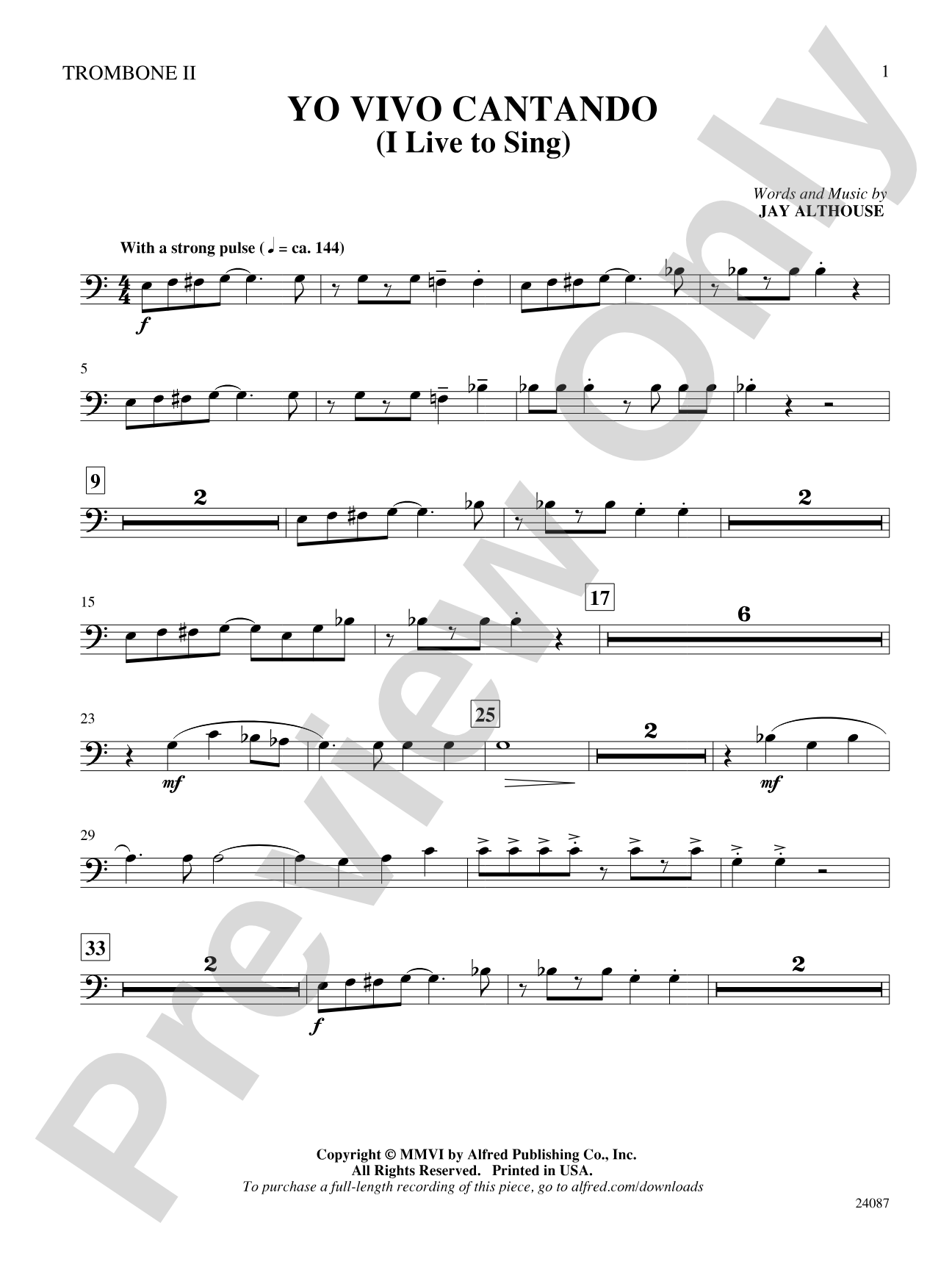
Yo Vivo Cantando (I Live to Sing): 2nd Trombone Sheet Music Preview

Yo Vivo Cantando (I Live to Sing): 2nd Trombone: Choral SoundPax

(I Live to Sing)

Words and music by Jay Althouse

Item: 00-PC-0000761_TN2

Digital Download
$3.00
Description
Parts included are: 2 tpt., 2 tbn., rhy., 2 perc.

Don't just read it, hear it, play along with it, and watch your students grow with it. In MakeMusic Cloud, Yo Vivo Cantando (I Live to Sing): 2nd Trombone: Choral SoundPax comes alive with professional accompaniment, adjustable tempo, and built-in practice tools that turn solo practice into real progress.

Sample Audio
0:00
0:00
Sample Video
Additional Details
Series: Alfred Choral Designs
Publisher: Alfred Music
Page Count: 34
SKU: 00-PC-0000761_TN2
Instrumentation: 2 tpt., 2 tbn., rhy., 2 perc.

More about this title

About the Composer: Jay Althouse

Jay Althouse

Jay Althouse holds degrees in Music Education and Music from Indiana University of Pennsylvania, where he later received the Distinguished Alumni award. His eight-year tenure in rights and licenses administration at a major educational music publisher gave him deep insight into what works in the classroom, and he served on the Executive Board of the Music Publishers Association of America during that period.

As a composer, Althouse has over 800 choral works in print across all levels and levels of difficulty, performed widely throughout English-speaking countries. A writer member of ASCAP and frequent recipient of the ASCAP Special Award, he has co-created children's musicals with his wife Sally K. Albrecht, edited acclaimed vocal solo collections, co-authored standard references like The Complete Choral Warm-up Book and Accent on Composers, and written classroom resources including Ready to Read Music and One-Page Composer Bios. His choral composition I Hear America Singing, co-written with Albrecht, was performed by the San Francisco Girls and Boys Choirs at President Obama's inauguration in 2009. He currently serves on the National Advisory Board of the Folk Art Society of America and contributes to its quarterly publication.

Why we love this

Althouse brings Latin and multicultural material to choral directors without sacrificing accessibility. The inclusion of brass parts and percussion gives smaller ensembles genuine instrumental color without requiring a full pit band, making this practical for school concerts that want energy and authenticity.

What to expect

The piece radiates joy and infectious rhythm. Sung with Spanish language authenticity and supported by the brass and percussion writing, it feels celebratory and grounded, balancing contemporary choral technique with the warmth of a traditional Latin vocal tradition.

Who it's for

Choirs at intermediate to advanced levels who want to program contemporary choral music with cultural substance. Works equally well for high school choirs, community ensembles, and college groups seeking material that engages singers with Spanish text and genuine Latin idiom.

How to get the most out of it

  • Balance the brass parts so they support rather than overwhelm the choir; these instruments anchor the Latin rhythm section, not lead it.
  • Work the percussion detail with your rhythm section early. The interplay between the two percussion parts drives the groove and keeps ensemble cohesion tight.
  • Recorded accompaniment is available separately if you need to hear the full arrangement before committing rehearsal time to instrumental parts.

How to use it

Program this as a set-closer or festival centerpiece where you want a high-energy finish. The Spanish text and Latin groove make it ideal for spring or end-of-year concerts that celebrate cultural diversity, and the manageable page count (34 pages) means rehearsal time stays efficient.

Skills your students will build

  • Singing in Spanish with authentic pronunciation and cultural understanding
  • Maintaining rhythmic precision in Latin meters and syncopated patterns
  • Balancing choral tone with active brass accompaniment
  • Understanding how percussion and rhythm section drive ensemble cohesion in non-traditional choral contexts

You May Also Like