
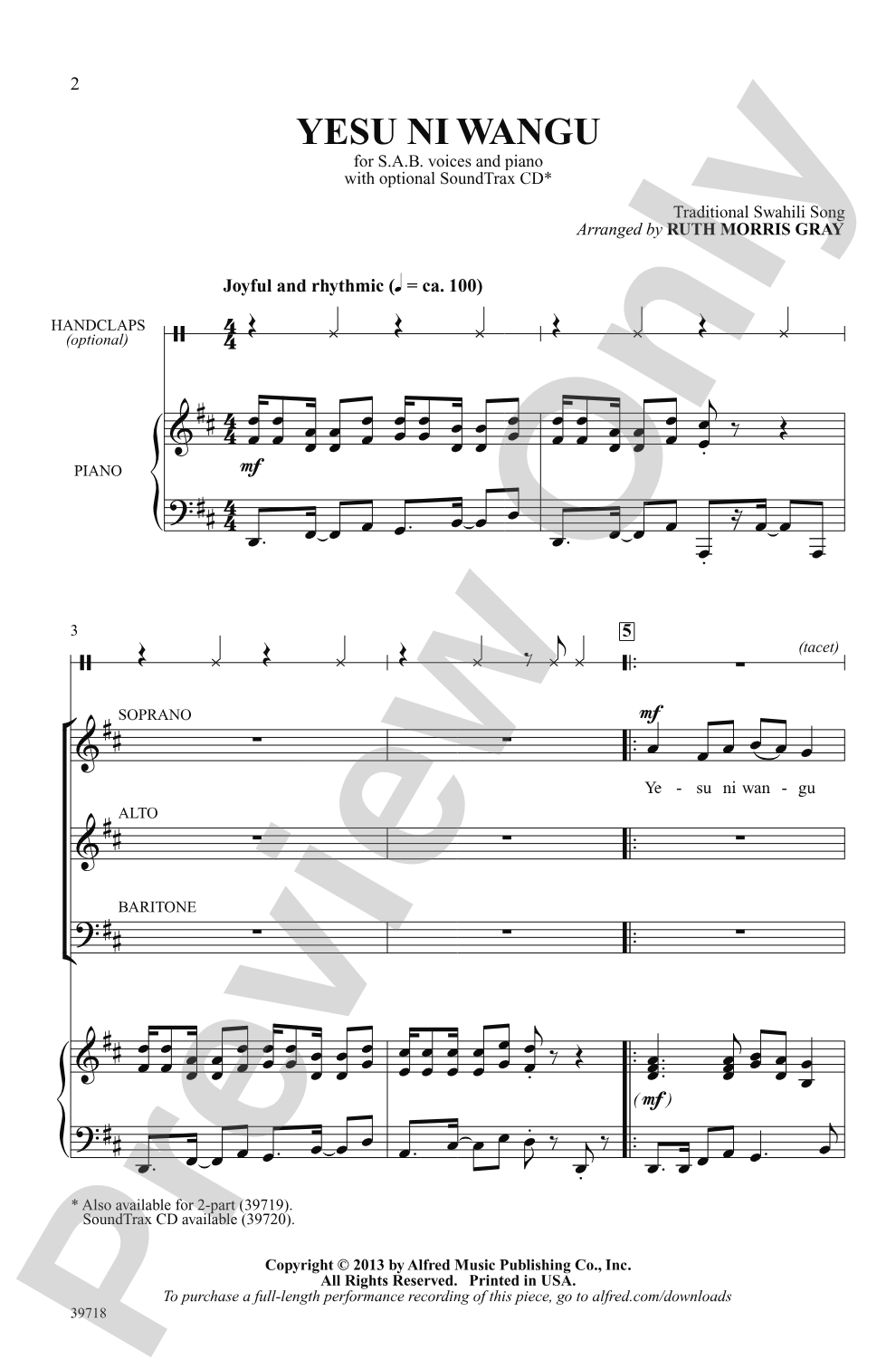
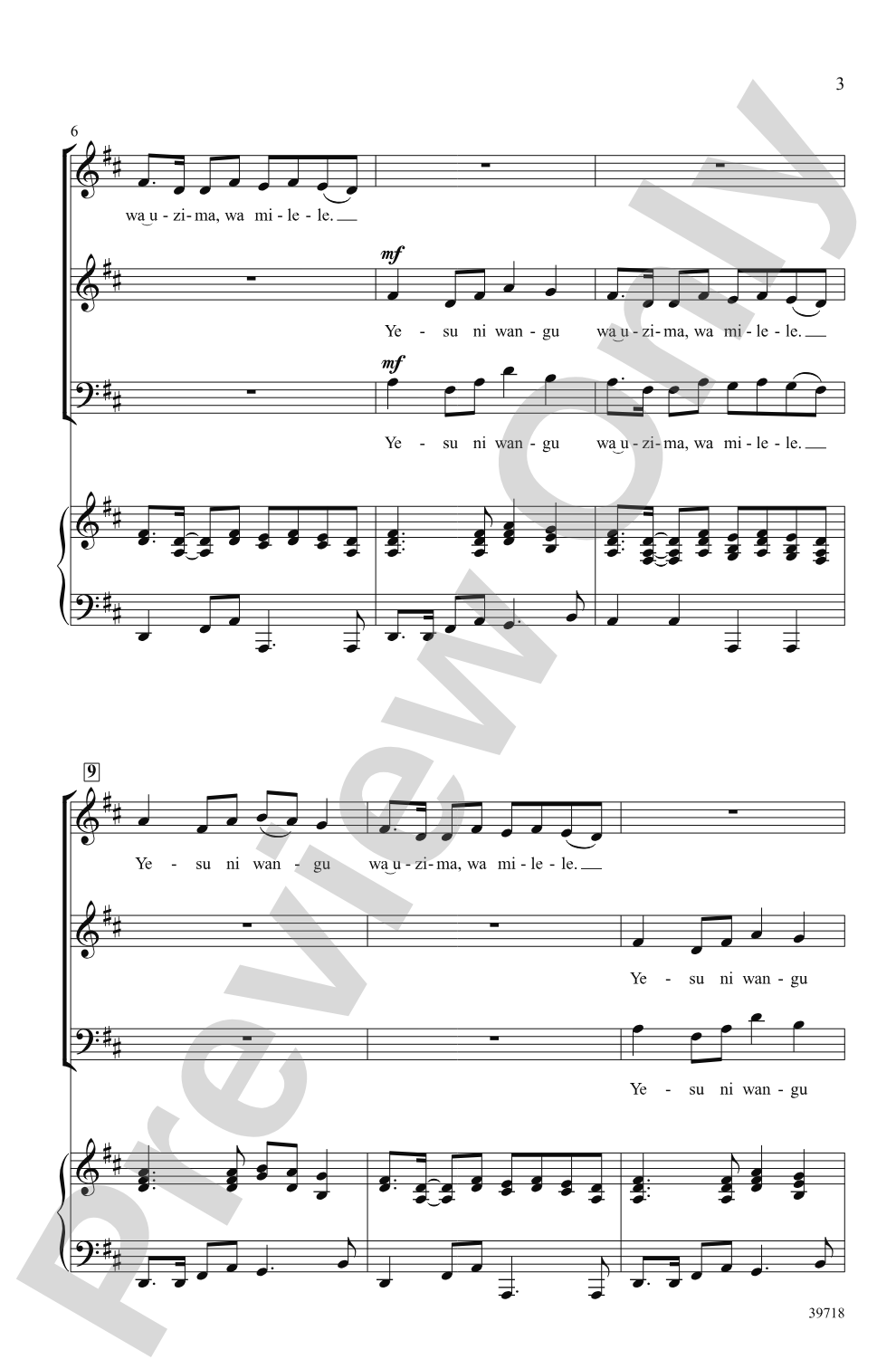

Yesu Ni Wangu: SAB Choral Octavo
Traditional Swahili Song / arr. Ruth Morris Gray
Item: 00-PO-0001561
$1.85
Minimum order quantity: 20 copies
Pickup currently not available
Description
This rhythmic call and response song from East Africa is so much fun to sing! The traditional harmonies are easy to find, with just a touch of optional divisi toward the end. A joyful song of praise. Featured on "Reaching for the Stars" choral movement DVD 00-39928. Check this out! https://leapingbrain.com/modshop/product/?shop=9&product=5695


Yesu Ni Wangu: SAB Choral Octavo isn't in MakeMusic Cloud just yet...but it could be. Let us know you'd like to see it, and you'll help shape what comes next. In the meantime, start a free trial and dive into thousands of interactive titles your students can play along with today.
Request This Title
Tell us you want it.
Start Your Free Trial
Explore everything that's ready to play right now.
Sample Audio
1
Audio File
--:--
0:00
0:00
Sample Video
No sample videos found.
Additional Details
Series:
Alfred Choral Designs
Publisher:
Alfred Music
Page Count:
12
SKU:
00-PO-0001561
More about this title
About the Arranger: Ruth Morris Gray

Ruth Morris Gray brings deep roots in both classical and choral music to her work as arranger and composer. She holds degrees in piano performance and composition from Biola University and the University of California, Santa Barbara, and has directed choirs at Rosemead High School since 2004, where she also teaches piano. Her catalog of over 100 published choral works reflects a career spent understanding what singers need: music that is singable, engaging, and rooted in real musical traditions.
Beyond the music room, Gray is an active performer and traveler whose personal interests in diverse cultures inform her arrangements of world music. Her combination of formal training in composition with direct experience teaching high school choirs makes her particularly attuned to creating pieces that work in rehearsal and resonate with student singers.
Why we love this
Gray's arrangement captures the infectious energy of a traditional East African song while keeping the vocal writing honest and accessible for three-part choirs. The call and response structure does the heavy lifting pedagogically, building ensemble cohesion naturally, and the optional divisi near the end gives singers a moment to stretch without compromising the ease of the piece overall.
What to expect
A burst of warmth and movement. The call and response structure creates immediate dialogue between sections, and the traditional harmonies feel both fresh and grounded. This is music that invites singers to smile and audiences to feel welcomed into something joyful and alive.
Who it's for
SAB choirs looking for repertoire that energizes singers and audiences alike. This piece works equally well for high school choirs building confidence in world music and mixed ensembles wanting to add rhythmic vitality to a program.
How to get the most out of it
- Lock in the rhythmic momentum during the call and response exchanges; this piece thrives on crisp, confident answers rather than polished perfection.
- Use the recorded accompaniment to establish the groove in early rehearsals, then gradually reduce reliance on it so the choir's own rhythmic confidence shines through.
- Encourage singers to feel the pulse in their bodies during the movement and staging sections; the physicality of this piece reinforces the joy of the text.
- Balance the optional divisi carefully so the added voices enhance rather than muddy the overall sound, particularly if your lower voices are lighter in number.
How to use it
Pair this with other world music selections to build a thematic concert around global traditions, or use it as a mood-lifter in a mixed program to break up heavier fare. The suggested movement and staging also make it a natural choice for concert choreography or school assembly performances where visual engagement matters.
Skills your students will build
- Call and response singing with rhythmic precision
- Singing in parallel thirds and traditional harmonic structures
- Managing optional divisi while maintaining ensemble blend
- Connecting physical movement and gesture to musical phrasing
- Stylistic expression in world music traditions