
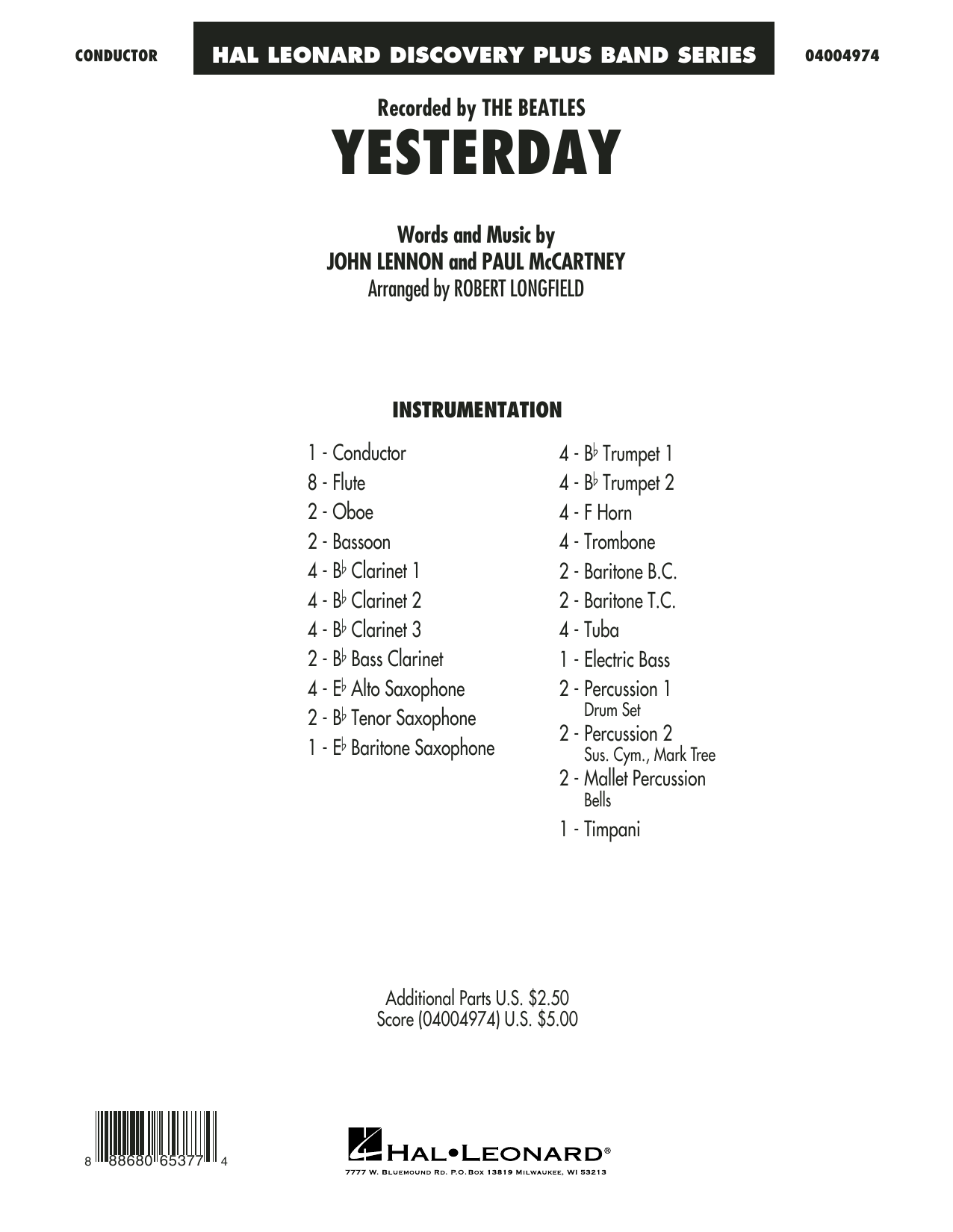

Yesterday: Concert Band Conductor Score & Parts
As performed by The Beatles / Arranged by Robert Longfield
Grade: 2
Item: 35-PK00367477
$65.00
Pickup currently not available
Buy Extra Parts (Digital PDF Download)
| Product | Price | Quantity |
|---|---|---|
| Yesterday - Conductor Score (Full Score) | $7.50 | |
| Yesterday - Flute | $6.00 | |
| Yesterday - Oboe | $6.00 | |
| Yesterday - Bassoon | $6.00 | |
| Yesterday - Bb Clarinet 1 | $6.00 | |
| Yesterday - Bb Clarinet 2 | $6.00 | |
| Yesterday - Bb Clarinet 3 | $6.00 | |
| Yesterday - Bb Bass Clarinet | $6.00 | |
| Yesterday - Eb Alto Saxophone | $6.00 | |
| Yesterday - Bb Tenor Saxophone | $6.00 | |
| Yesterday - Eb Baritone Saxophone | $6.00 | |
| Yesterday - Bb Trumpet 1 | $6.00 | |
| Yesterday - Bb Trumpet 2 | $6.00 | |
| Yesterday - F Horn | $6.00 | |
| Yesterday - Trombone | $6.00 | |
| Yesterday - Baritone B.C. | $6.00 | |
| Yesterday - Baritone T.C. | $6.00 | |
| Yesterday - Tuba | $6.00 | |
| Yesterday - Electric Bass | $6.00 | |
| Yesterday - Percussion 1 | $6.00 | |
| Yesterday - Percussion 2 | $6.00 | |
| Yesterday - Mallet Percussion | $6.00 |
Parts Added to Cart!
Description
Originally recorded with only a guitar and string quartet for accompaniment, this classic Beatles hit, sung by Paul McCartney, seems to cross all generations and musical tastes. It remains as popular today as ever, and has become one of the most recorded songs in recent history. Robert Longfield has skillfully arranged this tender ballad for younger bands. Dur: 3:00


Yesterday: Concert Band Conductor Score & Parts isn't in MakeMusic Cloud just yet...but it could be. Let us know you'd like to see it, and you'll help shape what comes next. In the meantime, start a free trial and dive into thousands of interactive titles your students can play along with today.
Request This Title
Tell us you want it.
Start Your Free Trial
Explore everything that's ready to play right now.
Sample Audio
No sample audio found.
Sample Video
No sample videos found.
Additional Details
Publisher:
Hal Leonard
SKU:
35-PK00367477
More about this title
About the Artist: The Beatles
The Beatles fundamentally altered popular music and the broader cultural landscape in the 1960s. Their harmonic sophistication, melodic inventiveness, and willingness to experiment across genres set a standard that continues to influence musicians across all idioms. For music educators, their catalog offers accessible entry points into songwriting craft, arrangement possibilities, and the intersection of pop sensibility with genuine musical substance.
Why we love this
Grade 2 bands rarely get material this emotionally resonant without sacrificing playability. Longfield's arrangement preserves the song's intimate character while distributing the parts logically across a developing ensemble. Your students will feel the legitimacy of what they're playing, and audiences will connect immediately to a melody they already know.
What to expect
The arrangement captures the original's quiet dignity and reflective quality. Even with younger players, the music breathes with genuine expression rather than feeling simplified.
Who it's for
This works beautifully for developing bands that need repertoire showcasing lyrical playing without extreme technical demands. It's equally valuable for directors building concert programs that reach beyond the traditional band audience.
How to get the most out of it
- Shape the opening phrase with careful dynamic control in the woodwinds; think of it as a single long breath rather than a series of note groups.
- Balance the melody between first and second parts during the primary statement; neither should dominate, and the blend matters as much as the individual lines.
- Treat the accompaniment figures as active support rather than filler; rhythmic precision in the sustained voices anchors the harmonic foundation.
- Allow space and air around cadential moments; resist the urge to push through the tender conclusions of phrases.
How to use it
Pair this with a themed concert exploring songwriting across genres, or use it as a standalone concert opener that signals to your audience an evening of varied and engaging music. It also serves well as a confidence builder during early rehearsal season when students benefit from material that sounds more mature than it plays.
Skills your students will build
- Sustaining long melodic lines with consistent tone quality
- Balancing foreground and background voices in homophonic textures
- Responding to the emotional content of familiar material
- Maintaining ensemble rhythmic cohesion in slower tempos
- Reading and executing articulation and dynamic markings as musical expression