
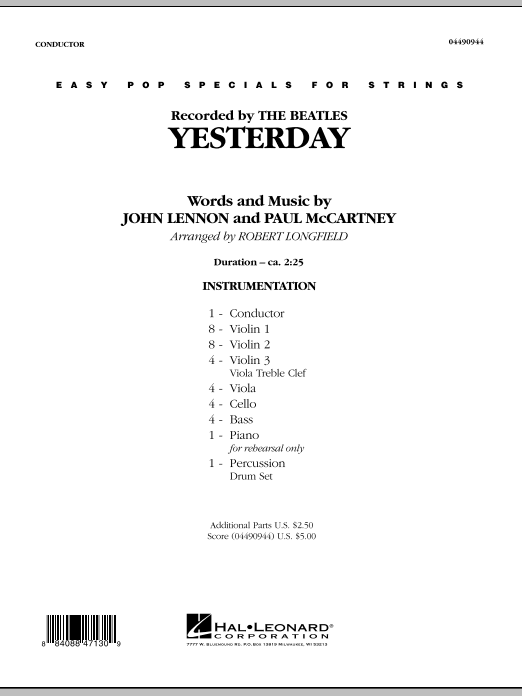

Yesterday: String Orchestra Conductor Score & Parts
By John Lennon / By Paul McCartney / As performed by The Beatles / Arranged by Robert Longfield
Grade: 2
Item: 35-PK00156496
$40.00
Pickup currently not available
Buy Extra Parts (Digital PDF Download)
| Product | Price | Quantity |
|---|---|---|
| Yesterday - Full Score | $7.50 | |
| Yesterday - Violin 1 | $7.00 | |
| Yesterday - Violin 2 | $7.00 | |
| Yesterday - Violin 3 (Viola T.C.) | $7.00 | |
| Yesterday - Viola | $7.00 | |
| Yesterday - Cello | $7.00 | |
| Yesterday - String Bass | $7.00 | |
| Yesterday - Piano | $7.00 | |
| Yesterday - Percussion | $7.00 |
Parts Added to Cart!
Description
Probably the most memorable Beatles ballad, "Yesterday" remains one of the most iconic songs of our time. This new version for easy strings is sure to be a favorite with your students and features melody sections for all players. Dur: 2:25


Yesterday: String Orchestra Conductor Score & Parts isn't in MakeMusic Cloud just yet...but it could be. Let us know you'd like to see it, and you'll help shape what comes next. In the meantime, start a free trial and dive into thousands of interactive titles your students can play along with today.
Request This Title
Tell us you want it.
Start Your Free Trial
Explore everything that's ready to play right now.
Sample Audio
No sample audio found.
Sample Video
No sample videos found.
Additional Details
Publisher:
Hal Leonard
SKU:
35-PK00156496
More about this title
About the Composer: John Lennon
John Lennon shaped modern songwriting through his work with The Beatles, crafting melodies and lyrics that remain embedded in popular culture decades later. His gift for writing introspective, emotionally direct ballads established a template that songwriters still follow today, making his compositions enduring teaching tools in music classrooms worldwide.
Why we love this
String players connect immediately to this arrangement because the melody sits naturally across the ensemble, allowing every section to shine rather than clustering all the material in the first violins. Grade 2 accessibility paired with genuine musical substance means your students perform a legitimate artistic work, not a simplified knockoff, which builds their confidence and respect for the repertoire.
What to expect
The arrangement captures the quiet resignation and lingering sadness of the original, with lush harmonic support that deepens the melody's emotional impact. Playing it feels contemplative rather than energetic; the orchestra becomes an instrument for expressing vulnerability.
Who it's for
String orchestras at the elementary and early middle school level seeking repertoire that connects with students' actual musical world. This works equally well for ensembles building foundational ensemble skills and for experienced groups wanting a piece that feels current and relevant.
How to get the most out of it
- Shape the opening phrase with gentle rubato in the first four measures; let the weight of the melody breathe rather than keeping it metronomic.
- Balance the inner voices carefully once the arrangement thickens. Second violins and violas carry important harmonic color that shouldn't disappear beneath the top line.
- Treat the fermatas as moments of reflection rather than stops. Hold them slightly longer than notation suggests to honor the song's introspective quality.
- Work dynamics in small increments. This piece communicates through nuance, not dramatic contrast, so a shift from p to mp reads as significant.
How to use it
Slot this into a concert that mixes classical and contemporary repertoire, positioning it as a bridge between what students study in method books and the music they hear in their lives. The 2:25 duration also makes it ideal for variety programs or end-of-year concerts where you need a moment of quiet reflection between larger works.
Skills your students will build
- Playing sustained melodic lines with consistent tone quality and vibrato control
- Balancing ensemble parts with attention to harmonic texture rather than just the top voice
- Interpreting expressive rubato and fermatas in popular music contexts
- Reading across multiple string parts written on separate staves