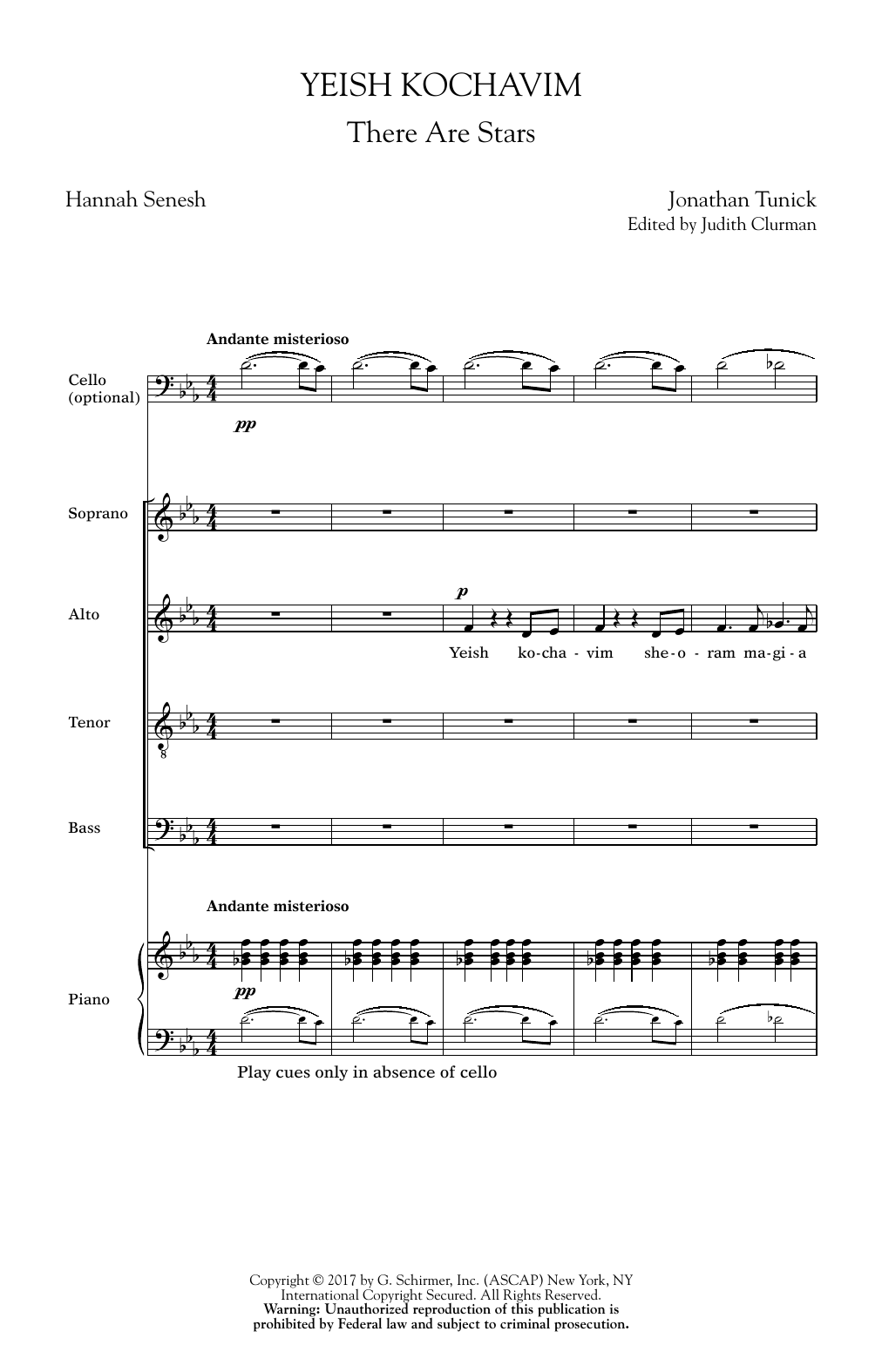
Yeish Kochavim (There Are Stars) Sheet Music Preview

Yeish Kochavim (There Are Stars): SATB Choral Octavo

By Jonathan Tunick

Item: 35-DS00386044

Digital Download
$2.99
Description

Yeish Kochavim (There Are Stars): SATB Choral Octavo isn't in MakeMusic Cloud just yet...but it could be. Let us know you'd like to see it, and you'll help shape what comes next. In the meantime, start a free trial and dive into thousands of interactive titles your students can play along with today.

Sample Audio
No sample audio found.
Sample Video
Additional Details
Publisher: Hal Leonard
Page Count: 7
SKU: 35-DS00386044

More about this title

About the Composer: Jonathan Tunick

Jonathan Tunick is an orchestrator and composer with deep roots in musical theater, having shaped the sound of Stephen Sondheim's works and numerous Broadway productions. His background in arranging complex vocal and instrumental textures informs his approach to choral writing, where clarity and sophistication coexist naturally.

Why we love this

Tunick brings the harmonic language and textural refinement of his theatrical work into this sacred setting, creating a piece that feels both contemporary and rooted in Jewish musical tradition. The writing balances accessibility with genuine sophistication, giving singers something substantial to sink their teeth into without requiring virtuosic demands.

What to expect

The piece carries a quiet wonder, reflecting on the presence of stars as a meditation on the vast and the eternal. Tunick's writing creates moments of luminous beauty without sentimentality, letting the text and harmony do the emotional work.

Who it's for

This octavo works well for choirs seeking repertoire that honors Jewish liturgical tradition while offering modern compositional depth. It suits intermediate to advanced ensembles with solid ensemble skills and the ability to navigate Tunick's sophisticated harmonic language.

How to get the most out of it

  • Attend to the Hebrew text pronunciation with care; consider having a native speaker coach the choir on vowel colors and consonant placement, as this shapes the piece's authentic character.
  • Shape the dynamic contours with precision rather than relying on sudden shifts. Tunick's orchestrator's ear means small adjustments in balance reveal the harmonic architecture.
  • Let the part writing breathe; resist over-blending the voices into uniformity. Each line has distinct melodic purpose and benefits from slight projection of its own voice.

How to use it

Pair this with other contemporary settings of Jewish texts or spiritual works to create a thematic program exploring faith and reflection. It also serves as an excellent anchor piece for concerts celebrating cultural identity or interfaith understanding, holding its own in mixed sacred repertoire.

Skills your students will build

  • Voice leading across four parts with sustained independence
  • Hebrew text clarity and diction
  • Harmonic listening and tuning in contemporary harmonic language
  • Interpretive control of subtle dynamic shadings

You May Also Like