
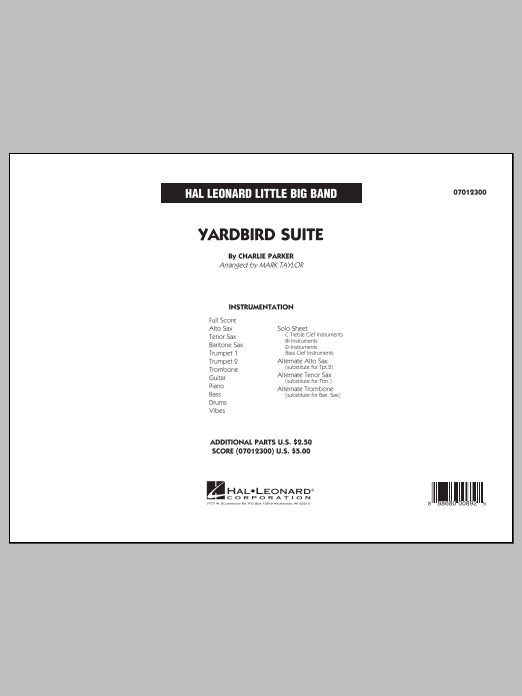

Yardbird Suite: Jazz Ensemble Conductor Score & Parts
As performed by Charlie Parker / Arranged by Mark Taylor
Grade: 4
Item: 35-PK00296901
$45.00
Pickup currently not available
Buy Extra Parts (Digital PDF Download)
| Product | Price | Quantity |
|---|---|---|
| Yardbird Suite - Full Score | $6.00 | |
| Yardbird Suite - Alto Sax | $6.00 | |
| Yardbird Suite - Tenor Sax | $6.00 | |
| Yardbird Suite - Baritone Sax | $6.00 | |
| Yardbird Suite - Trumpet 1 | $6.00 | |
| Yardbird Suite - Trumpet 2 | $6.00 | |
| Yardbird Suite - Trombone | $6.00 | |
| Yardbird Suite - Guitar | $6.00 | |
| Yardbird Suite - Piano | $6.00 | |
| Yardbird Suite - Bass | $6.00 | |
| Yardbird Suite - Drums | $6.00 | |
| Yardbird Suite - Vibes | $6.00 | |
| Yardbird Suite - C Solo Sheet | $6.00 | |
| Yardbird Suite - Bb Solo Sheet | $6.00 | |
| Yardbird Suite - Eb Solo Sheet | $6.00 | |
| Yardbird Suite - Bass Clef Solo Sheet | $6.00 | |
| Yardbird Suite - Alternate Alto Sax | $6.00 | |
| Yardbird Suite - Alternate Tenor Sax | $6.00 | |
| Yardbird Suite - Alternate Trombone | $6.00 |
Parts Added to Cart!
Description
Arranged for six horns, this accessible chart on Charlie Parker's swing classic features a trio of alto, trumpet and guitar to start things off, followed later by great-sounding scoring for the entire group. Includes solos for trumpet and alto sax.


Yardbird Suite: Jazz Ensemble Conductor Score & Parts isn't in MakeMusic Cloud just yet...but it could be. Let us know you'd like to see it, and you'll help shape what comes next. In the meantime, start a free trial and dive into thousands of interactive titles your students can play along with today.
Request This Title
Tell us you want it.
Start Your Free Trial
Explore everything that's ready to play right now.
Sample Audio
No sample audio found.
Sample Video
No sample videos found.
Additional Details
Publisher:
Hal Leonard
SKU:
35-PK00296901
More about this title
About the Artist: Charlie Parker
Charlie Parker revolutionized jazz in the 1940s by developing bebop alongside Dizzy Gillespie and other innovators. His harmonic sophistication, lightning-fast improvisational lines, and ability to make complex changes sound inevitable established him as one of the most influential saxophonists in music history.
Parker's compositions like "Yardbird Suite" became standards precisely because they balance accessibility with harmonic depth. For student musicians, his work offers a masterclass in melodic writing that sounds both swinging and singable, making his pieces ideal vehicles for developing jazz language.
Why we love this
Mark Taylor's arrangement scales this bebop cornerstone perfectly for student ensembles without sacrificing Parker's melodic brilliance or harmonic integrity. The scoring lets individuals shine through featured solos while building confidence with a strong ensemble sound, and the Grade 4 level means your students actually play the tune rather than just survive it.
What to expect
Bright and spirited, with the kind of forward momentum that makes audiences lean in. The tune swings naturally, and there is genuine joy in how Parker's melody unfolds, especially once the full ensemble locks into the section scoring.
Who it's for
Jazz ensembles working solidly at the Grade 4 level who are ready to tackle a real standard without oversimplification. Directors seeking a piece that teaches jazz vocabulary while sounding polished enough for any concert.
How to get the most out of it
- Balance the opening trio texture carefully. The alto, trumpet, and guitar should lock rhythmically so they feel like one unit before the full section enters.
- Encourage soloists to listen to Parker's original recordings and study his phrasing before improvising. His approach to time and space around the melody directly informs how students should think about their own lines.
- Keep the ensemble articulation crisp and unified throughout the scored passages. Jazz articulation lives between legit and commercial; aim for clarity without making it sound clinical.
- Let the rhythm section breathe slightly and settle into the swing feel before hitting full tempo. A relaxed foundation makes everything on top sit better.
How to use it
Program this alongside other jazz standards to build a legitimate jazz curriculum throughout the year. It works especially well as a second or third piece for an ensemble that has already cut their teeth on a more foundational swing chart.
Skills your students will build
- Reading jazz chord changes and comping patterns
- Improvisation over a ii-V-I progression
- Swing articulation and phrasing
- Listening and responding to other soloists in real time
- Section balance in a mixed instrumentation setting
- Interpreting lead sheet notation