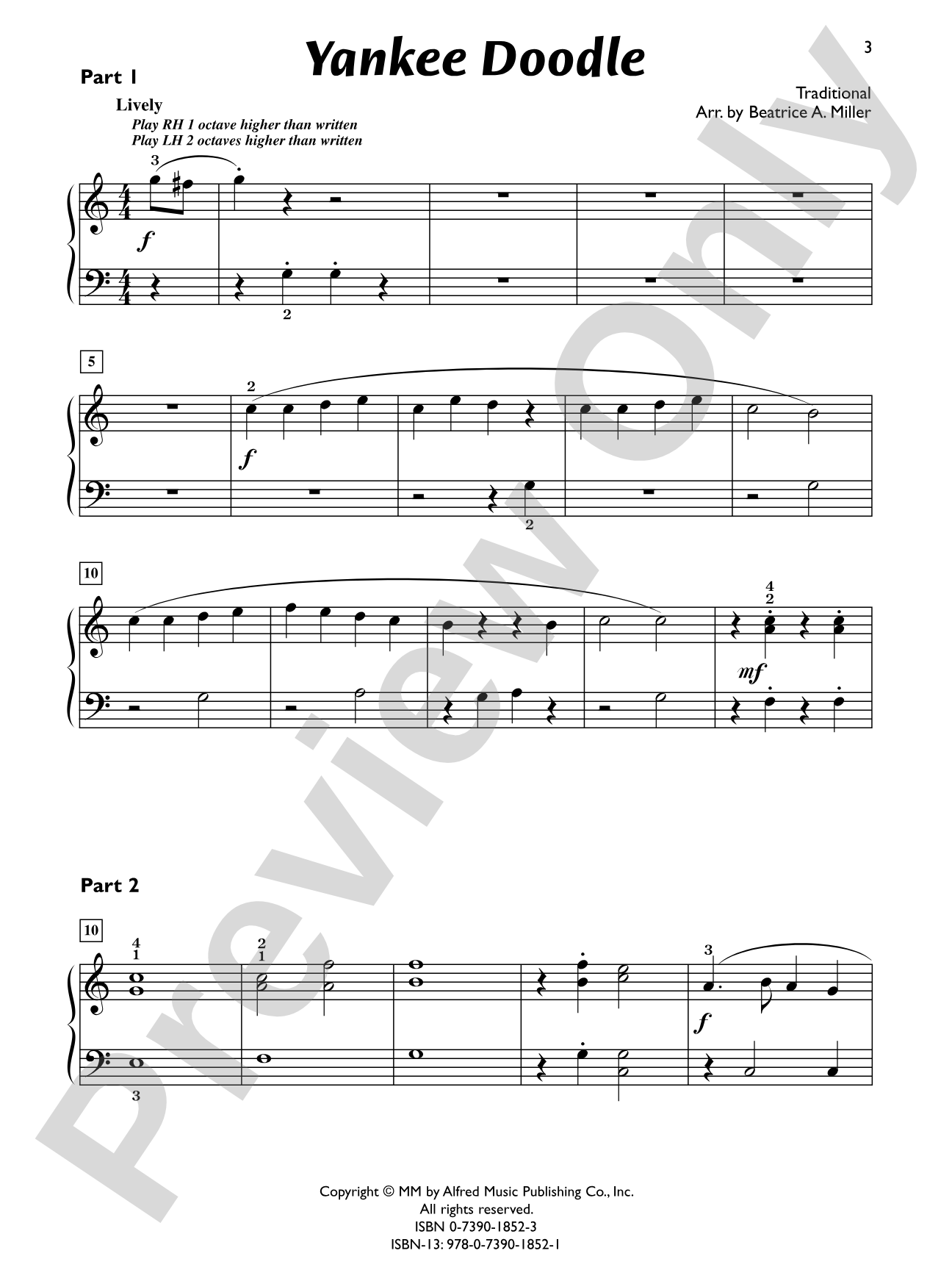
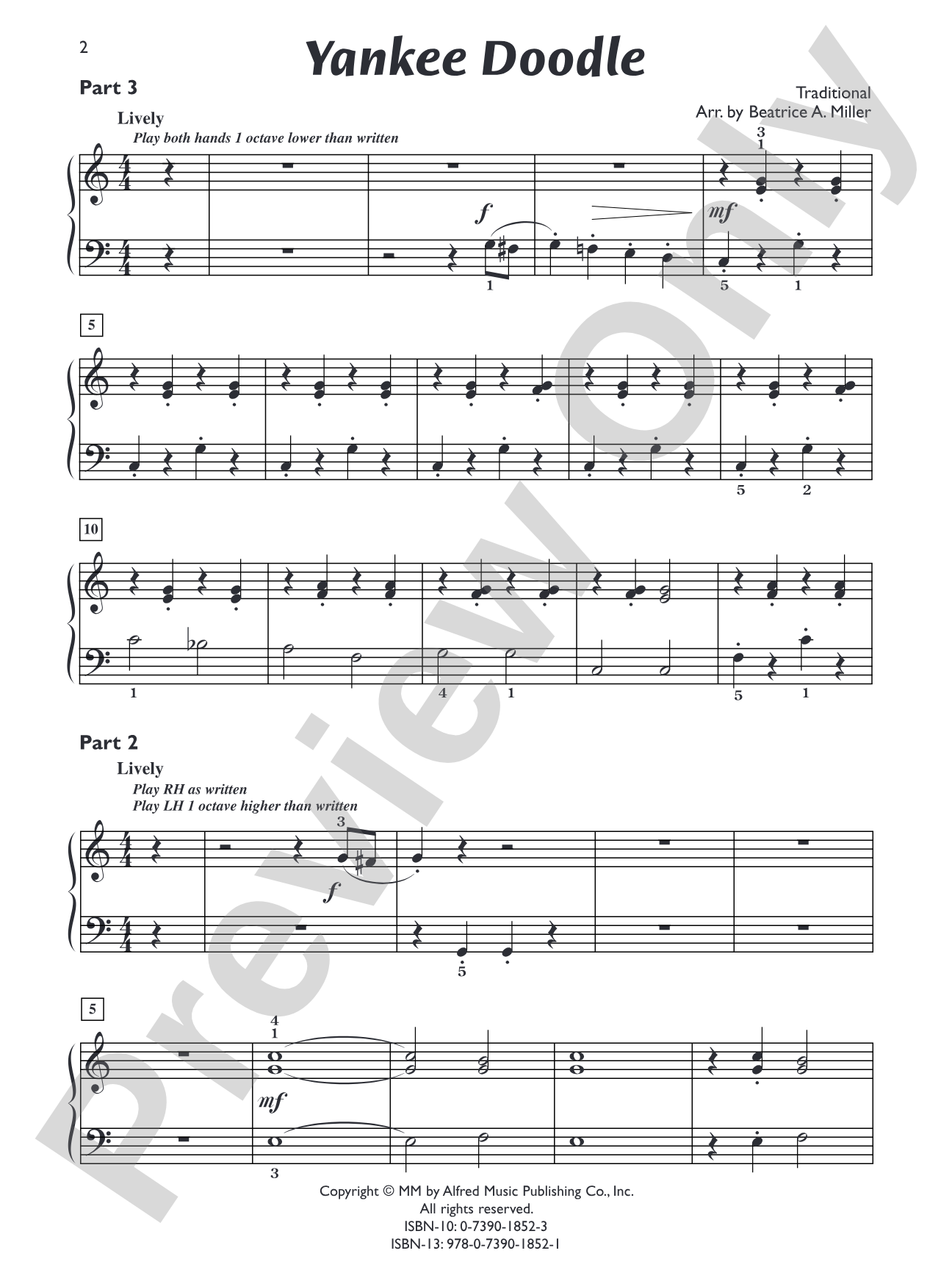
Yankee Doodle - Piano Trio (1 Piano, 6 Hands) Sheet Music Preview

Yankee Doodle - Piano Trio (1 Piano, 6 Hands): Piano Duets & Four Hands

By Beatrice A. Miller

Level: Late Elementary

Item: 00-PB-0000815

Digital Download
$4.99
Description
Melodic duties are shared between three performers in this famous American folk song, written for late elementary level pianists in C Major, with an abundance of dynamic contrasts and a variety of touches to add to the great fun and big sound of six hands at one keyboard. A Federation Festivals 2016-2020 selection. A Federation Festivals 2020-2024 selection.

Yankee Doodle - Piano Trio (1 Piano, 6 Hands): Piano Duets & Four Hands isn't in MakeMusic Cloud just yet...but it could be. Let us know you'd like to see it, and you'll help shape what comes next. In the meantime, start a free trial and dive into thousands of interactive titles your students can play along with today.

Sample Audio
No sample audio found.
Sample Video
Additional Details
Series: The Alfred Trio Series
Publisher: Alfred Music
Page Count: 8
SKU: 00-PB-0000815

More about this title

About the Composer: Beatrice A. Miller

Beatrice A. Miller

Beatrice A. Miller grew up in Detroit, Michigan, in a musical household where her father, a Lutheran pastor and accomplished musician, made singing a cornerstone of family life. Her early exposure to hymn singing and sacred music became foundational to her compositional voice; a family legend describes how, as a nine-month-old, she mimicked the cadence of a hymn her family had just sung, an early sign of the musical gift that would define her life.

Miller earned her Master's degree in music composition from Northwestern University and spent decades teaching piano, directing choirs, and serving as a church organist in Corvallis, Oregon. When she retired from studio teaching in 1979, she devoted herself fully to composition, beginning her publishing career in 1987. The Oregon Music Teacher's Association recognized her as Composer of the Year in 1997, honoring a body of work that brings clarity, accessibility, and genuine musicianship to educational repertoire.

Why we love this

Miller's arrangement captures the spirit of this beloved tune without sacrificing musical substance. The shared melodic duties and dynamic variety make it genuinely engaging for three pianists while remaining true to late elementary technique, and the Federation Festivals selections prove it holds up to adjudicated performance standards.

What to expect

Patriotic and spirited, with the warmth of a folk melody transformed through playful contrasts in touch and dynamics. The arrangement invites three pianists to create a surprisingly full, confident sound together, turning a familiar tune into a moment of genuine musical partnership.

Who it's for

Late elementary pianists ready to explore ensemble playing without advancing to more complex chamber music. Three students at similar technical levels can share one piano and experience the joy of collaborative music-making while maintaining age-appropriate difficulty.

How to get the most out of it

  • Establish clear communication about hand placement before the first rehearsal. With three performers sharing one keyboard, agree on who occupies which octaves and practice transitions between hands calmly and without rushing.
  • Pay close attention to the dynamic contrasts Miller specifies throughout. These shifts in volume and articulation are what give six hands at one keyboard its full, impressive sound; rushing through them flattens the effect.
  • Lock into a steady tempo during early rehearsals using a metronome. The rhythmic independence of three parts requires precise alignment, especially in sections where the melody moves between performers.

How to use it

Program this for a school assembly, patriotic concert, or spring recital where ensemble contributions add variety to a solo-heavy lineup. Its accessibility and crowd-pleasing character make it an ideal bridge between individual achievement and group performance, particularly useful for late elementary students encountering ensemble playing for the first time.

Skills your students will build

  • Playing melody and accompaniment roles interchangeably
  • Coordinating with ensemble partners at a shared keyboard
  • Responding to dynamic and articulation markings in context
  • Maintaining steady tempo while tracking independent musical lines
  • Reading C Major without ledger line complications

You May Also Like