
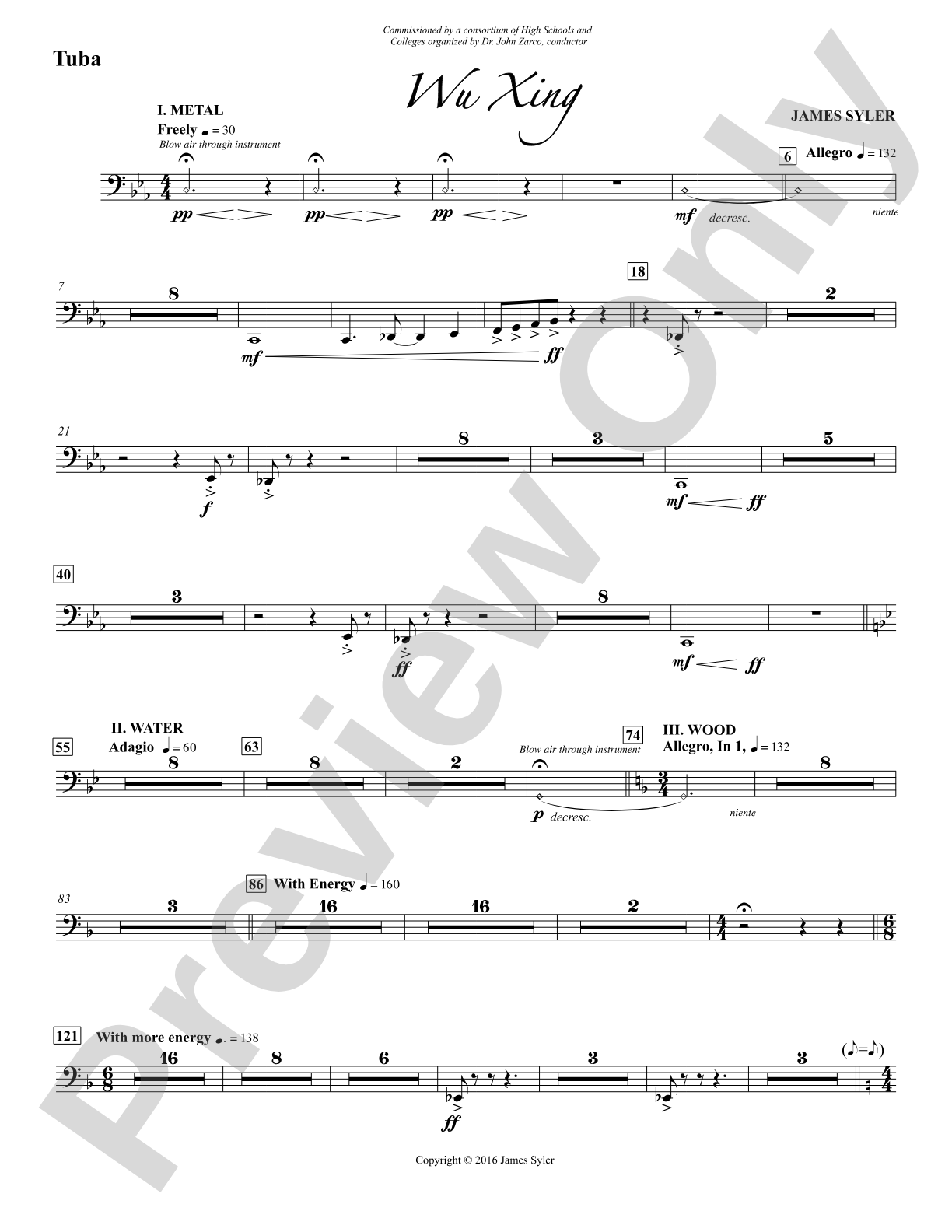

Wu Xing: Tuba
By James Syler
Grade: 5 (Medium Advanced)
Item: 00-PC-0018612_TB1
$3.00
Pickup currently not available
Description
The Wu Xing (pronounced wu-hsing) are the traditional Chinese five phases---Wood, Fire, Earth, Metal, and Water. "Wu" refers to the number 5 and "Xing" means phases. In Wu Xing the concept is more fluid, ever-changing, and more akin to phases. These five phases also have traditional pitch associations in Western solfege that produce a pentatonic scale and these corresponding harmonies.
This work is in effect a Concertino for Two Percussion and Band. The number five is referred to throughout the idea of Wu Xing, and I have used it here in a variety of musical ways---five-measure phrases, five-note harmonies, a five-note melody, five-note rhythms, etc. The work features two solo percussionists playing a variety of sounds organized by instruments made of, or representing, metal, water, wood, fire, and earth. Winner of the 2016 College Band Director's National Association Young Band Composition Contest.


This work is in effect a Concertino for Two Percussion and Band. The number five is referred to throughout the idea of Wu Xing, and I have used it here in a variety of musical ways---five-measure phrases, five-note harmonies, a five-note melody, five-note rhythms, etc. The work features two solo percussionists playing a variety of sounds organized by instruments made of, or representing, metal, water, wood, fire, and earth. Winner of the 2016 College Band Director's National Association Young Band Composition Contest.
Wu Xing: Tuba isn't in MakeMusic Cloud just yet...but it could be. Let us know you'd like to see it, and you'll help shape what comes next. In the meantime, start a free trial and dive into thousands of interactive titles your students can play along with today.
Request This Title
Tell us you want it.
Start Your Free Trial
Explore everything that's ready to play right now.
Sample Audio
No sample audio found.
Sample Video
No sample videos found.
Additional Details
Series:
Alfred Digital Concert Band
SKU:
00-PC-0018612_TB1
More about this title
About the Composer: James Syler
James Syler is a composer whose work engages with both Western concert music traditions and ideas drawn from world music. His compositional voice emphasizes structural clarity and thematic development, often exploring how traditional concepts from other cultures can reshape musical organization in the concert band idiom.
Why we love this
Wu Xing stands out because it treats percussion not as accompaniment but as true soloists carrying equal dramatic weight with the full band. The work's constraint-based approach (five-measure phrases, five-note harmonies) becomes liberating rather than limiting, producing music that feels both mathematically deliberate and emotionally immediate. It won the 2016 CBDNA Young Band Composition Contest for good reason: this is sophisticated writing that Grade 5 ensembles can actually execute and audiences will remember.
What to expect
Wu Xing unfolds with meditative clarity, each phase revealing itself through shifting timbres and sparse, crystalline harmonies. The pentatonic language creates an atmosphere both foreign and strangely familiar, as if traditional Western band sound has been gently realigned into a new tonal universe. Percussion colors dominate the textural landscape, and the overall effect is contemplative yet energetic.
Who it's for
Directors leading Grade 5 concert bands who want repertoire that combines contemporary compositional thinking with accessible execution. Programs serving bands ready to move beyond standard band fare into more conceptually sophisticated writing. Ensembles with capable percussion sections willing to develop two featured soloists.
How to get the most out of it
- Balance the two percussion soloists with transparency in the band parts; this is chamber music with orchestration, not a percussion section accompanied by winds. Check your mix regularly in rehearsal and adjust dynamic markings downward if the soloists get buried.
- The pentatonic harmonic language may feel unfamiliar at first. Have the band internalize the scalar relationships by singing or playing the pentatonic scale on concert pitch before tackling their parts.
- Honor the five-measure phrase structure by conducting it as the organizing principle rather than fighting against it. This phrasing pattern creates the work's distinctive rhythmic shape.
- Coordinate carefully with your two percussion soloists regarding mallet choices and instrument setup. Different mallets on the same instruments produce the timbral variety Syler requires.
How to use it
Program Wu Xing as a concert centerpiece or festival showcase piece where it can stand alone without requiring narrative context. Its abstract approach to form and timbre makes it particularly effective as a bridge piece between more traditional band literature and contemporary works, allowing audiences to hear how cultural ideas reshape instrumental writing.
Skills your students will build
- Balancing featured soloists against ensemble accompaniment
- Reading and internalizing pentatonic scale relationships
- Executing five-measure phrase structures as primary formal unit
- Understanding percussion as melodic rather than rhythmic primary voice
- Interpreting contemporary compositional techniques within concert band idiom