
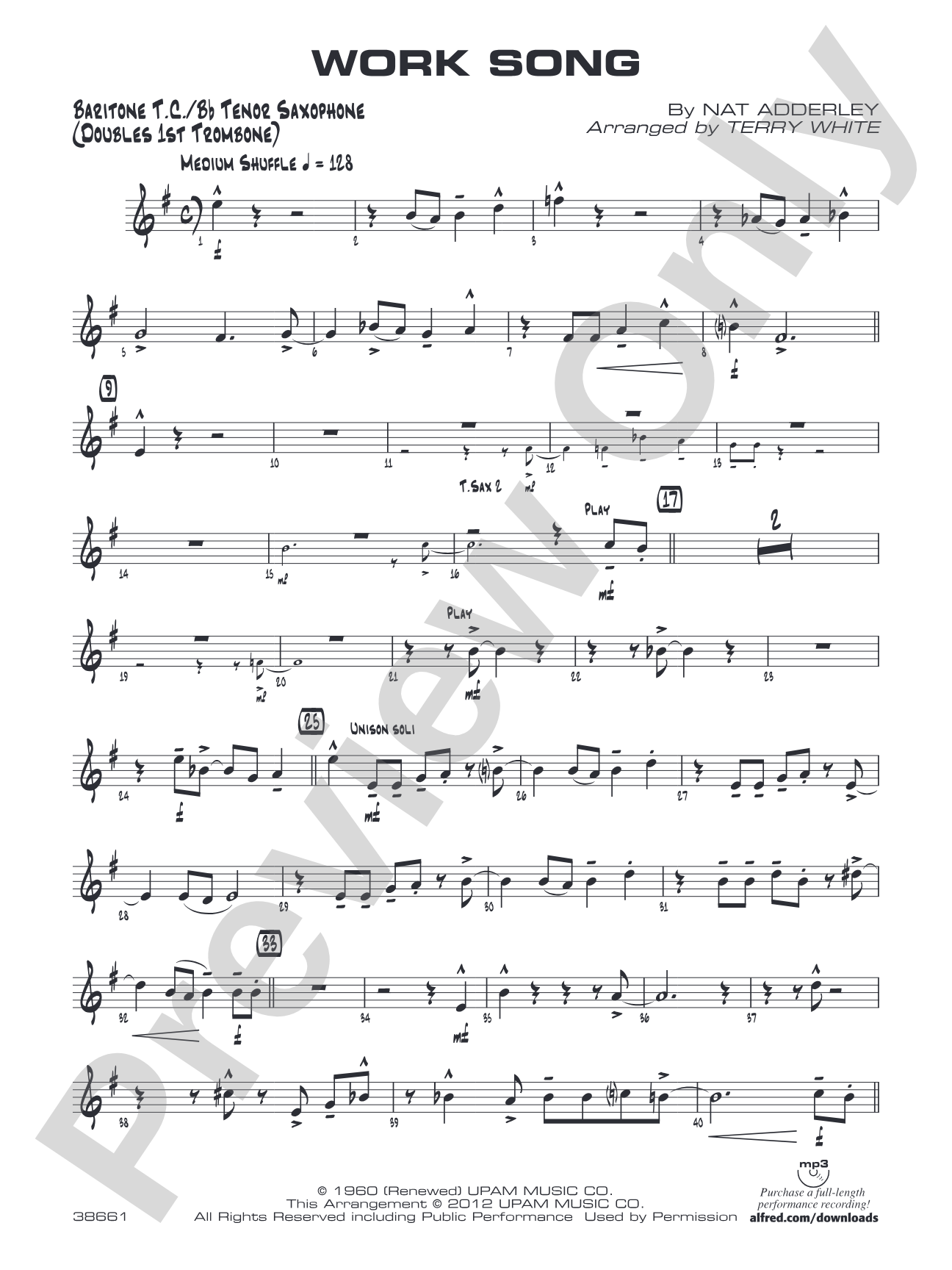

Work Song: Baritone T.C.
By Nat Adderley / arr. Terry White
Grade: 1 (Easy)
Item: 00-PC-0017213_BTC1
$3.00
Pickup currently not available
Description
Recorded by the Adderley brothers, Nat and "Cannonball," Nat's composition is ideal for the young player. This swing chart is catchy, easy to play, and mature sounding. Written-out solos are provided for alto 1 and trumpet 1, plus there is a great interlude and shout chorus. Trumpet 1 top note is written F-sharp, top line. This title is available in MakeMusic Cloud.


Don't just read it, hear it, play along with it, and watch your students grow with it. In MakeMusic Cloud, Work Song: Baritone T.C. comes alive with professional accompaniment, adjustable tempo, and built-in practice tools that turn solo practice into real progress.
Open in the Player
Jump straight in and assign it today.
Start Your Free Trial
Open this title and explore the full library in minutes.
Sample Audio
1
Audio File
--:--
0:00
0:00
Sample Video
Additional Details
Series:
First Year Charts for Jazz Ensemble
Publisher:
Alfred Music
Page Count:
78
SKU:
00-PC-0017213_BTC1
More about this title
About the Composer: Nat Adderley
Nat Adderley was a cornet and trumpet player whose warm, bluesy tone and accessible compositional style made him a bridge between hard bop and popular audiences. His partnership with his brother Cannonball defined a generation of soul jazz, and his writing emphasized melody and groove over abstract complexity, making him an ideal model for young ensemble arrangers and players.
As a bandleader and composer, Adderley understood what makes music stick with listeners and what makes it work for ensembles of varying ability. His best work, including "Work Song," proves that sophistication and approachability are not opposites, a lesson every jazz educator should study.
Why we love this
This chart respects your players' intelligence while staying playable from day one. The written-out solos for alto and trumpet remove the intimidation factor of improvisation without sacrificing authenticity, and the shout chorus and interlude give the ensemble memorable moments that feel genuinely satisfying to execute. It's the kind of tune that makes students excited to come to jazz band.
What to expect
"Work Song" swings with a soulful, purposeful stride. The melody sits naturally under the fingers and in the voice, the harmony is warm without being complex, and there's a grounded, slightly funky energy that makes it impossible to play without moving. It feels like a real jazz standard in miniature.
Who it's for
First-year jazz ensemble directors who need material that teaches real jazz language without overwhelming developing musicians. Alto players and trumpet players benefit especially from the written solos, which serve as pedagogical models for phrasing and articulation. Ensembles preparing for contests or festivals will find a crowd-pleasing, musically legitimate option.
How to get the most out of it
- Lean into the groove with your rhythm section; a relaxed half-time feel lifts the whole band and lets the melody breathe rather than pushing it.
- The written solos are starting points, not ceilings. Once students master them, encourage alto and trumpet players to develop variations that keep the spirit of the original phrasing.
- Balance the shout chorus so it lands with weight without overwhelming the soloists; think "ensemble punctuation" rather than full volume from everyone.
- Use the recorded reference early and often, but have players sing the head before they read it. The tune is memorable for a reason.
How to use it
Open a concert with this to establish an accessible, swinging tone that puts the audience at ease and demonstrates your ensemble's musicality. It pairs well on the same set as other early-level standards or can anchor a "soul jazz" thematic program. The written solos make it an excellent choice for a student spotlight concert or a first jazz festival appearance.
Skills your students will build
- Swing articulation and phrasing over a blues-influenced harmonic structure
- Reading and interpreting written solos with attention to dynamics and note grouping
- Ensemble balance and blend in a section with multiple voices on the same part
- Listening and responding to a walking bass line and comping rhythm section
- Building a solo from a notated framework, eventually extending into improvisation