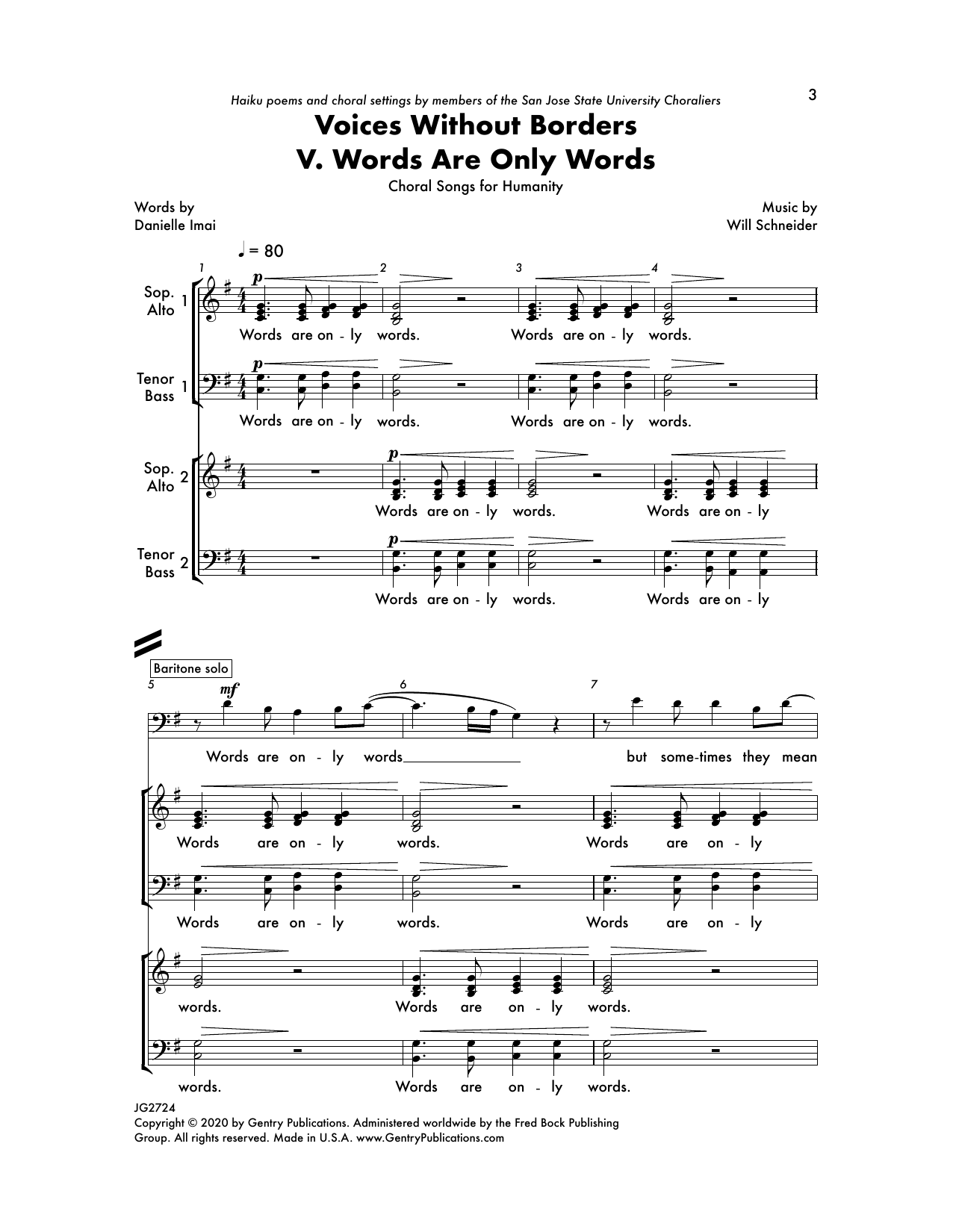
Words Are Only Words Sheet Music Preview

Words Are Only Words: SATB Choral Octavo

By Will Schneider / By Danielle Imai

Item: 35-DS01444190

Digital Download
$3.05
Description

Words Are Only Words: SATB Choral Octavo isn't in MakeMusic Cloud just yet...but it could be. Let us know you'd like to see it, and you'll help shape what comes next. In the meantime, start a free trial and dive into thousands of interactive titles your students can play along with today.

Sample Audio
No sample audio found.
Sample Video
Additional Details
Publisher: Hal Leonard
Page Count: 6
SKU: 35-DS01444190

More about this title

Why we love this

Schneider captures something true about human connection in this a cappella setting. The piece trusts the text to land without instrumental support, which means your singers' voices and diction carry all the weight. It's the kind of arrangement that sounds deceptively simple until your choir finds the nuance in it.

What to expect

Intimate and contemplative. A cappella writing in this context creates immediacy. Your singers and audience exist in the same acoustic space with nowhere to hide, which paradoxically makes the piece feel more vulnerable and honest.

Who it's for

This works for intermediate to advanced choirs with solid intonation skills and the ability to balance multiple lines independently. The a cappella format demands singers who can hold their parts without leaning on an accompaniment, making it ideal for select ensembles or strong concert choirs.

How to get the most out of it

  • Prioritize vowel unity across all four parts in the slower sections. A cappella writing exposes every slight mismatch, so lock the vowel shapes early in rehearsal.
  • Let the text drive the phrasing. Since there's no accompaniment to lean on, shape phrases around the natural rhythm of the words themselves.
  • Sit with the dynamics for their own sake. Without instrumental color, even subtle dynamic shifts between phrases become significant.
  • Record rehearsals and listen back to check blend and balance. Your ear adjusts quickly in the room; playback reveals what the audience actually hears.

How to use it

Consider pairing this with other contemporary a cappella works to create a thematic set that highlights unaccompanied voices. It also fits naturally into a concert that explores language and communication through music, or stands alone as a reflective moment that contrasts with fuller orchestral or accompanied repertoire.

Skills your students will build

  • Sustaining independent vocal lines without instrumental support
  • Achieving blend and balance in four-part harmony
  • Connecting text to musical phrasing and interpretation
  • Precision intonation in a cappella settings
  • Listening to multiple parts simultaneously while singing

You May Also Like