
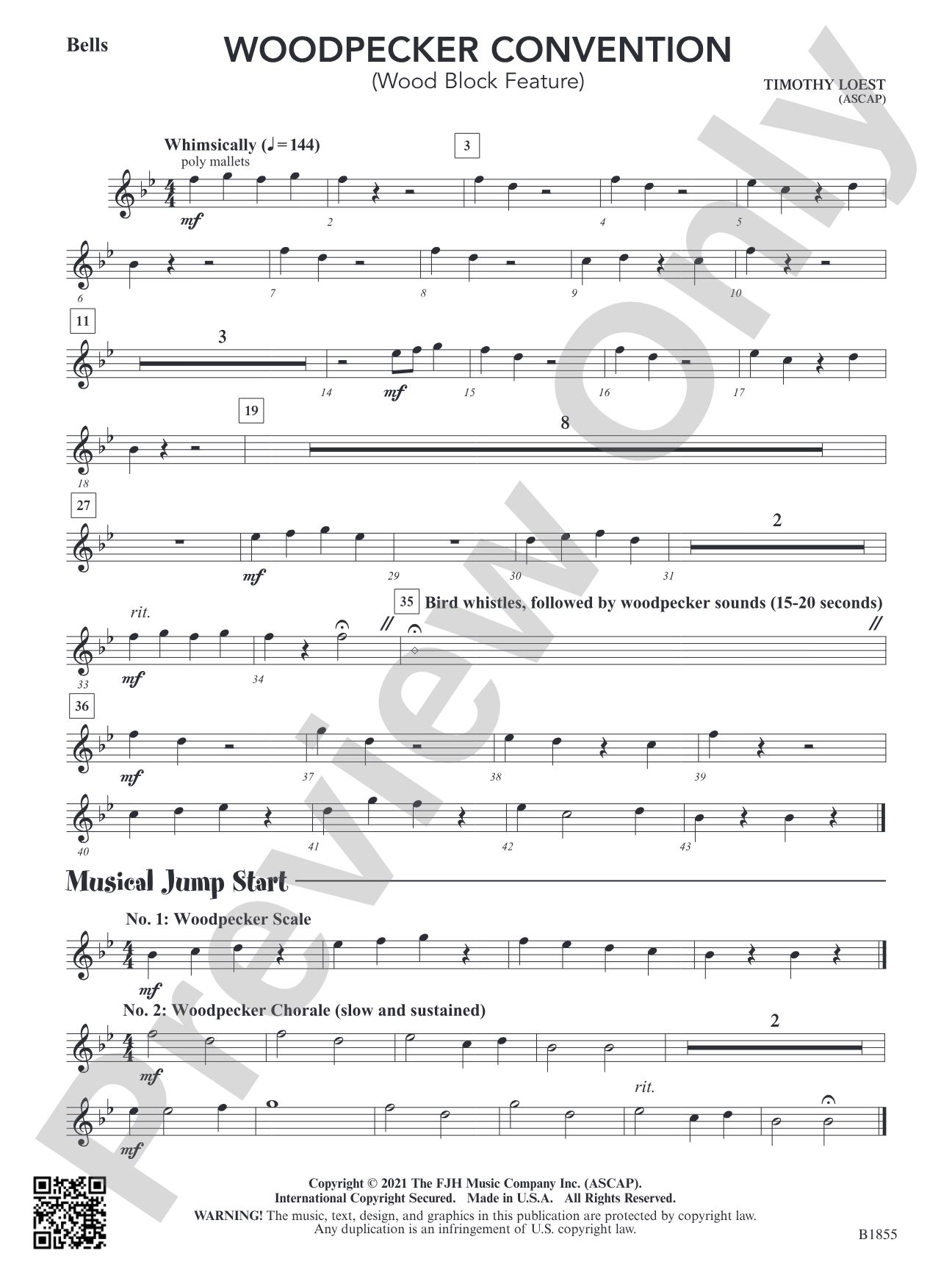

Woodpecker Convention (Wood Block Feature): Bells
Wood Block Feature
By Timothy Loest
Level:.5
Item: 98-PC-DB1855_B
$7.00
Pickup currently not available
Description
Embark on a scenic birdwatching adventure in this clever wood block feature. Discover the sounds of the forest, complete with singing birds and drumming woodpeckers. This one is sure to be the hit of your next concert and the talk of the town. Curiously creative, easily accessible, and definitely memorable!


Don't just read it, hear it, play along with it, and watch your students grow with it. In MakeMusic Cloud, Woodpecker Convention (Wood Block Feature): Bells comes alive with professional accompaniment, adjustable tempo, and built-in practice tools that turn solo practice into real progress.
Open in the Player
Jump straight in and assign it today.
Start Your Free Trial
Open this title and explore the full library in minutes.
Sample Audio
1
Audio File
--:--
0:00
0:00
Sample Video
Additional Details
Series:
FJH Starter Series
Publisher:
The FJH Music Company, Inc.
SKU:
98-PC-DB1855_B
More about this title
About the Composer: Timothy Loest

Timothy Loest has built a three-decade teaching career at F.E. Peacock Middle School in Itasca, Illinois, while becoming one of the most prolific and performed composers for young bands. His works appear regularly on network television (The Tonight Show Starring Jimmy Fallon, Good Morning America, and others) and have reached audiences at major venues like Chicago's Millennium Park. In 2017, he received the Illinois Grade School Music Association's Cloyd Myers Memorial Award for Excellence in Music Education, recognizing his impact on instrumental music pedagogy and performance standards.
Loest's publications span multiple major publishers, including FJH Music Company, C.L. Barnhouse, and his own Fanfare Music Press (founded in 2022). He is the primary voice behind several widely adopted band methods, among them Measures of Success: A Comprehensive Musicianship Band Method and the Beyond series (Warm-ups and Beyond, Rhythms and Beyond, Chorales and Beyond). His approach to young band composition balances accessibility with genuine musical substance, ensuring that early repertoire challenges and engages developing musicians. Loest holds degrees from Illinois State University and Northwestern University and maintains active membership in ASCAP.
Why we love this
Loest has a gift for writing novelty pieces that genuinely entertain without sacrificing musicianship. The wood block feature here is perfectly calibrated for the half-step level: it showcases young percussionists with rhythmically engaging material while keeping the full band part accessible and supportive, making every student feel like they're part of something genuinely fun. Programming a Loest novelty guarantees an audience moment that stays in the program's memory long after the curtain falls.
What to expect
Playful and imaginative, with the wood block's rapid-fire patterns evoking the percussion of a woodpecker at work. The piece creates a vivid forest soundscape that draws listeners into a birdwatching scenario, balancing whimsy with genuine rhythmic interest and allowing young musicians to experience character-driven composition without excessive technical demands.
Who it's for
Beginning to early intermediate concert bands (Level 0.5, Grade 1-2) looking for a crowd-pleasing novelty that highlights percussion and keeps the full band part manageable. Directors seeking repertoire that appeals equally to young musicians and audiences will find this particularly valuable for family concerts, spring programs, or festival performances where entertainment and engagement matter as much as musical growth.
How to get the most out of it
- Lock the wood block rhythm with the timpani or bass drum player during rehearsal; independent percussion lines need synchronization before the full band joins in.
- Encourage the wood block soloist to play with clear articulation and consistent stick height, letting the block's natural resonance carry the melody without forcing volume.
- Balance the bird sound effects (if using pitched percussion like chimes or bells) so they complement rather than overshadow the woodpecker feature.
- Shape the band's accompaniment dynamics around the wood block line, treating it as the featured voice throughout.
How to use it
Position this as a highlight moment in a spring or family concert program, where it can serve as a palate-cleanser between more serious fare or as a program closer that sends audiences out smiling. It pairs well with other light or descriptive concert band pieces, and the novelty element makes it especially effective for younger school programs where you want to showcase what band students can accomplish while keeping the audience entertained.
Skills your students will build
- Rhythmic independence between percussion and band parts
- Precision rhythm reading and coordination with other ensemble members
- Expression and phrasing in featured instrumental roles
- Understanding of program music and musical storytelling in concert band context
- Balance and blend when accompanying a featured percussionist