
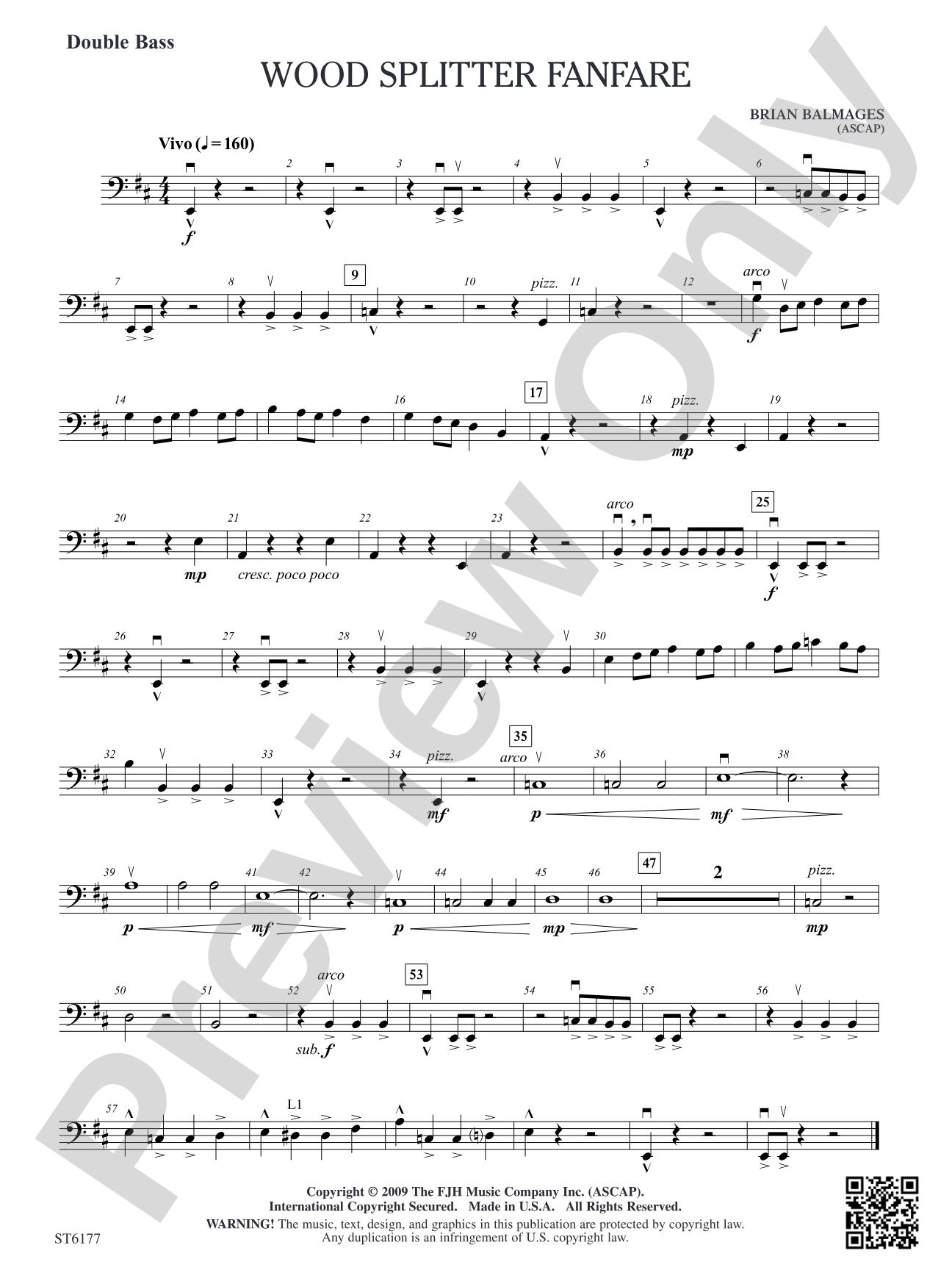

Wood Splitter Fanfare: Double Bass
By Brian Balmages
Grade: 2.5
Item: 98-PC-DST6177_SB
$7.00
Pickup currently not available
Description
Immediately command your audience's attention with this thrilling fanfare that includes sweeping lines, forceful rhythms, and counterpoint - and all in a short grade 2.5 that is quite achievable! Your group will sound like a symphony orchestra as the music drives through several sections before a flurry of chords bring the work to an exciting conclusion. Intense!


Don't just read it, hear it, play along with it, and watch your students grow with it. In MakeMusic Cloud, Wood Splitter Fanfare: Double Bass comes alive with professional accompaniment, adjustable tempo, and built-in practice tools that turn solo practice into real progress.
Open in the Player
Jump straight in and assign it today.
Start Your Free Trial
Open this title and explore the full library in minutes.
Sample Audio
1
Audio File
--:--
0:00
0:00
Sample Video
No sample videos found.
Additional Details
Series:
FJH Developing Strings
Publisher:
The FJH Music Company, Inc.
SKU:
98-PC-DST6177_SB
More about this title
About the Composer: Brian Balmages

Brian Balmages has established himself as a composer and conductor whose voice spans orchestral, band, and chamber repertoires with equal facility. His works have been performed by ensembles at every level, from professional symphony orchestras to elementary school groups, in prestigious venues including Carnegie Hall, the Kennedy Center, and the Sydney Opera House. He received the A. Austin Harding Award from the American School Band Directors Association and won the 2020 NBA William D. Revelli Composition Contest for Love and Light. Balmages holds the distinction of being an elected member of the American Bandmasters Association.
Beyond composition, Balmages maintains an active conducting schedule with all-state and regional ensembles, university orchestras, and professional groups internationally. His music was performed at the 2013 Presidential Inaugural Prayer Service, and he has served as a guest conductor at major conferences including the Midwest Clinic and Western International Band Clinic. Currently, he leads MakeMusic Publications and Digital Education for Alfred and MakeMusic. His alma maters, James Madison University and the University of Miami, have both honored his contributions to music education and artistry.
Why we love this
Balmages delivers genuine orchestral density and drama at a grade that feels honest for developing ensembles. The counterpoint and multiple simultaneous lines create the full, sophisticated sound your students will hear in professional orchestras, while the achievable technical demands mean rehearsal time goes toward refining ensemble balance and clarity rather than battling notes. It's contest or festival material that doesn't require months of preparation.
What to expect
A bold orchestral statement that grabs the audience from the first moment. The piece propels forward with forceful rhythms and sweeping melodic arcs, layering independent voices that create depth and richness. The drive builds steadily toward a brilliant, chord-filled conclusion that lands with genuine weight and excitement.
Who it's for
String orchestras at the high intermediate level (grades 2.5 and above) who want to program something with genuine impact for a contest, festival, or concert. This works equally well for groups eager to build sophisticated ensemble skills and for conductors seeking repertoire that sounds more advanced than its technical difficulty.
How to get the most out of it
- Shape the sweeping lines with clear dynamic intention from the opening. Balmages writes lines that naturally want to sing, so guide your students to think in phrases rather than measure-to-measure attacks.
- Balance the counterpoint by identifying which strand carries the primary line in each section and allowing other parts to sit lightly beneath it. Mark parts clearly so students understand their hierarchical role moment to moment.
- Approach the closing flurry of chords with rhythmic precision and unified articulation. Lock in the rhythm section first, then layer upper voices on top so the excitement builds rather than scatters.
How to use it
Open a concert or festival set with this fanfare to command immediate attention and establish energy. It pairs well alongside lyrical or slower pieces, giving you dynamic contrast. At under five minutes, it also makes an ideal contest selection for groups wanting to showcase orchestral sophistication without the extended preparation time a longer work demands.
Skills your students will build
- Balancing independent melodic lines within a homophonic texture
- Sustaining lyrical phrasing across sweeping string lines
- Executing rhythmic precision and unified articulation in rapid passages
- Reading and performing counterpoint with clear voice independence
- Building dynamic shape and architecture across multiple sections