
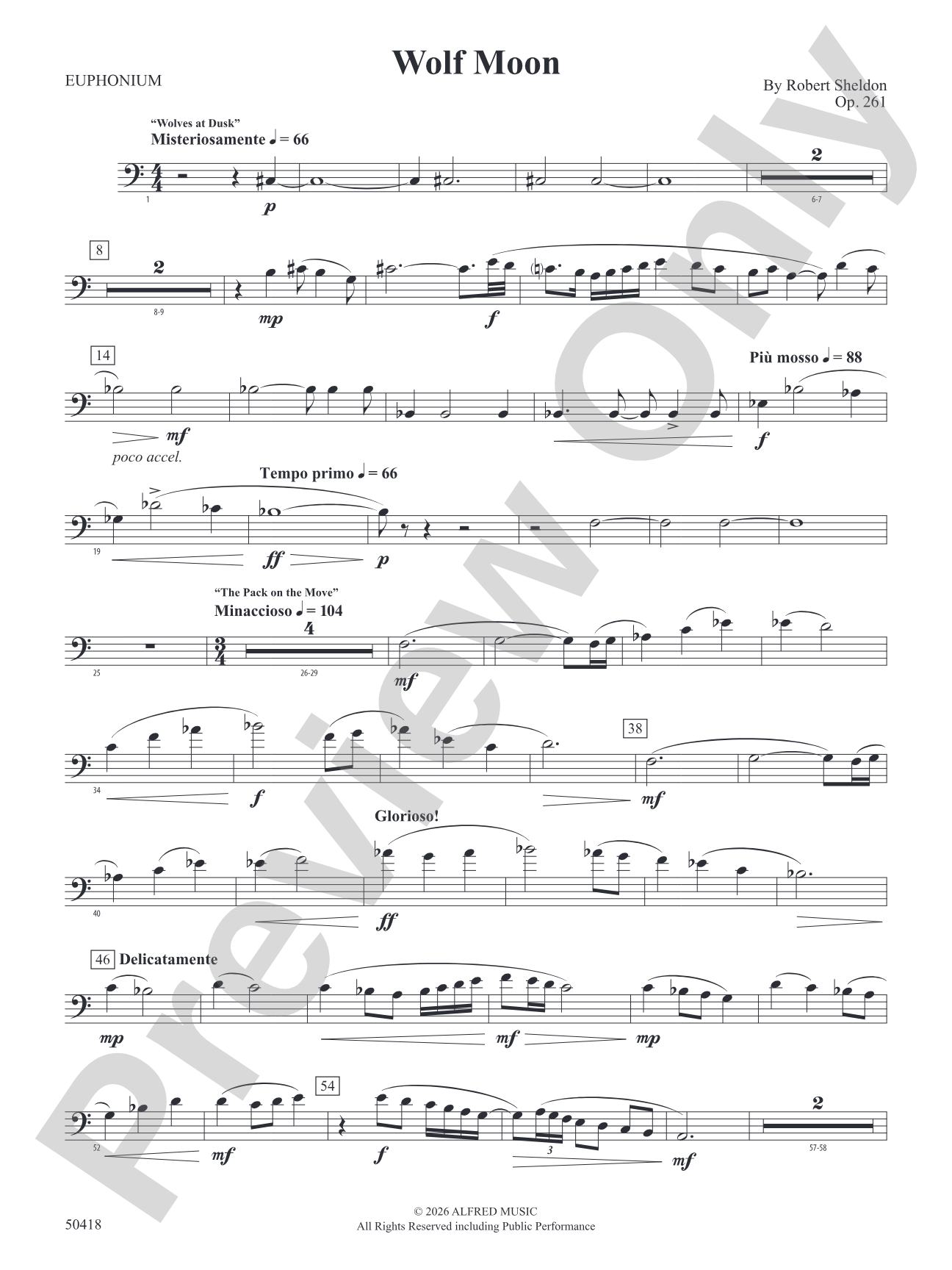

Wolf Moon: Baritone B.C.
By Robert Sheldon
Grade: 5
Item: 00-PC-0019770_BBC1
$3.00
Pickup currently not available
Description
Wolves have brought about a sense of intrigue throughout human history. The tone poem, Wolf Moon, by Robert Sheldon, depicts these fascinating and noble creatures in four connected movements: "Wolves at Dusk," which sets the scene in dark and mysterious tones; "The Pack on the Move" which is quite menacing; "Wolves in Moonlight" imagining sadness, joy and apprehension; and "The Hunt," displaying a scene of ruthlessness along with the breathtaking speed and coordination of the wolves as they run wildly through the night to capture their prey, enhanced by the multiple meters and extreme dynamics. A dramatic and bold work!


Don't just read it, hear it, play along with it, and watch your students grow with it. In MakeMusic Cloud, Wolf Moon: Baritone B.C. comes alive with professional accompaniment, adjustable tempo, and built-in practice tools that turn solo practice into real progress.
Open in the Player
Jump straight in and assign it today.
Start Your Free Trial
Open this title and explore the full library in minutes.
Sample Audio
1
Audio File
--:--
0:00
0:00
Sample Video
Additional Details
Series:
Alfred Concert Band Series
Publisher:
Alfred Music
SKU:
00-PC-0019770_BBC1
More about this title
About the Composer: Robert Sheldon

Robert Sheldon's catalog represents some of the most frequently performed wind band music in concert halls and festivals worldwide. His compositions have earned recognition from the American School Band Director's Association, Phi Beta Mu, and ASCAP, and have graced stages ranging from Carnegie Hall to the Sydney Opera House. Beyond composition, Sheldon serves as lead author of Sound Innovations for Concert Band and maintains an active schedule as guest conductor for honor bands and clinician at universities and state music education conferences.
Sheldon's work has traveled globally through performances and commissions across the United States, Japan, Canada, Italy, Germany, Australia, and China. He received an honorary doctorate from VanderCook College of Music in 2020, recognizing a career defined by compositions that engage both ensembles and audiences with distinctive musical expression.
Why we love this
Sheldon crafts a narrative arc that unfolds across four distinct movements, each with its own musical character and dramatic purpose. The writing balances accessibility at Grade 5 with genuine compositional sophistication, particularly in how shifting meters and dynamic contrast create visceral tension without overwhelming young musicians. This is a work that holds its own in any contest or concert program while delivering the kind of thematic clarity and forward momentum that keeps students engaged throughout rehearsals.
What to expect
Wolf Moon unfolds as a cinematic journey through four distinct landscapes of wild nature. From the shadowed opening through the frenzied final hunt, the music captures both the isolation and coordinated power of these creatures, oscillating between moments of brooding tension and explosive energy that demands full commitment from the ensemble.
Who it's for
Concert bands at Grade 5 level seeking a substantial work with contest potential and genuine artistic merit. Directors programming events where narrative and dramatic scope elevate the concert experience will find this tone poem rewarding for both ensemble growth and audience engagement.
How to get the most out of it
- Establish the dark, mysterious opening of 'Wolves at Dusk' through precise control of sustained tones and careful attention to balance. This movement sets the listener's expectations, so clarity in the lower voices is essential.
- Navigate the multiple meter changes in 'The Hunt' by breaking sections into manageable rehearsal units and drilling transitions repeatedly. Mark beat patterns on parts if needed to anchor players through rhythmic shifts.
- Shape the contrasts between the sadness and apprehension in 'Wolves in Moonlight' by varying vibrato intensity and air speed across voice groups. These emotional nuances require expressive maturity that this movement itself will help develop.
- Emphasize the coordination and ensemble precision required in 'The Pack on the Move' and 'The Hunt.' The ruthlessness and speed Sheldon describes depend on rhythmic unity, so balance technical accuracy against maintaining forward energy.
How to use it
Program Wolf Moon as a standalone feature work or concert centerpiece where its dramatic arc can breathe without competition for the audience's attention. It works equally well in festival contests or as the emotional anchor of a concert themed around nature, storytelling, or orchestral wind writing.
Skills your students will build
- Reading and executing multiple meter changes (including sections with alternating or mixed meters)
- Dynamic control and contrast across the full dynamic spectrum
- Sustaining tonal balance and blend in extended soft passages
- Rhythmic precision and ensemble coordination during rapid, complex passages
- Expressive interpretation and narrative musicianship across contrasting character movements