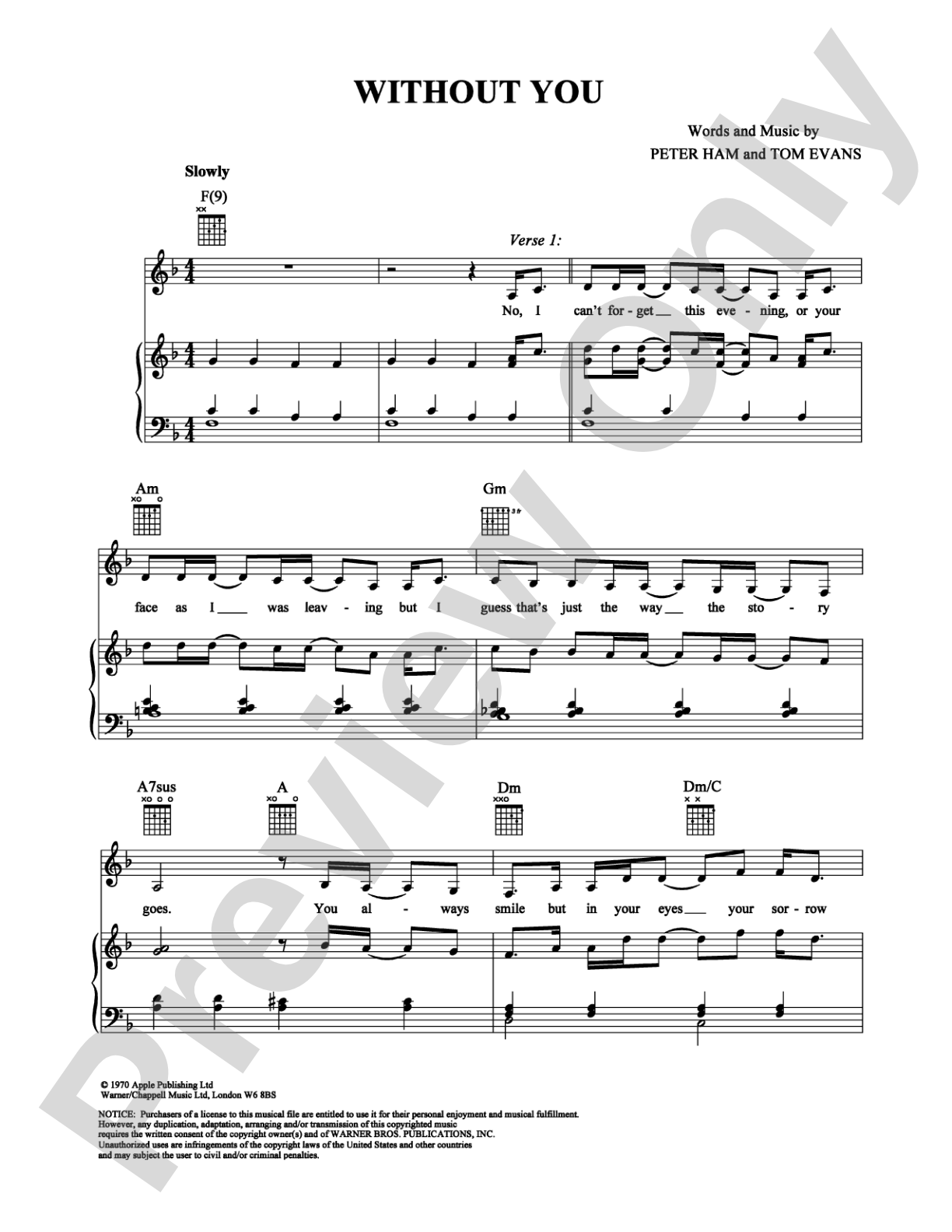
Without You: Piano/Vocal/Chords Digital Sheet Music

Without You: Piano/Vocal/Chords Digital Sheet Music

Harry Nilsson, Tom Evans, William Peter Ham

Item: 00-PS-0005935

Digital Download
$3.99
Description

Without You: Piano/Vocal/Chords Digital Sheet Music isn't in MakeMusic Cloud just yet...but it could be. Let us know you'd like to see it, and you'll help shape what comes next. In the meantime, start a free trial and dive into thousands of interactive titles your students can play along with today.

Sample Audio
No sample audio found.
Sample Video
Additional Details
SKU: 00-PS-0005935

More about this title

About the Artist: Harry Nilsson

Harry Nilsson (1941-1994) was an American singer-songwriter known for his distinctive vocal style, inventive arrangements, and willingness to work across genres. His catalog ranges from avant-garde pop to deeply emotional ballads, and his songs have become standards in American popular music. Nilsson's approach to composition emphasizes melody and emotional directness, making his work accessible to performers at many levels while rewarding careful interpretation.

Why we love this

This song sits at the intersection of vulnerability and craft. The melody is instantly memorable, yet the harmonic movement underneath rewards thoughtful voicing at the piano. Singers connect immediately with the emotional core, while the relatively straightforward chord progression allows pianists to focus on supporting the vocal line and shaping the song's arc rather than wrestling with technical complexity.

What to expect

The song carries a bittersweet resignation, with a melody that feels almost conversational in its simplicity. The piano provides gentle harmonic support without overwhelming the voice; this is intimate and honest rather than grand.

Who it's for

This arrangement works well for singers exploring contemporary American pop standards, pianists preparing material for recitals or studio work, and music students analyzing how conversational songwriting translates to notated form. It suits performers comfortable with pop idiom who want to deepen their understanding of melody and restraint.

How to get the most out of it

  • Shape the vocal line with the piano accompaniment rather than against it; use dynamics and touch at the keyboard to echo and support the singer's phrasing.
  • Let the opening phrase breathe without rushing; this song builds its power through restraint and space, not momentum.
  • Pay attention to the lyrical subtext when choosing tempo and dynamics; this is not a cheerful pop song, and the arrangement should reflect that emotional weight.
  • Experiment with the density of the voicings in your chord comping; a sparse approach often serves this material better than fuller harmonies.

How to use it

Consider programming this as a bridge between classical art song and contemporary pop, especially in recitals that explore emotional authenticity across genres. It pairs well with other singer-songwriter material from the 1970s and can anchor a program focused on how American popular song functions as a vehicle for vulnerability.

Skills your students will build

  • Reading and interpreting chord symbols in a pop/rock context
  • Balancing vocal line with piano accompaniment
  • Sustaining emotional focus across a simple but affecting melody
  • Navigating the relationship between notated harmony and expressive interpretation

You May Also Like