
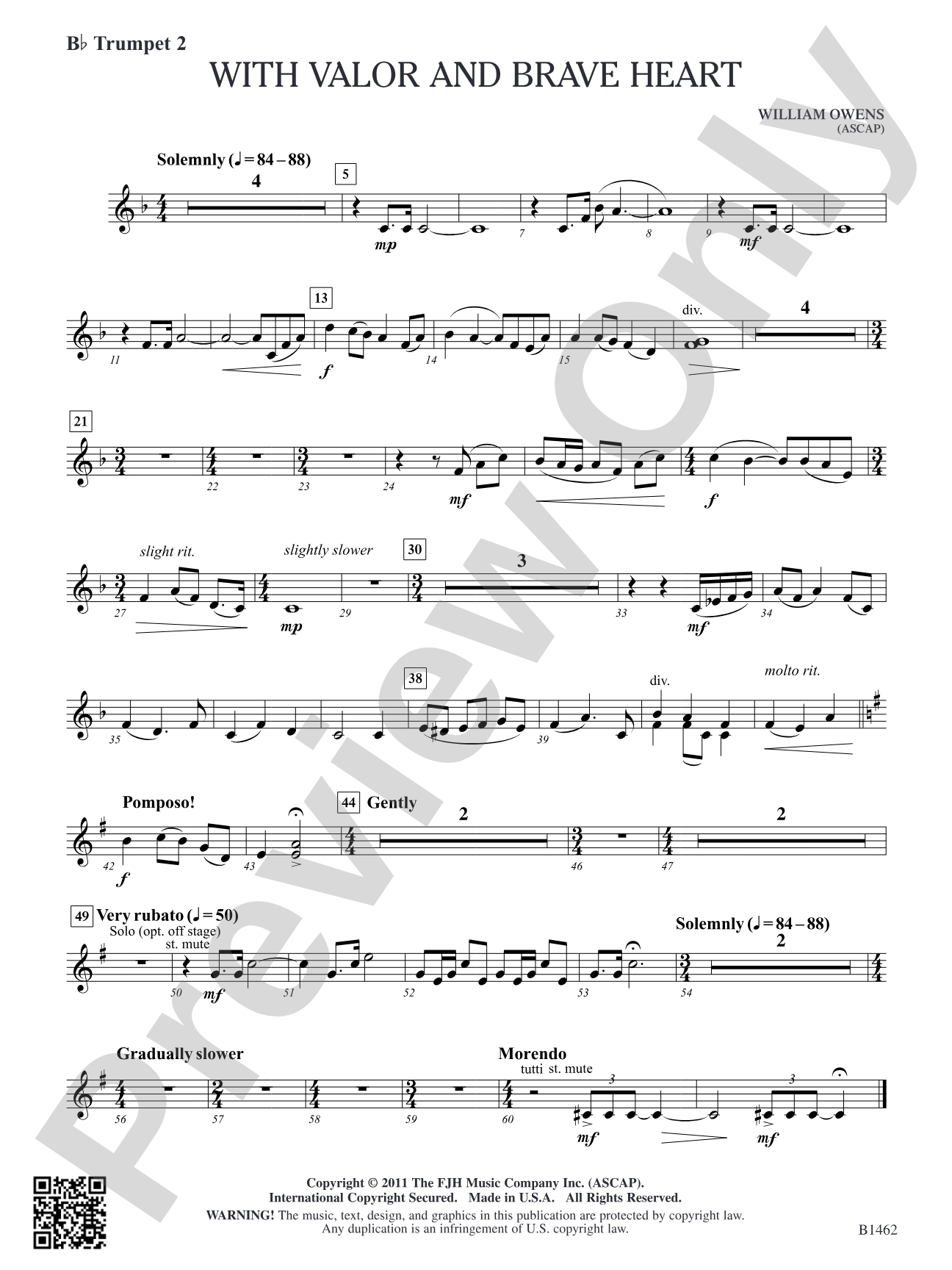

With Valor and Brave Heart: B-flat Trumpet 2
By William Owens
Grade: 2.5;3
Item: 98-PC-DB1462_T2
$7.00
Pickup currently not available
Description
This heartfelt work was written for a school in Texas and remembers the tragedy at Fort Hood in November 2009. The lyrical lines mix with a whispering military drum cadence and concludes with a haunting version of Echo Taps, which is followed by a sensitive harmonic treatment of the melody. A final dissonant, soft fanfare in the trumpets leaves the audience with a sense of awe. Extremely thought provoking.


Don't just read it, hear it, play along with it, and watch your students grow with it. In MakeMusic Cloud, With Valor and Brave Heart: B-flat Trumpet 2 comes alive with professional accompaniment, adjustable tempo, and built-in practice tools that turn solo practice into real progress.
Open in the Player
Jump straight in and assign it today.
Start Your Free Trial
Open this title and explore the full library in minutes.
Sample Audio
1
Audio File
--:--
0:00
0:00
Sample Video
No sample videos found.
Additional Details
Series:
FJH Young Band
Publisher:
The FJH Music Company, Inc.
SKU:
98-PC-DB1462_T2
More about this title
About the Composer: William Owens
William Owens brings three decades of classroom experience to his compositions for young ensembles. Born in Gary, Indiana, and trained at VanderCook College of Music, he has established himself as both a practitioner and prolific voice in band music, with more than 300 published works spanning concert band, string orchestra, and chamber settings. His output appears on required lists across the country and has become foundational to young band repertoires in schools nationwide.
Owens' approach to composition reflects his deep understanding of what works in the rehearsal room. He has served the Texas music education community extensively, holding leadership roles in state and regional organizations, and was recognized with the Texas Bandmasters Association's Meritorious Achievement Award before retiring from 30 years of band direction. His works have been featured in educational texts and analyzed for their pedagogical value, cementing his reputation as a composer who writes with young musicians' needs firmly in mind.
Why we love this
Owens crafted this work with a specific tragedy and a specific community in mind, which gives it a gravity that students feel immediately. The piece balances accessibility at Grade 2.5-3 with genuine emotional weight, moving from lyrical passages through a whispered military drum pattern into the profound silence of Echo Taps; that kind of structural clarity teaches young musicians how to shape a narrative arc. Directors seeking repertoire that honors remembrance while remaining performable by developing bands will find this both musically and pedagogically sound.
What to expect
The piece unfolds with hymnal quietness, building a foundation of respect and reflection before the military drum whispers become audible; listeners enter a space that feels both solemn and intimate. As the music moves through Echo Taps into its sensitive harmonic treatment, there is a quality of shared witnessing, and the final soft trumpet fanfare leaves an ache of recognition rather than resolution.
Who it's for
This work reaches conductors and musicians in Grades 5-8 bands seeking repertoire with genuine emotional substance and ceremony. It serves programs preparing pieces for contest or festival settings where depth of character matters as much as technical display, and it works equally well for commemorative concerts or programs acknowledging service and loss.
How to get the most out of it
- Allow the whispering military drum cadence to breathe as a separate textural idea rather than rushing toward the next section; this shift in color gives students a tactile understanding of how timbre carries meaning.
- The haunting Echo Taps passage demands restraint from the ensemble; encourage players to listen inward and shape the harmonic treatment with the kind of attention they'd give a sustained chorale, even as they're only playing individual notes.
- Balance the final trumpet fanfare carefully so its dissonance reads as contemplative rather than harsh; the soft dynamic marking is essential to the piece's emotional resolution, and students should understand that 'soft' does not mean 'timid.'
How to use it
Program this at moments when your concert needs a tonal shift toward reverence and remembrance, particularly in contexts honoring veterans, fallen service members, or community resilience. It pairs naturally with patriotic or American repertoire and provides a powerful centerpiece for programs addressing difficult topics with dignity, offering young musicians a chance to engage meaningfully with music that serves a purpose beyond performance technique.
Skills your students will build
- Sustaining long melodic lines with consistent tone and phrasing
- Listening to and blending dynamic textures (lyrical lines against whispered percussion patterns)
- Interpreting soft dynamics with clarity rather than loss of definition
- Understanding how musical form conveys emotional narrative
- Responding to timbral shifts as structural signposts