
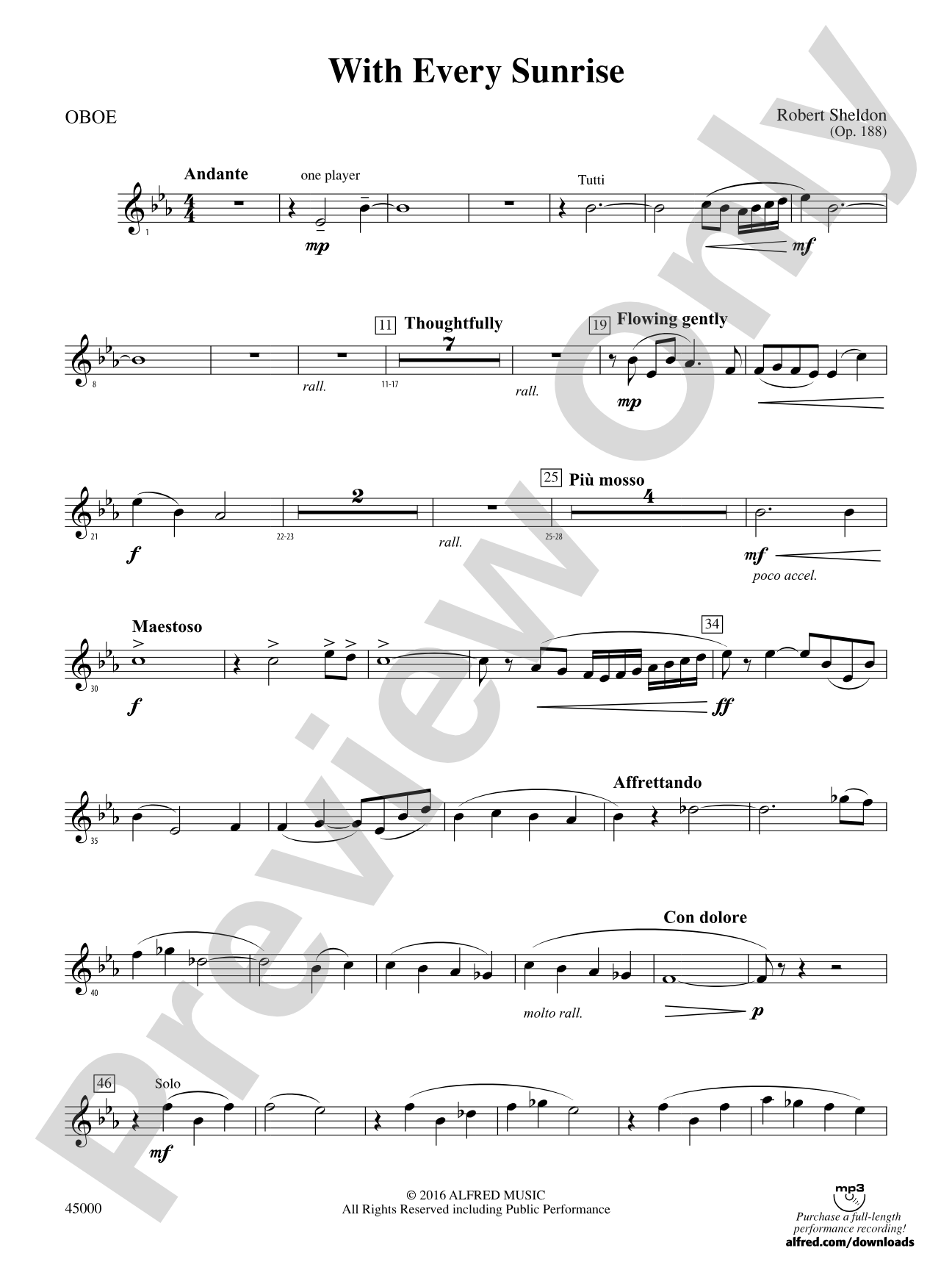

With Every Sunrise: Oboe
By Robert Sheldon
Grade: 3.5 (Medium)
Item: 00-PC-0017465_O1
$3.00
Pickup currently not available
Description
"With Every Sunrise" is a lyrical composition that is all at once poignant, uplifting, and wistful, yet hopeful in its presentation. Moments of power and joy contrast with the gentle nature of the piece, providing a vehicle for a broad range of expressive possibilities. (5:30)


Don't just read it, hear it, play along with it, and watch your students grow with it. In MakeMusic Cloud, With Every Sunrise: Oboe comes alive with professional accompaniment, adjustable tempo, and built-in practice tools that turn solo practice into real progress.
Open in the Player
Jump straight in and assign it today.
Start Your Free Trial
Open this title and explore the full library in minutes.
Sample Audio
1
Audio File
--:--
0:00
0:00
Sample Video
Additional Details
Series:
Alfred Concert Band
Publisher:
Alfred Music
Page Count:
194
SKU:
00-PC-0017465_O1
More about this title
About the Composer: Robert Sheldon

Robert Sheldon stands among the most widely performed composers of wind band repertoire in the world today. His works appear regularly on international concert and festival programs, and he has received major recognition from the American School Band Director's Association, Phi Beta Mu, and the American Society of Composers, Authors and Publishers. His music consistently balances accessibility with artistic depth, allowing student ensembles and professional groups alike to find genuine expression within the score.
Beyond composition, Sheldon has shaped wind band pedagogy as lead author of Sound Innovations for Concert Band. He maintains an active schedule as guest conductor for All-State and Regional Honor Bands, and conducts clinics and seminars at universities and state music education conferences across the United States and internationally (Japan, Canada, Italy, Germany, Australia, China). His works have been performed at Carnegie Hall, Orchestra Hall, Boston Symphony Hall, the Sydney Opera House, and the Kennedy Center. In 2020, VanderCook College of Music awarded him an honorary doctorate in recognition of his contributions to music education.
Why we love this
Sheldon writes concert band music that respects both the capabilities and the aspirations of developing ensembles. With Every Sunrise manages the difficult balance of offering genuine musical substance while remaining within reach of a Grade 3.5 band; the contrasts between lyrical passages and moments of power give students something substantive to build, and conductors find rich interpretive possibilities throughout a piece that never condescends to its ensemble.
What to expect
The piece opens with quiet introspection, building toward moments of genuine joy and power before settling into reflective, hopeful space. Its emotional landscape moves between wistfulness and uplift, creating a musical journey that feels complete without becoming overly dramatic or sentimental.
Who it's for
This score and parts set serves a Grade 3.5 concert band that seeks repertoire with genuine emotional range and programmatic substance. Directors programming festivals, concerts, or contest performances will find a piece that plays well in any context while offering students meaningful interpretive challenges beyond technical facility.
How to get the most out of it
- Shape the gentle sections with careful attention to dynamic layering. Let lighter voices emerge from the fuller textures, and use subtle tempo flexibility to support the emotional arc without losing structural coherence.
- Prepare the powerful moments as genuine climaxes, not mere volume increases. These contrast most effectively when both the quiet and loud passages have been carefully rehearsed for tonal quality and ensemble balance.
- Establish clear voice independence in the middle registers, where Sheldon often places important countermelodic material. This reveals the harmonic richness beneath the surface and prevents the piece from sounding generic at the Medium difficulty level.
How to use it
Program this as a centerpiece in a concert's second half, where its length (5:30) and emotional arc give audiences a moment of focused listening. It works equally well as a festival or contest selection, offering judges and audiences a substantial performance that showcases ensemble musicianship and interpretive growth.
Skills your students will build
- Expressive conducting and interpretation of contrasting dynamic and emotional material
- Ensemble balance and voice independence across the full concert band instrumentation
- Sustaining long phrases and managing harmonic tension across extended passages
- Tonal control in both lyrical and powerful registers
- Coordination of independent melodic lines in middle voices