

With a Joyful Song: 3-Part, a cappella Choral Octavo
Music by Donald Moore
Item: 00-PO-0007928
$1.65
Minimum order quantity: 20 copies
Pickup currently not available
Description
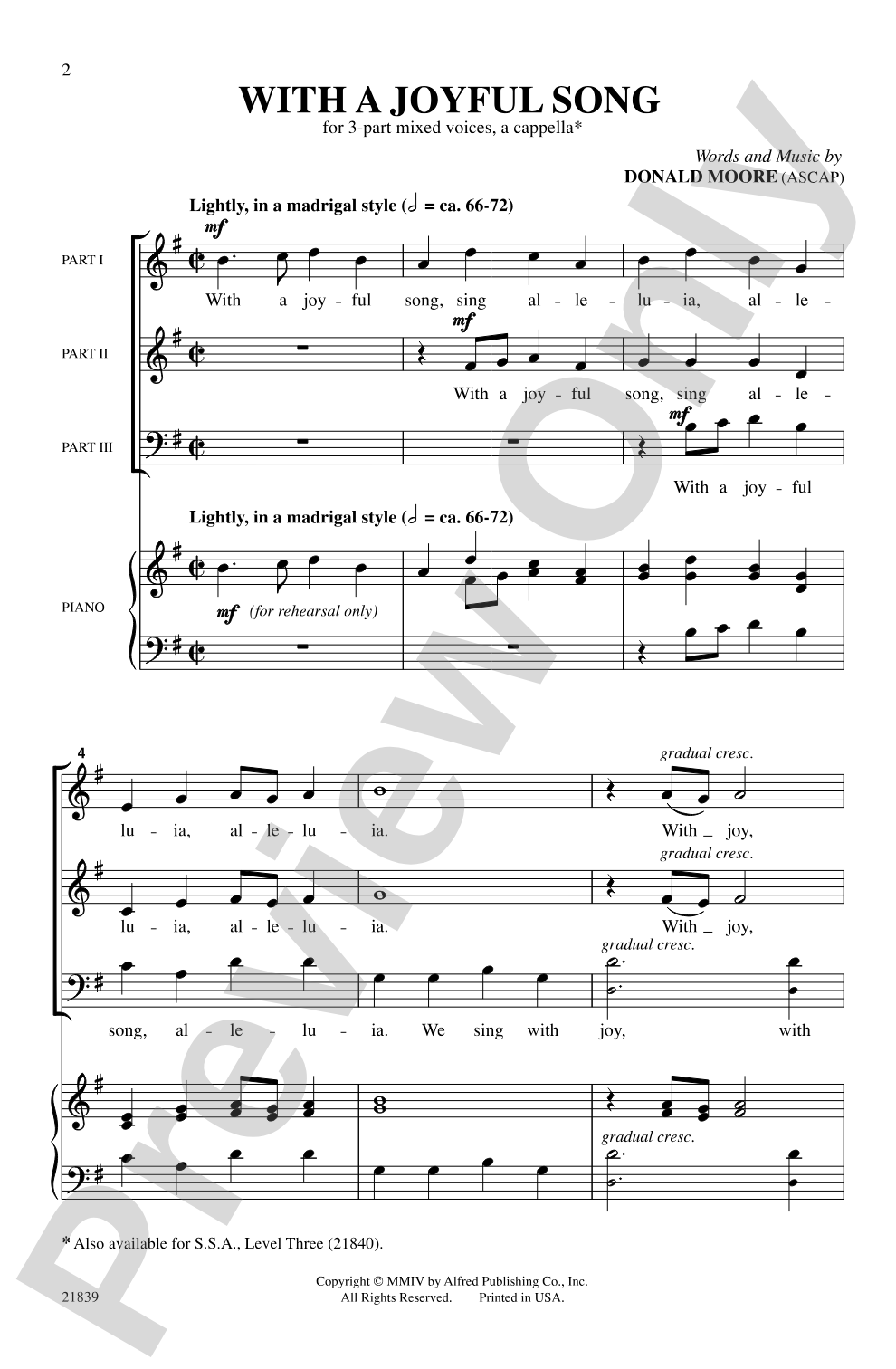
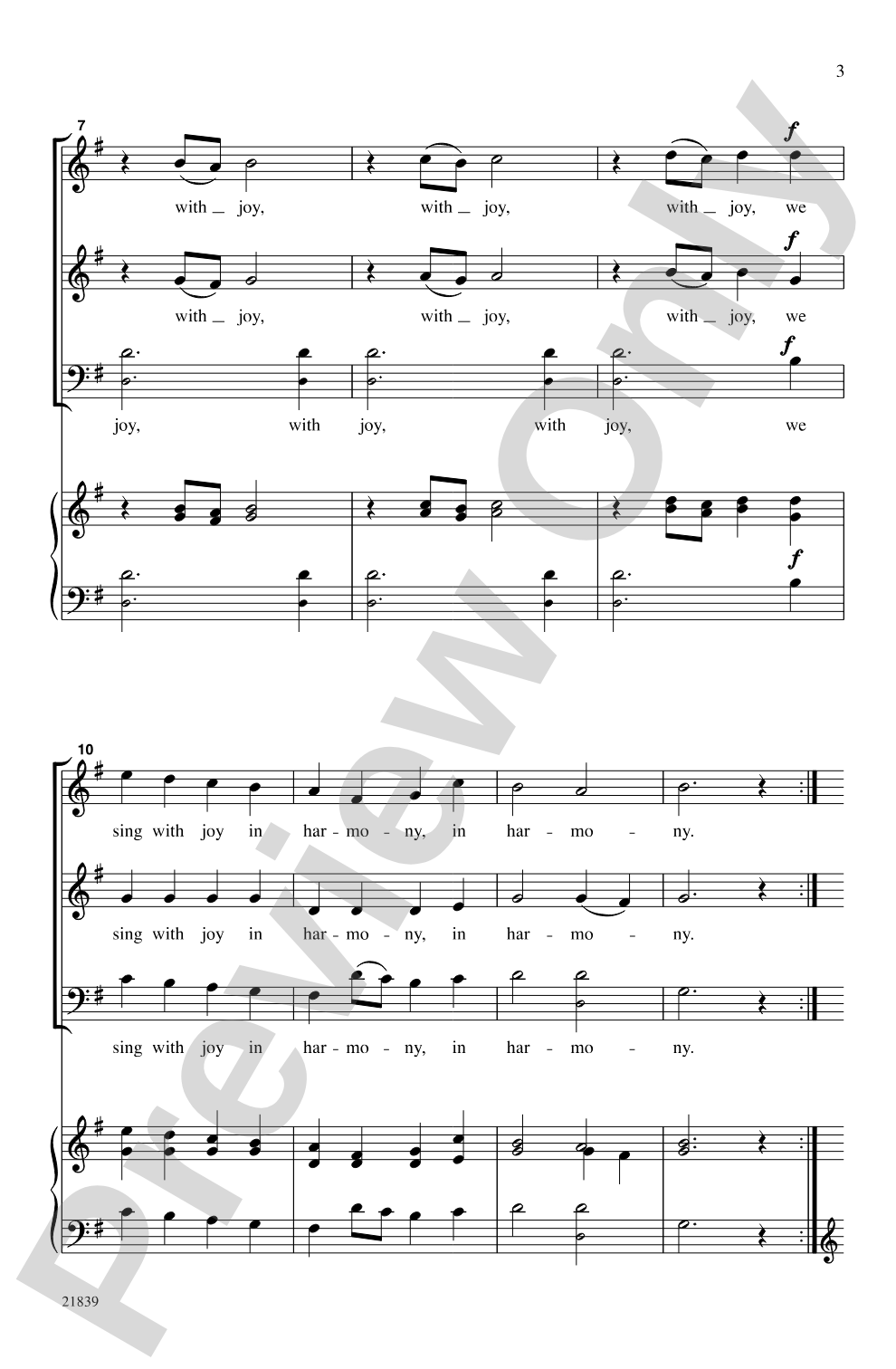
Look no further for a light madrigal to teach your three-part choir how to sing a cappella, and in tune. Donald Moore's With a Joyful Song will get the job done in a snap. It's so easy to learn and sing this charming and festive original. ABA form, modest vocal ranges, and simple intervals create an easy-to-achieve contrapuntal piece. Terrific as a first-of-its-type composition. Appropriate for general or seasonal use.


With a Joyful Song: 3-Part, a cappella Choral Octavo isn't in MakeMusic Cloud just yet...but it could be. Let us know you'd like to see it, and you'll help shape what comes next. In the meantime, start a free trial and dive into thousands of interactive titles your students can play along with today.
Request This Title
Tell us you want it.
Start Your Free Trial
Explore everything that's ready to play right now.
Sample Audio
1
Audio File
--:--
0:00
0:00
Sample Video
No sample videos found.
Additional Details
Series:
Alfred Choral Designs
Publisher:
Alfred Music
Page Count:
8
SKU:
00-PO-0007928
More about this title
About the Composer: Donald Moore

Donald Moore earned his Bachelor of Music in organ performance and Master of Arts in Teaching from Kent State University. He currently serves as Organist-Choirmaster at Pilgrim United Church of Christ in Cuyahoga Falls, Ohio, and has established himself as one of the most prolific composers in American choral music.
With over 500 published compositions across major publishers including Alfred Music, Hal Leonard, and Heritage Music Press, Moore's catalog spans sacred works, secular pieces, educational choral compositions, and instrumental music. His work has earned seventeen ASCAP Composers Standard Awards and regular performances at state and national music festivals. The American Choral Directors Association recently recognized him among 400 elite composers of historical significance in American choral music.
Why we love this
Moore writes with genuine understanding of what three-part choirs need: modest ranges, singable intervals, and genuine musical substance without complexity. The ABA structure gives students an architectural framework they can actually hear and remember, making this an ideal vehicle for teaching a cappella blend and tuning without the frustration of dense harmonic writing.
What to expect
Light-hearted and graceful, with the bounce of a Renaissance madrigal but the straightforward charm of a contemporary original. The text underscores joy without sentimentality, and the modest ranges let singers breathe comfortably while the simple intervals create satisfying harmonic moments.
Who it's for
Middle school through early high school choirs taking on a cappella singing for the first time, or any ensemble building foundational skills in blend and tuning. This works equally well in general music settings where you need accessible introduction to part singing or in church and seasonal concert programs.
How to get the most out of it
- Establish unison vowels before introducing parts. Have each section isolate their line, then layer parts one at a time so singers hear where they sit vertically.
- Mark the harmonic rhythm in rehearsal scores so singers recognize where vertical sonorities shift; this sharpens ensemble focus and intonation work.
- Record a sectional run-through early in the learning process. Hearing themselves without piano reference builds confidence and ear training simultaneously.
How to use it
Open a spring or holiday concert with this; its brief length and cheerful character make it an excellent warm-up that engages audiences immediately. It also sits naturally in an educational context where you're demonstrating ensemble technique, as the visible simplicity actually showcases clarity of part singing.
Skills your students will build
- Reading and singing SAB voicing with correct part independence
- Maintaining intonation in a cappella context without instrumental reference
- Recognizing and executing ABA form structure
- Blending vocal lines through attention to vowel consistency
- Singing simple melodic intervals with accuracy and control