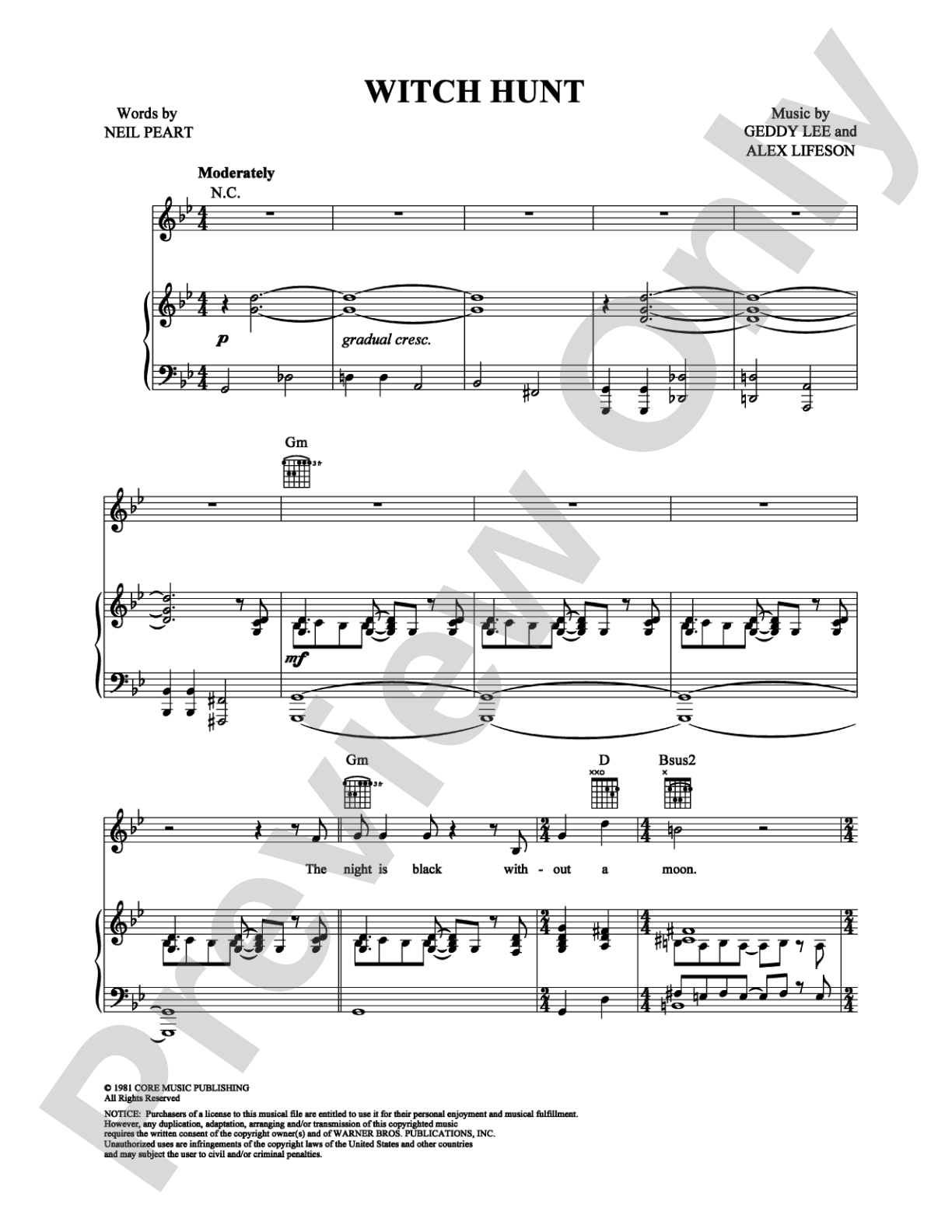
Witch Hunt: Piano/Vocal/Chords Digital Sheet Music

Witch Hunt: Piano/Vocal/Chords Digital Sheet Music

Rush, Geddy Lee, Alex Lifeson

Item: 00-PS-0003575

Digital Download
$3.99
Description

Witch Hunt: Piano/Vocal/Chords Digital Sheet Music isn't in MakeMusic Cloud just yet...but it could be. Let us know you'd like to see it, and you'll help shape what comes next. In the meantime, start a free trial and dive into thousands of interactive titles your students can play along with today.

Sample Audio
No sample audio found.
Sample Video
Additional Details
SKU: 00-PS-0003575

More about this title

About the Artist: Rush

Rush stands as one of progressive rock's most technically demanding and influential bands. Formed in Toronto in 1968, the trio of Geddy Lee, Alex Lifeson, and Neil Peart became known for virtuosic musicianship, complex compositional structures, and lyrics rooted in science fiction, philosophy, and social observation. Their catalog spans five decades and continues to inspire musicians across genres.

Why we love this

This arrangement captures one of Rush's most distinctive vocal moments, offering pianists and singers a chance to tackle genuinely interesting harmony and syncopation without oversimplifying the source material. The piece rewards careful attention to chord voicings and rhythmic precision, making it ideal for advanced students or adult musicians seeking repertoire that respects their intelligence.

What to expect

Propulsive and intellectually driven, the piece maintains an unsettling energy that matches its lyrical themes. The piano accompaniment moves restlessly beneath the vocal line, creating tension that never fully resolves, while the harmonic language pulls between major and minor tonalities in ways that feel both modern and deeply introspective.

Who it's for

This arrangement suits advanced pianists comfortable with jazz-influenced voicings and singers with solid upper range control and rhythmic maturity. It works equally well for music students exploring rock and pop arrangement techniques or for recital performers seeking contemporary material with real compositional substance.

How to get the most out of it

  • Pay close attention to the rhythmic feel; Rush's syncopation requires locking the vocal melody with the piano line so neither rushes ahead of the other.
  • Treat chord inversions as integral to the arrangement, not optional. The voice leading through these chords shapes the harmonic color throughout.
  • Balance the vocal line so it sits clearly above the accompaniment, especially in passages where the piano carries complex inner voices.
  • Experiment with articulation in the piano part to match the percussive quality of the original recording without losing legato where it serves the phrase.

How to use it

Program this in a set exploring how rock and progressive music extend traditional harmony and form. It pairs well with art songs or contemporary classical work that shares similar sophistication in texture and rhythmic language. Consider featuring it in a recital centered on 20th and 21st century repertoire or in a showcase highlighting student arrangements and interpretations of popular music.

Skills your students will build

  • Reading complex jazz-influenced chord voicings and inversions
  • Syncopated rhythm coordination between voice and piano
  • Harmonic analysis of modal and chromatic movement
  • Stylistic interpretation of rock and progressive rock idioms
  • Balance and blend when accompany singing with intricate piano lines

You May Also Like