Wish You Were Here Sheet Music Preview

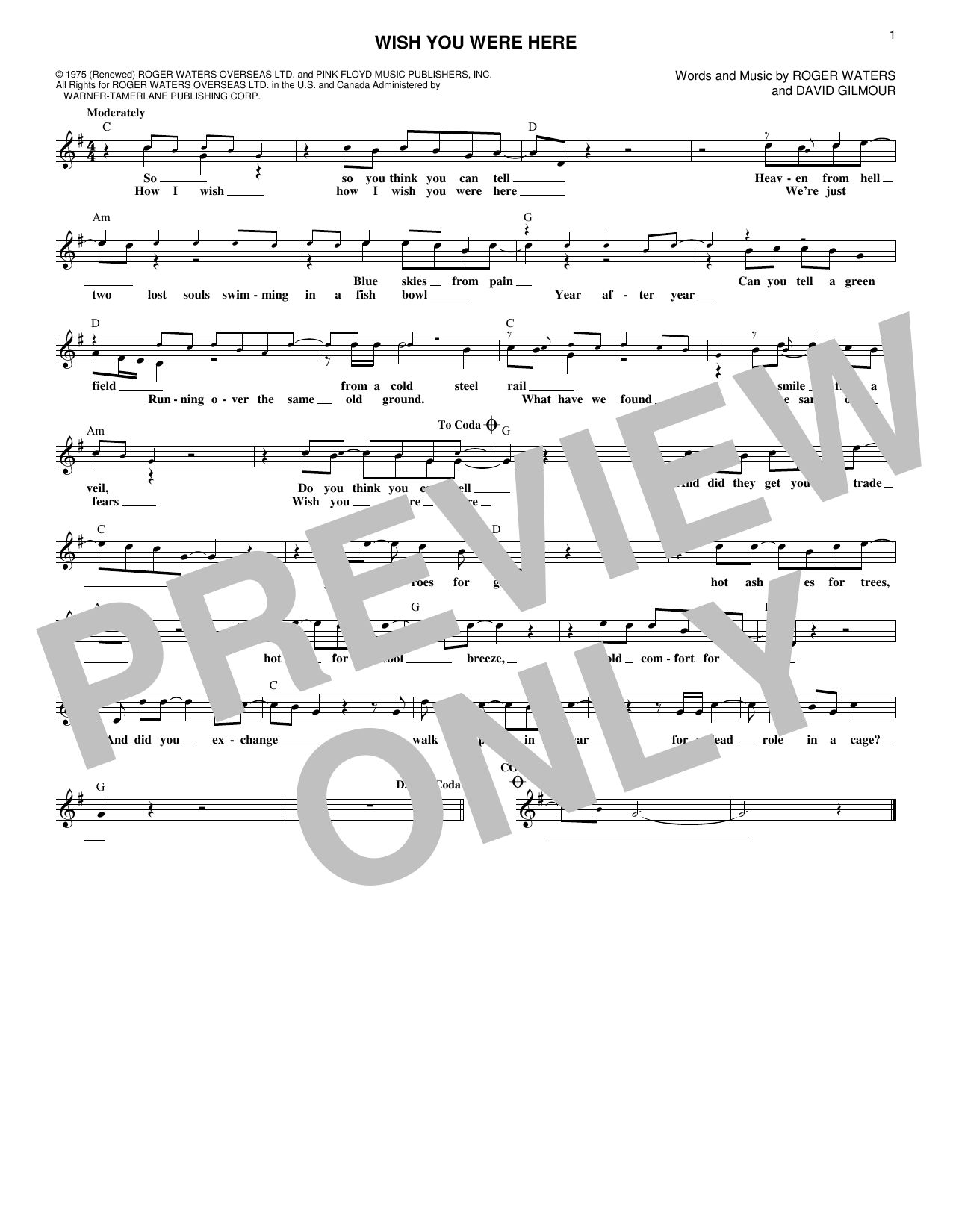
Wish You Were Here: Lead Sheet / Fake Book

As performed by Pink Floyd

Item: 35-DS00380520

Digital Download
$3.99
Description

Wish You Were Here: Lead Sheet / Fake Book isn't in MakeMusic Cloud just yet...but it could be. Let us know you'd like to see it, and you'll help shape what comes next. In the meantime, start a free trial and dive into thousands of interactive titles your students can play along with today.

Sample Audio
No sample audio found.
Sample Video
Additional Details
Publisher: Hal Leonard
Page Count: 1
SKU: 35-DS00380520

More about this title

About the Artist: Pink Floyd

Pink Floyd emerged from the late 1960s Cambridge psychedelic scene as one of rock's most innovative and philosophically ambitious bands. Their approach to songwriting, arrangement, and studio production fundamentally changed what rock music could express, blending complex harmonic thinking with emotional directness across four decades of recording.

Why we love this

This lead sheet captures one of rock's most poignant reflections on absence and memory in a format that lets students explore how sophisticated harmonic language works in a contemporary context. The straightforward melodic line paired with the underlying changes makes it ideal for understanding voice leading and jazz-inflected harmony outside the classical tradition.

What to expect

The piece inhabits a reflective, aching space; melancholy underscores every phrase without descending into sentimentality. The harmonic language suggests yearning and distance, anchored by a melody that stays with you long after playing.

Who it's for

Pianists and singers exploring contemporary songwriting with sophisticated harmonic vocabulary will find this lead sheet essential. It works equally well for students building improvisation skills or understanding how pop and rock songwriting can embrace extended chords and unexpected harmonic movements.

How to get the most out of it

  • Honor the rubato in the vocal line; the phrasing shouldn't feel metrically rigid, especially during the opening phrases.
  • Balance the accompaniment to support rather than compete with the melody, letting lyrical content drive the dynamic shape.
  • Experiment with different keyboard textures; sparse voicings often serve this song better than dense comping.
  • Pay attention to the harmonic rhythm; some changes sustain longer than others, which affects how you voice and voice-lead through transitions.

How to use it

Include this in a showcase spotlighting contemporary songwriting across genres, pairing it with classical or jazz selections to demonstrate how harmonic sophistication transcends stylistic boundaries. It also serves as a gateway for students who connect more readily with rock and pop repertoire but need exposure to advanced harmonic concepts.

Skills your students will build

  • Reading and interpreting lead sheet notation
  • Identifying and performing extended chord voicings (sevenths, ninths, suspended chords)
  • Understanding harmonic rhythm and phrase structure in popular music
  • Rubato and expressive timing in vocal performance
  • Accompanying skills with flexible, responsive comping

You May Also Like