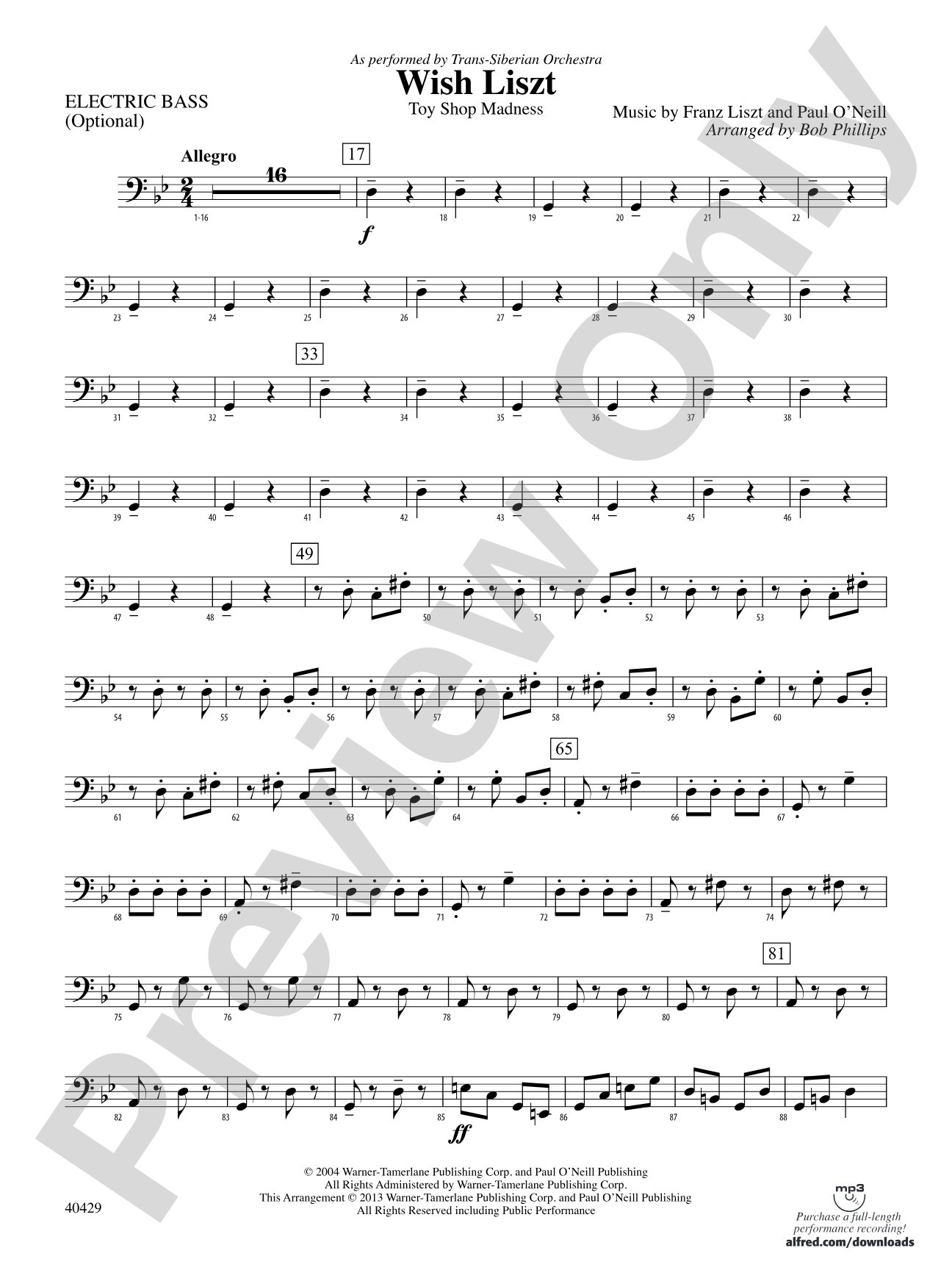
Wish Liszt: Electric Bass
Toy Shop Madness (As Performed by Trans-Siberian Orchestra)
Music by Franz Liszt and Paul O'Neill / arr. Bob Phillips
Grade: 3
Item: 00-PC-0015963_EB
Pickup currently not available
Description
Don't just read it, hear it, play along with it, and watch your students grow with it. In MakeMusic Cloud, Wish Liszt: Electric Bass comes alive with professional accompaniment, adjustable tempo, and built-in practice tools that turn solo practice into real progress.
Jump straight in and assign it today.
Open this title and explore the full library in minutes.
Sample Audio
Sample Video
Additional Details
More about this title
About the Composer: Franz Liszt
Franz Liszt (1811-1886) was a Hungarian virtuoso pianist and composer whose technical innovations and dramatic sensibilities shaped Romantic music across genres. His compositions ranged from transcendental piano works to symphonic poems and sacred music, all marked by harmonic daring and orchestral imagination. As an arranger and transcriber himself, Liszt understood how to reimagine existing music for different ensembles without losing its essential character.
In this arrangement, Liszt's original harmonic language and melodic gift provide the foundation for a contemporary holiday treatment. His influence on music education remains profound: educators recognize his works as models for developing musicianship, technical facility, and interpretive depth across all instrument families.
Why we love this
Bob Phillips transforms a classical masterwork into something your string students will actually want to play. The piece balances technical demands (hooked bowings, articulation precision) with the kind of energy that makes a holiday concert feel current and engaging, not nostalgic. Grade 3 orchestras rarely get material this musically substantial paired with this much textural and rhythmic variety.
What to expect
Soaring and contemporary, this arrangement channels the lyrical strength of Liszt's original while moving with the drive of a modern rock sensibility. There's a brightness to the orchestration that feels celebratory without being saccharine, and enough textural layers to keep every voice engaged throughout.
Who it's for
String orchestras at the Grade 3 level looking for repertoire that's musically credible and energetically engaging for winter concerts. Directors who want to program something substantial without abandoning the modern, accessible sound that students and audiences respond to.
How to get the most out of it
- Isolate the hooked bowing passages in sectional rehearsals until they feel natural rather than technical; students should hear the articulation as part of the musical phrase, not a finger exercise.
- If adding rhythm section and electric instruments, anchor your rehearsal process around a clean string section first, then layer in the additional colors without letting it overtake the melodic line.
- Shape the dynamic arc across the full 3 minutes and 35 seconds; this piece has enough textural movement that pacing and breath prevent it from feeling static.
- Bring attention to intonation in the lower strings when they support the higher melodic material; the contemporary harmonic context demands precision that's easy to overlook in a pop arrangement.
How to use it
Place this in the second half of your winter concert as an upbeat centerpiece that bridges classical literacy with popular appeal. It works equally well standing alone or paired with lighter choral or instrumental fare, and its 3:35 duration gives your program breathing room without a long set.
Skills your students will build
- Hooked bowings and articulation control
- Balancing rhythmic precision with lyrical phrasing in contemporary arrangements
- Intonation in fast-moving harmonic contexts
- Part independence when rhythm section and electric instruments are layered in
- Dynamics and textural awareness across a full orchestration