
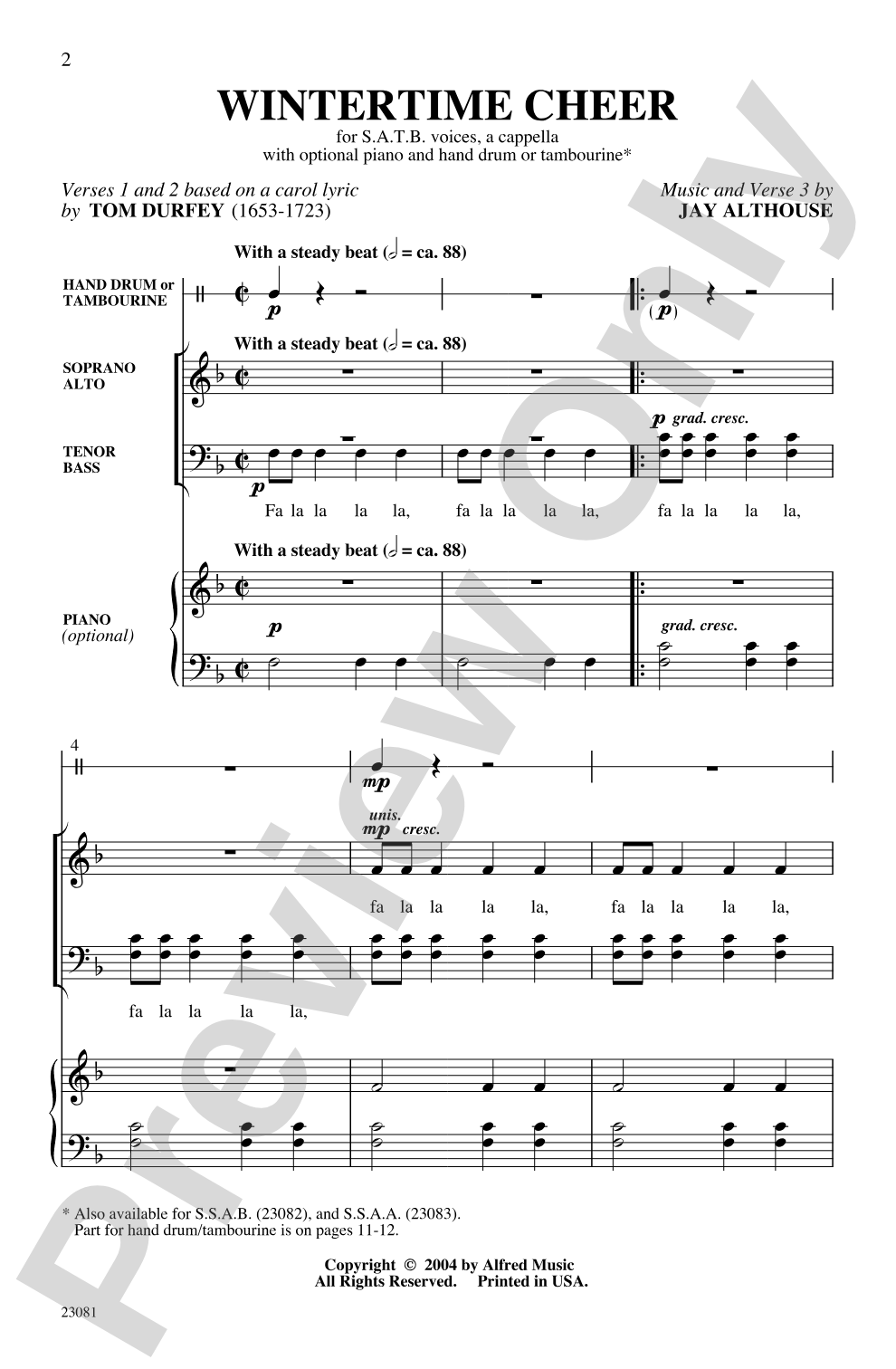
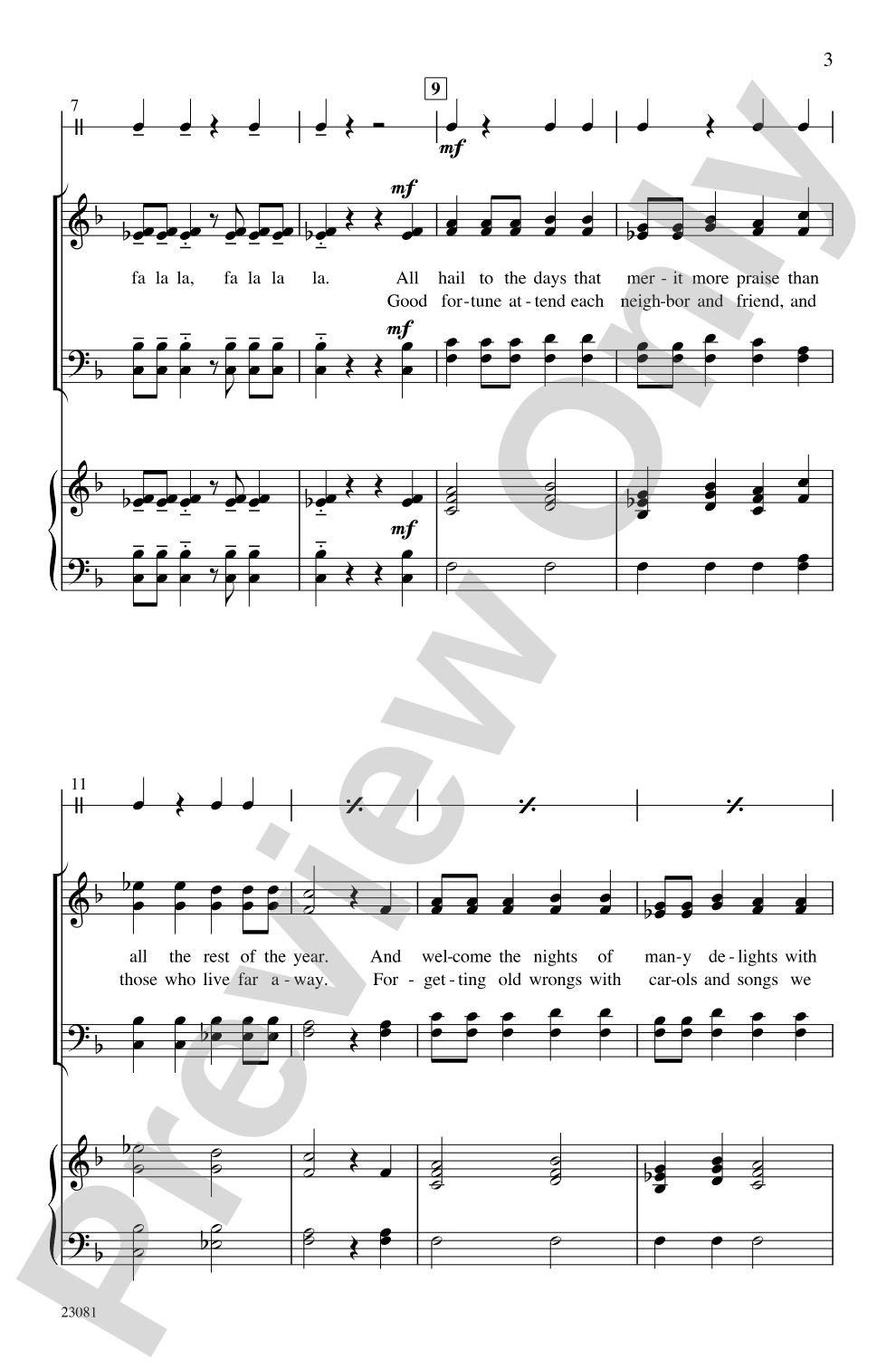
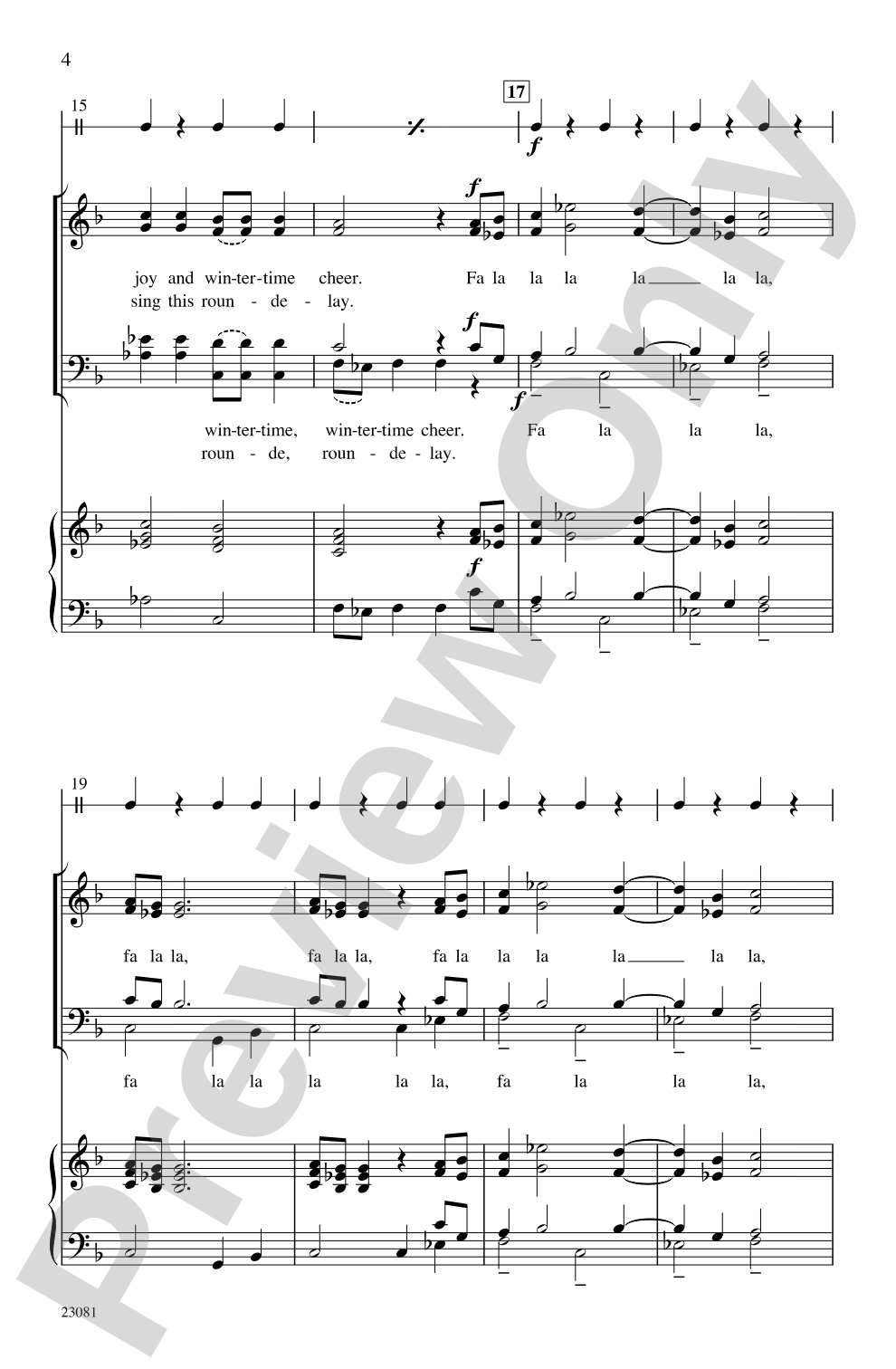

Wintertime Cheer: SATB, a cappella Choral Octavo
Music by Jay Althouse
Item: 00-PO-0006536
$1.65
Minimum order quantity: 20 copies
Pickup currently not available
Description
A contemporary a cappella madrigal. Filled with traditional "fa la la's" and resonant modern chords, Wintertime Cheer even includes a part for optional hand drum or tambourine. Jay Althouse's setting of a text by 17th century poet Tom Durfey mixes a historic musical form with crisp, up-to-date composition techniques. Interesting choral textures, and surprising tonal dissonances. Several four-part arrangements to choose from.


Wintertime Cheer: SATB, a cappella Choral Octavo isn't in MakeMusic Cloud just yet...but it could be. Let us know you'd like to see it, and you'll help shape what comes next. In the meantime, start a free trial and dive into thousands of interactive titles your students can play along with today.
Request This Title
Tell us you want it.
Start Your Free Trial
Explore everything that's ready to play right now.
Sample Audio
1
Audio File
--:--
0:00
0:00
Sample Video
No sample videos found.
Additional Details
Series:
Alfred Choral Designs
Publisher:
Alfred Music
Page Count:
12
SKU:
00-PO-0006536
Instrumentation:
Opt. Hand Drum or Tambourine
More about this title
About the Composer: Jay Althouse

Jay Althouse holds degrees in Music Education and Music from Indiana University of Pennsylvania, where he was recognized with the Distinguished Alumni award. His career spans both publishing and composition; he spent eight years managing rights and licenses for a major educational music publisher and served on the Executive Board of the Music Publishers Association of America. As a composer, he has accumulated more than 800 published works for choirs across all levels, with his music performed widely throughout English-speaking countries.
Althouse is an ASCAP member and a frequent recipient of the ASCAP Special Award for his compositions. Beyond individual choral pieces, he has collaborated with his wife Sally K. Albrecht on children's musicals and vocal collections, and co-authored influential pedagogical resources including The Complete Choral Warm-up Book and Accent on Composers. He served on the board of the North Carolina Master Chorale and presently contributes to the National Advisory Board of the Folk Art Society of America.
Why we love this
Althouse threads a needle that rarely gets threaded this cleanly: he honors the madrigal's playful spirit and structural traditions while composing with genuine harmonic sophistication. The "fa la la's" ground singers in a form they recognize, but the modern chord language keeps ears engaged and prevents pastiche. The optional percussion part gives your ensemble a clean way to add texture without requiring a full instrumental group.
What to expect
Wintertime Cheer occupies a distinct middle ground between nostalgia and innovation. The traditional madrigal framework and text-painting invite warmth and familiarity, while crisp modern harmonies introduce just enough edge to feel current and alive. The piece balances joy with sophistication, allowing singers to connect with both the historical tradition and the composer's fresh harmonic voice.
Who it's for
Intermediate to advanced high school and college choirs seeking a cappella repertoire with intellectual substance and seasonal relevance. Directors who want their singers to experience both historic form and contemporary composition techniques in a single piece will find this particularly rewarding.
How to get the most out of it
- Balance the "fa la la" refrains carefully so they land as punctuation rather than drowning out text in the verse sections. These moments should feel conversational, not ceremonial.
- If you include the hand drum or tambourine part, treat it as a textural layer that enters strategically. It should enhance ensemble blend, not compete for attention.
- Shape the modern harmonic moments with intention. The surprising tonal dissonances work best when each voice sings with clear tone and sustained intensity, allowing the color to register fully.
How to use it
Program this as a conversation between Renaissance and contemporary aesthetics on a concert that mixes periods or styles. It pairs naturally with other madrigals or folk-based choral works, or it can stand alone as a winter concert centerpiece that surprises audiences expecting purely traditional holiday fare. The optional percussion makes it flexible for both concert and more casual performance settings.
Skills your students will build
- Reading mixed harmonic language combining traditional voice-leading with contemporary chord structures
- Shaping madrigal text and interpretive phrasing within a historical form
- Balancing four-part blend while navigating chromatic and unexpected harmonic movement
- Ensemble coordination in a cappella performance without instrumental support
- Optional: percussion ensemble integration for singers not performing as soloists