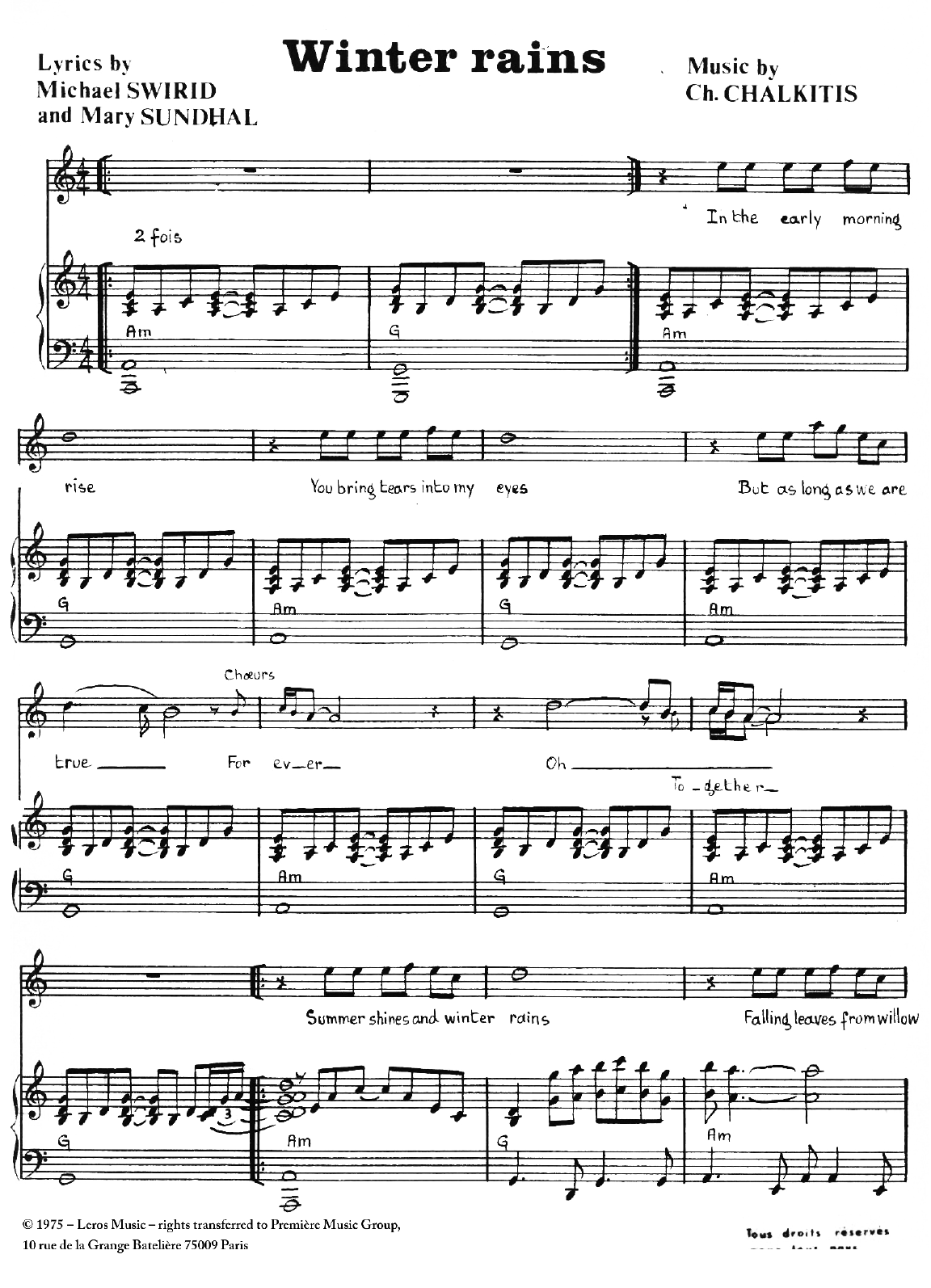
Demis Roussos was a Greek-born singer whose rich baritone voice and expressive phrasing made him one of the most recognizable vocalists of the 1970s and 1980s. His interpretations of popular standards and ballads demonstrated a sophisticated approach to melodic storytelling, blending classical training with contemporary sensibility. For singers and pianists studying vocal literature, Roussos's recordings offer valuable lessons in sustained legit singing and emotional restraint.
Why we love this
Roussos brings an unhurried elegance to this ballad that rewards singers who resist oversinging. The piano part sits comfortably for accompanists while remaining musically substantive, making this a genuine duet rather than a vocalist-plus-accompaniment scenario.
What to expect
The piece carries the reflective quality of rain observed from a distance; there is melancholy present, but it arrives quietly rather than insistently. The vocal line unfolds with the unhurried pacing of someone allowing emotion to surface gradually.
Who it's for
Vocalists and pianists in advanced community and semi-professional ensembles who want to explore the standard repertoire beyond jazz idioms. This works equally well for singers preparing art song recitals and for piano teachers seeking quality vocal literature with accessible accompaniment.
How to get the most out of it
Establish the vocal line's long-line phrasing in early rehearsals before addressing breath placement. This melody unfolds gradually, and the pianist benefits from understanding the vocal arc before locking into rhythm section duties.
Balance the piano's textural role carefully. The accompaniment should support rather than compete with the voice, particularly in the opening phrases where atmospheric quality matters.
Sing through dynamic peaks without rushing. Roussos's recorded interpretation demonstrates how restraint and forward motion coexist; avoid the trap of treating loudness as emotional intensity.
How to use it
Place this early in a recital program featuring contemporary standards and ballads, where its introspective character prepares listeners for what follows. The four pages make it substantial enough to anchor a solo set without overwhelming shorter art song groupings.
Skills your students will build
Sustaining long vocal lines without excessive vibrato or tonal shaping
Collaborative listening between vocalist and pianist in non-jazz vocal literature
Managing emotional expression through dynamic and tempo control rather than interpretive excess
Reading and performing straightforward harmonic progressions in a classical vocal context
You May Also Like
Scan to Complete Your Purchase
Use your phone's camera to scan the code below
You'll log in on your phone and the order will be added to your account