

Winter Rhapsody: Piano
By Dennis Alexander
Level: Late Intermediate
Item: 00-PS-0017738
$4.99
Pickup currently not available
Related Items
Winter Rhapsody: Piano Sheet |
$4.99
|
View |
Description
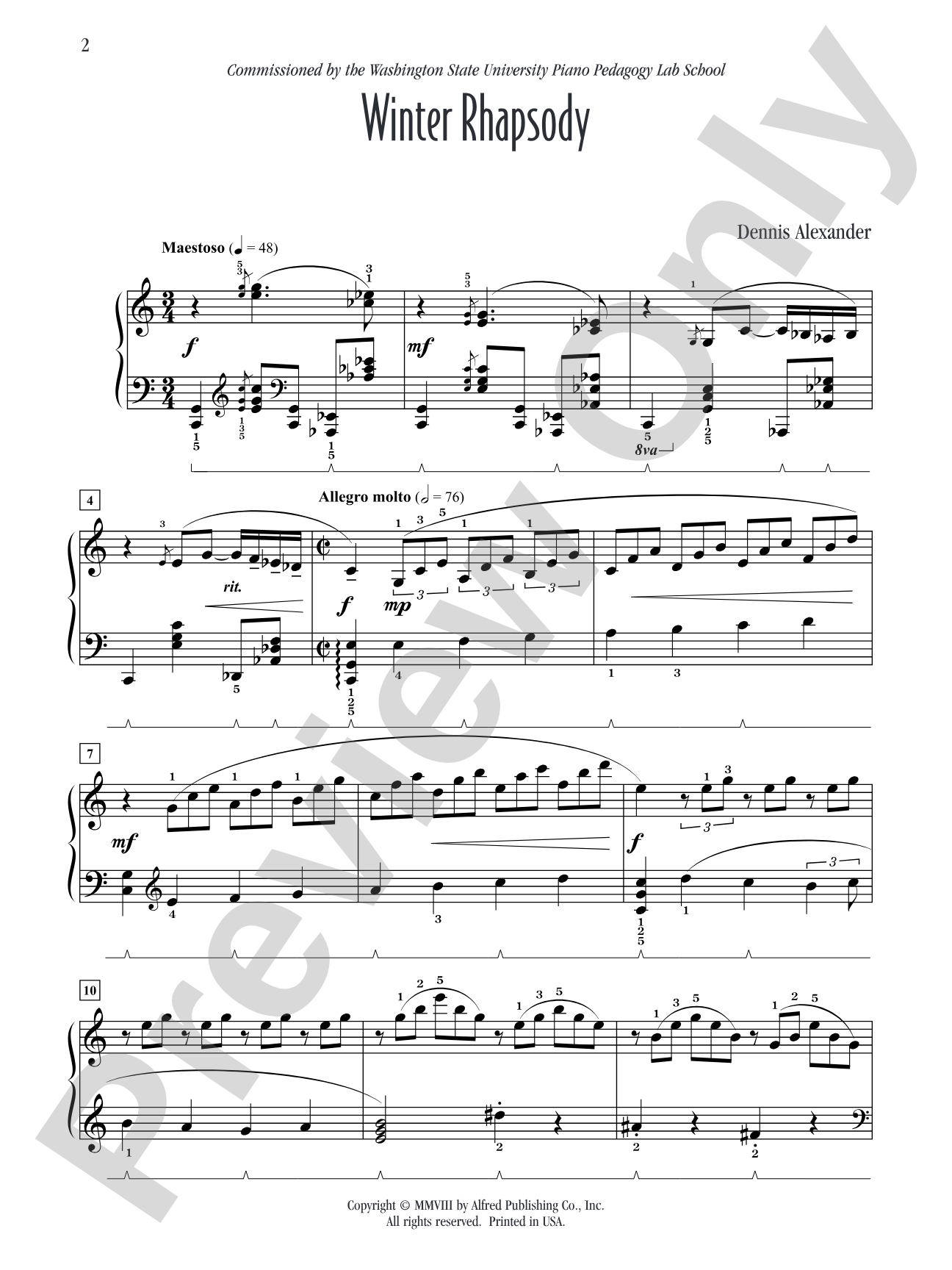
The maestoso opening of this solo in 3/4 meter leads to an allegro molto tempo. From there, the piece takes off on a wild chase using triplet arpeggios, chromatic scales and ostinato patterns until it returns to the maestoso section in the final four measures. Don't be fooled by the C major key signature---there are many accidentals and chromatic passages, yet they fall comfortably within the hand. This is definitely a show-stopper and is destined to be a favorite on recitals and contest lists.


Winter Rhapsody: Piano isn't in MakeMusic Cloud just yet...but it could be. Let us know you'd like to see it, and you'll help shape what comes next. In the meantime, start a free trial and dive into thousands of interactive titles your students can play along with today.
Request This Title
Tell us you want it.
Start Your Free Trial
Explore everything that's ready to play right now.
Sample Audio
1
Audio File
--:--
0:00
0:00
Sample Video
No sample videos found.
Additional Details
Series:
Signature Series
Publisher:
Alfred Music
Page Count:
8
SKU:
00-PS-0017738
More about this title
About the Composer: Dennis Alexander

Dennis Alexander stands among the most published composers of educational piano literature, having created over 400 works since joining Alfred Music Publishing in 1986. His career spans five decades of teaching, performing, and composing, including 24 years as a piano pedagogy instructor at the University of Montana and subsequent faculty positions at Cal State Fullerton and Cal State Northridge. Alexander earned his own training at the University of Kansas under Richard Reber and made his Carnegie Recital Hall debut in 1987 as a soloist and collaborative musician.
Beyond the studio and concert hall, Alexander has served as a clinician at state and national music teachers conventions and judged international competitions. He has toured extensively throughout Southeast Asia and beyond, performing recitals and leading workshops. Currently based in Albuquerque, New Mexico, he maintains an active schedule of composition and performance for Alfred Music Publishing, with numerous commissions from organizations and state associations shaping his catalog over the years.
Why we love this
Winter Rhapsody delivers the dramatic arc students crave without requiring technical facility beyond late intermediate grasp. The structural clarity, maestoso bookend around an energetic middle section, gives the piece theatrical shape, while the chromatic writing and arpeggiated passages feel adventurous even though they sit securely under the hand. This reads as a genuine recital moment, not a study disguised as a piece.
What to expect
Winter Rhapsody opens with measured grandeur, then shifts into exhilarating motion as rapid figures chase across the keyboard. The triplet arpeggios and chromatic runs create a sense of energy and restlessness before the music returns to its dignified opening character, creating a satisfying sense of closure. Throughout, the piece balances introspection with virtuosity, making it equally suited to intimate recitals and competitive stages.
Who it's for
Late intermediate pianists preparing for recitals or competitions who thrive on repertoire with clear dramatic arcs and technical substance. This piece appeals to students ready to handle harmonic complexity and varied tempos within a single work, and to teachers seeking a showpiece that sounds far more advanced than its level suggests.
How to get the most out of it
- Balance the opening maestoso with breadth and weight in the tone; this isn't merely a transition but an anchor for the entire piece. Return to this character with the same deliberation in the final four measures.
- Let the triplet arpeggios and chromatic scales flow with rhythmic precision rather than raw speed. The piece's momentum comes from clarity and articulation, not tempo alone.
- Map the ostinato patterns carefully during practice so they become physical muscle memory; this frees your attention for dynamic shaping and voicing adjustments in the surrounding material.
- Mark the accidentals and chromatic passages in your score before performance week. Even though they lie comfortably in the hand, knowing exactly where they occur prevents hesitation under stage pressure.
How to use it
This is an ideal closer for a student recital, particularly one structured around seasonal themes or concert series. Its eight pages and intermediate-to-advanced difficulty make it a strong anchor for a mixed program of Baroque, Classical, and contemporary works. It also serves well as a contest selection where judges expect strong technique alongside musicianship.
Skills your students will build
- Reading and performing chromatic passages and accidentals in a predominantly diatonic key
- Executing triplet arpeggios with rhythmic precision and hand position efficiency
- Managing tempo contrast between maestoso and allegro molto sections
- Shaping ostinato patterns without losing forward momentum
- Balancing technical display with musical phrasing and structural awareness