
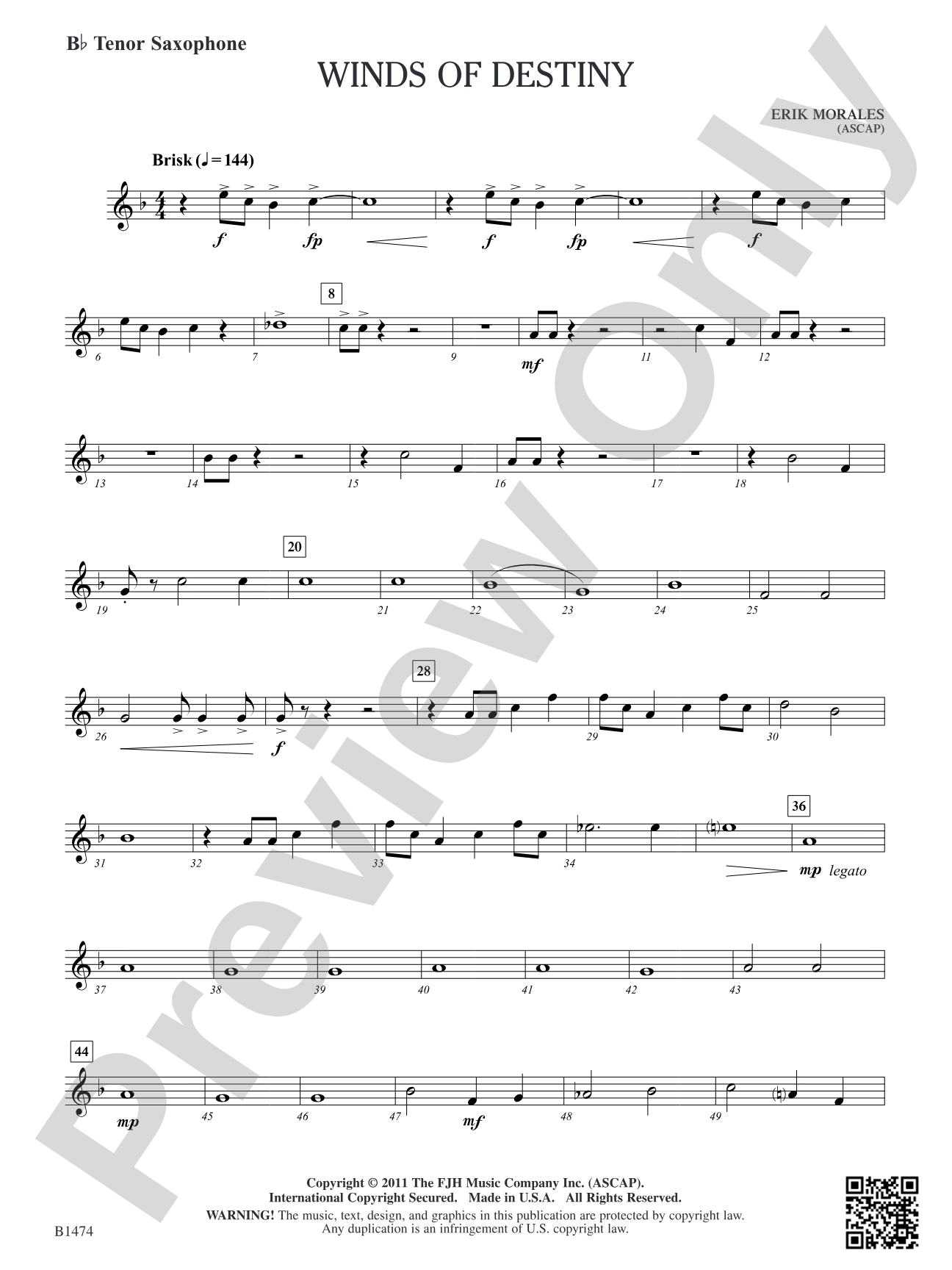

Winds of Destiny: B-flat Tenor Saxophone
By Erik Morales
Grade: 2
Item: 98-PC-DB1474_TX1
$7.00
Pickup currently not available
Description
Inspired by a modern turbine wind farm, this excellent concert overture is extremely effective and accessible. Interesting effects recreate the sound of gusting winds moving from one side of the stage to the other. A wonderful way to incorporate an overture-style work on your program without having to resort to the generic overture form or sound!


Winds of Destiny: B-flat Tenor Saxophone isn't in MakeMusic Cloud just yet...but it could be. Let us know you'd like to see it, and you'll help shape what comes next. In the meantime, start a free trial and dive into thousands of interactive titles your students can play along with today.
Request This Title
Tell us you want it.
Start Your Free Trial
Explore everything that's ready to play right now.
Sample Audio
1
Audio File
--:--
0:00
0:00
Sample Video
No sample videos found.
Additional Details
Series:
FJH Young Band
Publisher:
The FJH Music Company, Inc.
SKU:
98-PC-DB1474_TX1
More about this title
About the Composer: Erik Morales

Erik Morales has shaped the landscape of educational wind music for over two decades. Born in New York City in 1966, he began his composing career as a high school marching band arranger in south Florida in 1985, work that opened the door to educational publishing. He holds degrees from Florida International University and the University of Louisiana, Lafayette, and studied composition while developing his craft across wind, orchestral, jazz, and chamber settings.
With more than 150 published works, Morales has built a reputation for balancing artistic substance with pedagogical accessibility. His trumpet works have earned multiple awards at the National Trumpet Competitions, and his concert and ensemble pieces are performed regularly in schools and festivals nationwide. He was inducted into the Louisiana Association for Jazz Education's Hall of Fame in 2016, recognition of his sustained impact on music education and the wind band repertoire.
Why we love this
Morales sidesteps the predictable overture formula without sacrificing impact or accessibility. The concept of spatial wind effects moving across the stage is genuinely creative; students experience how ensemble placement and dynamics can create illusion and drama, all within reach of a Grade 2 band. It's the kind of piece that makes audiences sit forward in their seats while your ensemble learns something real about storytelling through sound.
What to expect
The piece conjures the image of wind turbines turning steadily across a landscape, with gusts of air sweeping from section to section. It's dynamic without being chaotic, modern without sounding cold, and maintains genuine momentum from start to finish. The orchestration sparkles in places and builds to genuine dramatic peaks, all while remaining transparent enough for a developing ensemble to shape convincingly.
Who it's for
Concert bands at the Grade 2 level looking for engaging repertoire that goes beyond standard overture fare. Ensembles preparing for festival or contest programming will find a piece that sounds more sophisticated than its difficulty level suggests, giving students room to focus on ensemble blend and expressive conducting rather than wrestling with technical demands.
How to get the most out of it
- Balance the panned wind effects carefully during rehearsal. Map out which sections carry the effect at each moment so players understand they're creating a visual and sonic journey, not just playing their notes.
- Encourage precise dynamic control in passages where the wind effect moves. Crispness in the attacks and releases will make the illusion of movement far more convincing to listeners.
- Use the full stage depth if possible. Even a modest concert setup benefits from subtle positioning that reinforces the left-to-right motion Morales builds into the score.
- Let your percussion section anchor the rhythmic foundation. Clear, confident support from timpani and bass drum gives the wind section freedom to shape the more delicate transitions.
How to use it
Program this as the centerpiece of an overture or opening slot to set an energetic, contemporary tone for your concert. It pairs well alongside traditional concert fare or lighter baroque arrangements since it signals something forward-thinking without requiring extended rehearsal time from your ensemble. For festivals or competitions, it demonstrates musical sophistication at an accessible technical level.
Skills your students will build
- Ensemble balance across distributed sections
- Dynamic shaping and control of phrased wind effects
- Reading and executing spatial or positional cues in the score
- Ensemble responsiveness to subtle conducting gestures that create musical contrast