
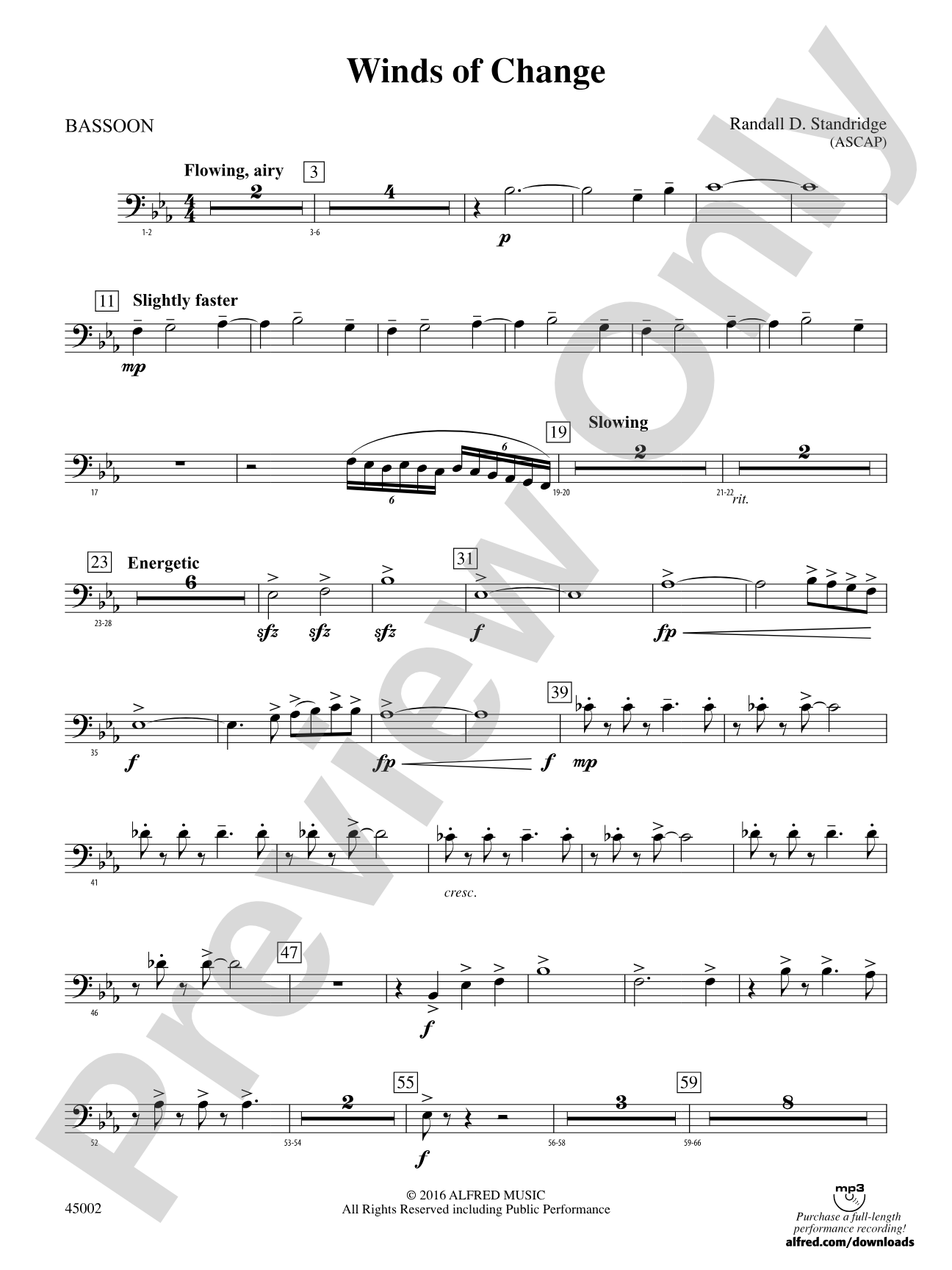

Winds of Change: Bassoon
By Randall D. Standridge
Grade: 3.5 (Medium)
Item: 00-PC-0017467_B1
$3.00
Pickup currently not available
Description
In recent years, Oklahoma has seen a great increase in the development of wind energy. This development in sustainable energy sources and the winds that flow across the great state serve as the inspiration for this composition. The piece begins by depicting the great open spaces that stretch for miles across the Oklahoma landscape. Small gusts of wind (represented by scalar and arpeggiated passages in the mallets and woodwinds) dance across the landscape. The piece picks up pace as the wind races across the land, turning the turbines and charging towards the future. (5:30)


Don't just read it, hear it, play along with it, and watch your students grow with it. In MakeMusic Cloud, Winds of Change: Bassoon comes alive with professional accompaniment, adjustable tempo, and built-in practice tools that turn solo practice into real progress.
Open in the Player
Jump straight in and assign it today.
Start Your Free Trial
Open this title and explore the full library in minutes.
Sample Audio
1
Audio File
--:--
0:00
0:00
Sample Video
Additional Details
Series:
Alfred Concert Band
Publisher:
Alfred Music
Page Count:
316
SKU:
00-PC-0017467_B1
More about this title
About the Composer: Randall D. Standridge
Randall D. Standridge is a prolific composer for concert band and wind ensemble whose works have become standard repertoire in school and university programs across the United States. His compositions span a wide range of themes and styles, from programmatic works inspired by landscape and culture to abstract concert pieces that challenge ensemble musicianship at multiple levels.
Standridge's writing is known for clarity of orchestration, accessibility across ability levels, and strong musical narratives that engage both performers and audiences. His pieces have been widely performed at festivals, contests, and concert halls, and his contributions to band literature have made him a respected voice in contemporary wind music education.
Why we love this
Standridge captures a specific sense of place and motion without resorting to thin pictorialism. The program unfolds through clear musical development: the opening evokes open landscape, then builds genuine momentum as wind imagery turns into forward propulsion. The orchestration sits naturally under the hands at this level, meaning you're building ensemble blend and phrasing, not wrestling with awkward voice leading.
What to expect
The piece opens with the quiet vastness of the high plains, where space itself becomes a character. Energy gradually accumulates as wind passages build and interweave, creating a sense of natural forces gathering momentum. By the final section, what began as gentle gusts has become an unstoppable surge toward something new.
Who it's for
Conductors programming a concert band at the Grade 3.5 level who want a substantial piece with both artistic substance and genuine narrative arc. This work rewards ensembles that have solid fundamentals in intonation, ensemble balance, and sustained phrasing but don't yet need extreme technical demands to stay engaged.
How to get the most out of it
- Balance the scalar and arpeggiated passages in mallets and woodwinds during the opening section so they land as delicate color rather than rhythmic fussiness. These gusts should feel like they're floating across the landscape.
- Shape the accelerating sections with clear weight changes in dynamics and articulation. As the wind picks up, the ensemble's energy should rise organically, not through louder playing alone.
- Let the transition to the faster material breathe slightly before committing to the forward momentum. The contrast between stillness and motion is what makes the narrative land.
- Use the conductor's score to study how Standridge voices the themes across the band. The doubling and layering will show you where the musical center lives at any given moment.
How to use it
This works beautifully as a centerpiece concert piece that programs well alongside both lighter fare and heavier contemporary works. The Oklahoma connection and environmental theme also make it ideal for community pops concerts or thematic programs exploring regional music and identity.
Skills your students will build
- Balancing transparent orchestration across mixed instrument families
- Shaping long-lined phrases that build momentum and energy
- Executing scalar and arpeggiated passages with consistent rhythmic clarity
- Responding to programmatic direction through ensemble color and dynamic shape
- Reading mixed meter and shifting tempos while maintaining ensemble cohesion