
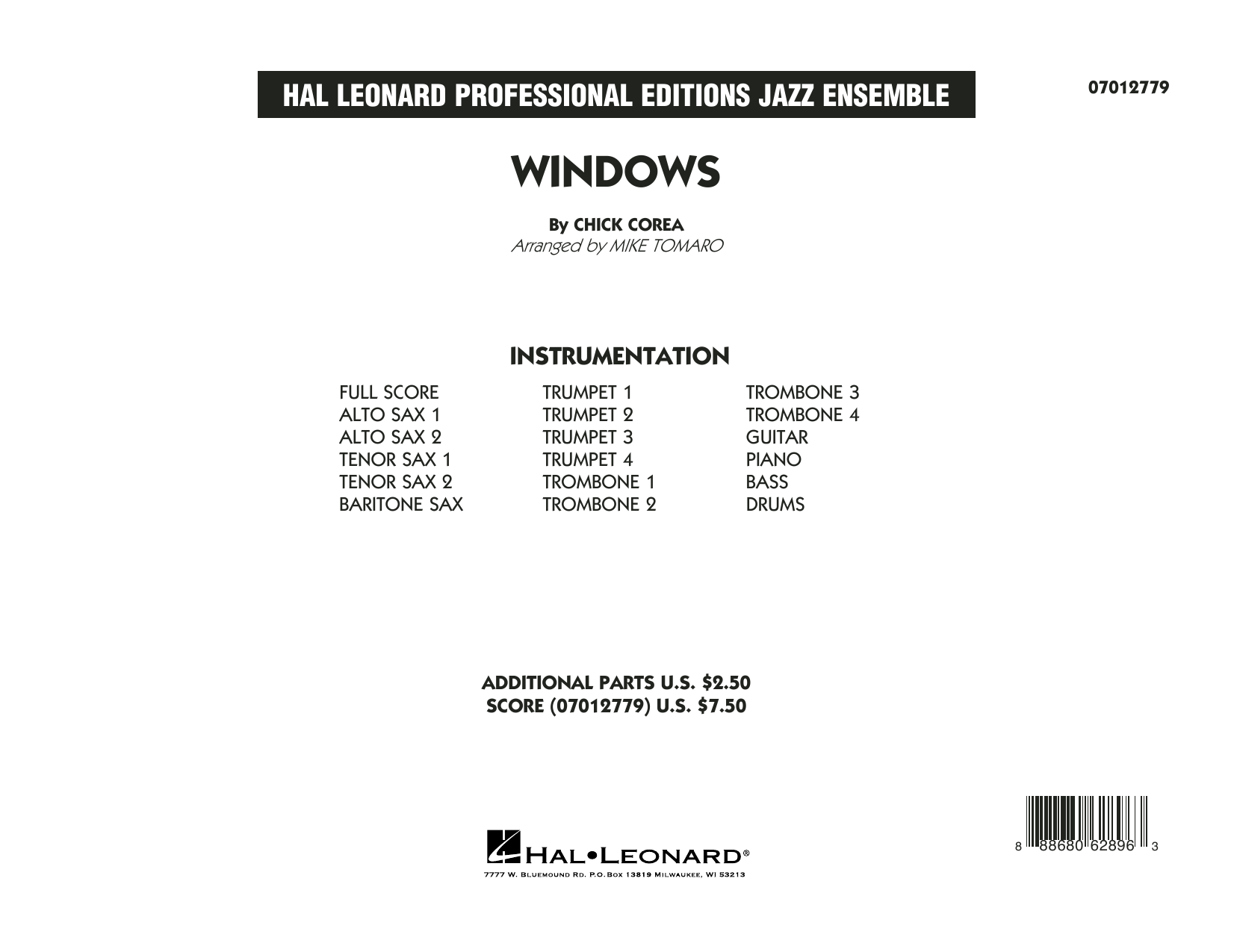

Windows: Jazz Ensemble Conductor Score & Parts
As performed by Chick Corea / As performed by Chick Corea Elektric Band / Arranged by Mike Tomaro
Grade: 4
Item: 35-PK00345464
$60.00
Pickup currently not available
Buy Extra Parts (Digital PDF Download)
| Product | Price | Quantity |
|---|---|---|
| Windows - Conductor Score (Full Score) | $7.50 | |
| Windows - Alto Sax 1 | $6.00 | |
| Windows - Alto Sax 2 | $6.00 | |
| Windows - Tenor Sax 1 | $6.00 | |
| Windows - Tenor Sax 2 | $6.00 | |
| Windows - Baritone Sax | $6.00 | |
| Windows - Trumpet 1 | $6.00 | |
| Windows - Trumpet 2 | $6.00 | |
| Windows - Trumpet 3 | $6.00 | |
| Windows - Trumpet 4 | $6.00 | |
| Windows - Trombone 1 | $6.00 | |
| Windows - Trombone 2 | $6.00 | |
| Windows - Trombone 3 | $6.00 | |
| Windows - Trombone 4 | $6.00 | |
| Windows - Guitar | $6.00 | |
| Windows - Piano | $6.00 | |
| Windows - Bass | $6.00 | |
| Windows - Drums | $6.00 |
Parts Added to Cart!
Description
This early composition by Chick Corea features a jazz waltz in a breezy medium tempo. Even in this standard jazz form you can hear Chick's unique twists and turns in this iconic jazz standard. Beautifully adapted by Mike Tomaro for full jazz ensemble.


Windows: Jazz Ensemble Conductor Score & Parts isn't in MakeMusic Cloud just yet...but it could be. Let us know you'd like to see it, and you'll help shape what comes next. In the meantime, start a free trial and dive into thousands of interactive titles your students can play along with today.
Request This Title
Tell us you want it.
Start Your Free Trial
Explore everything that's ready to play right now.
Sample Audio
No sample audio found.
Sample Video
No sample videos found.
Additional Details
Publisher:
Hal Leonard
SKU:
35-PK00345464
More about this title
About the Artist: Chick Corea
Chick Corea stands as one of jazz's most restless innovators, equally comfortable with acoustic piano trios, electric fusion ensembles, and straight-ahead bebop contexts. His harmonic sophistication and relentless curiosity shaped multiple generations of jazz musicians, and his willingness to explore new sonic territory without abandoning melodic clarity made him a singular voice in the music.
Corea's work with the Elektric Band brought fusion sensibilities into live ensemble settings, blending electric textures with the kind of compositional specificity that makes arrangements like Windows immediately recognizable. For educators, his catalog offers students both technical challenge and genuine musical substance; there's no filler in his writing.
Why we love this
Mike Tomaro's adaptation preserves what makes Corea's harmonic thinking compelling while distributing the material across a full ensemble in a way that stays playable at Grade 4. The jazz waltz frame gives students experience with an underused metric context, and the breezy tempo keeps the energy fresh without demanding superhuman precision from younger players.
What to expect
Breezy and hip, with the kind of effortless sophistication that masks its harmonic depth. The waltz meter adds an unexpected grace that keeps the music from feeling like standard blues or bebop changes, creating a floating quality that rewards listening as much as playing.
Who it's for
Intermediate jazz ensembles with solid fundamentals in time feel and section balance. Players need enough swing vocabulary to hear the difference between straight eighths and swing eighths, but Grade 4 phrasing and technique are well within reach for dedicated high school programs.
How to get the most out of it
- Keep the forward motion light and conversational rather than metronomic; jazz waltz breathing comes from the phrasing, not from rigid pulse.
- Balance the soloists so they sit in the ensemble rather than rising above it; Corea's melodies integrate with the harmony, not float over it.
- Attend to the harmonic substitutions Mike Tomaro likely included in the arrangement; they shift the color and require sensitive comping from the rhythm section.
- Let the ensemble breathe during the head statements; this isn't bebop with relentless forward drive but something closer to conversational interchange.
How to use it
Slot this into a concert segment that showcases your ensemble's ability to swing without resorting to 1940s standards. It pairs naturally with other fusion or contemporary jazz writing and gives audiences a taste of why Corea remains central to modern jazz history.
Skills your students will build
- Playing and maintaining swing feel in triple meter
- Comping harmonies with accuracy and taste
- Trading solos while keeping harmonic coherence
- Ensemble balance when melody and accompaniment share equal weight
- Reading and executing Corea-influenced harmonic substitutions