
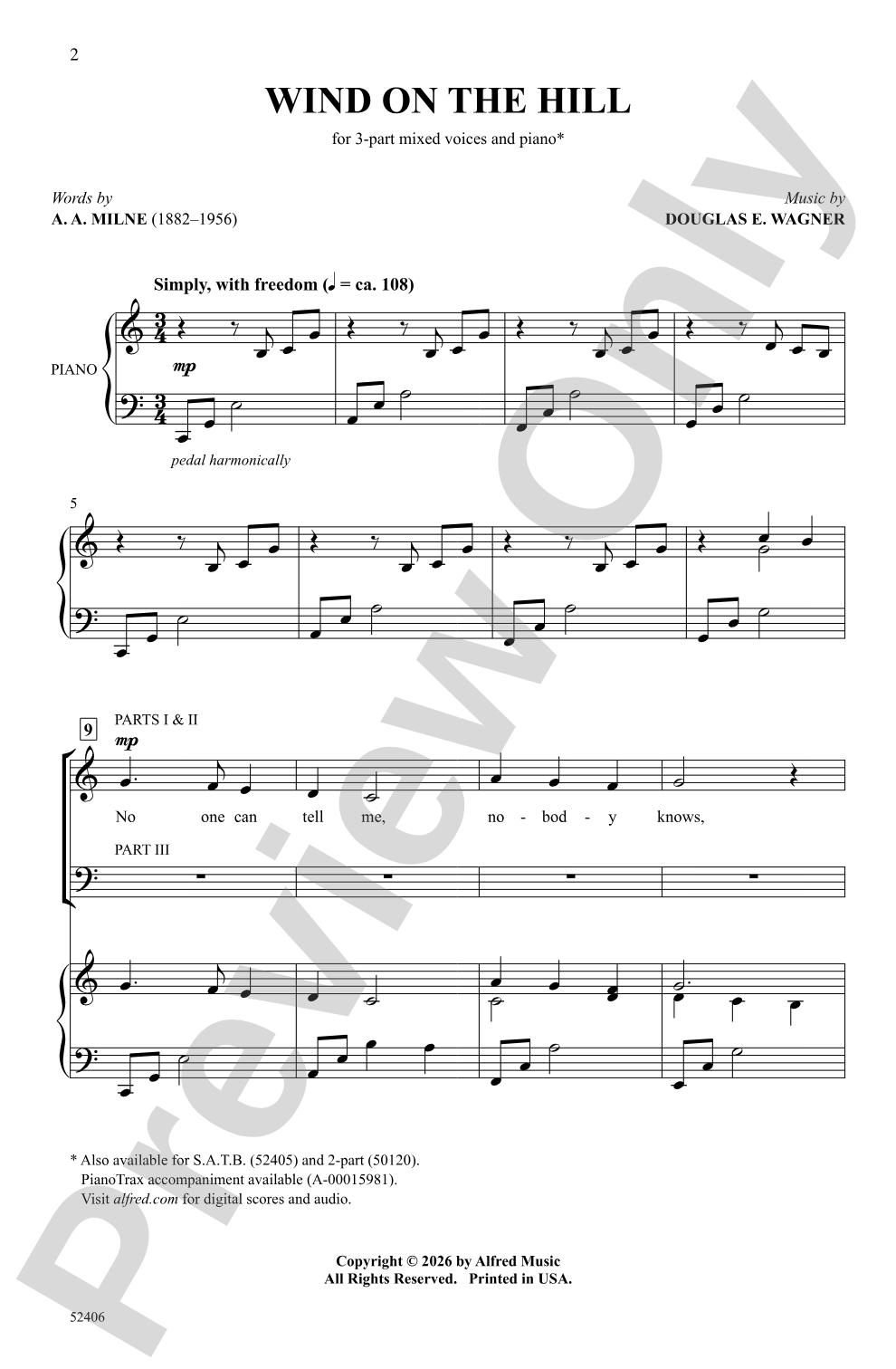
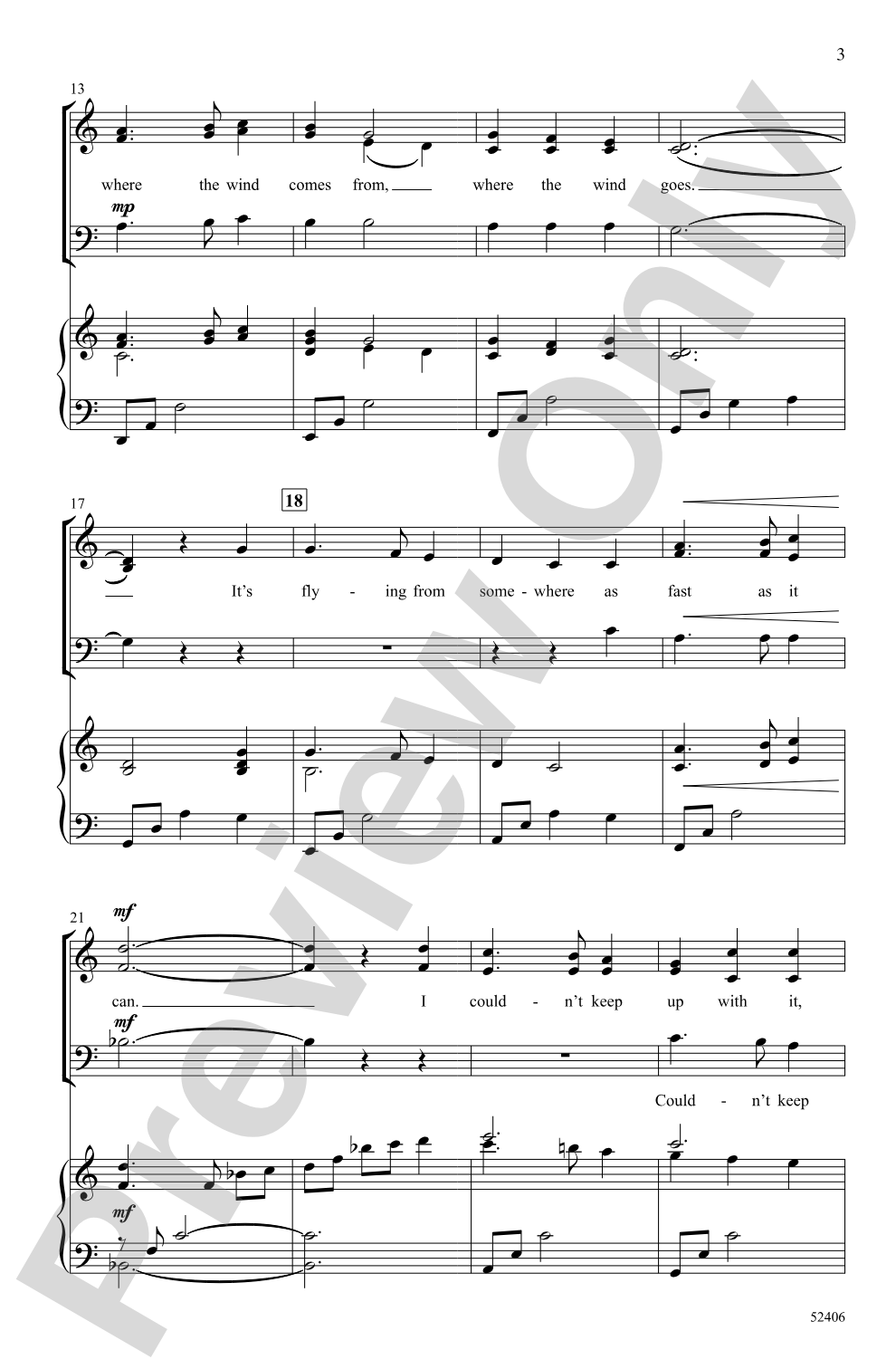

Wind on the Hill: 3-Part Mixed Choral Octavo
Words by A. A. Milne, music by Douglas E. Wagner
Item: 00-PO-0008289
$2.40
Minimum order quantity: 10 copies
Please note: Under U.S. copyright law, you must purchase the exact number of copies needed for your ensemble. Printing, duplicating or sharing additional copies is strictly prohibited.
Pickup currently not available
Description
New voicings! A. A. Milne considers nature's mysteries in this inquisitive text about the wind. We feel its presence and experience its effects, but cannot see it or change its direction. This curious sense of wonder is captured in a delightful musical interpretation for singers of any age. Elegant in its simplicity.


Discover MakeMusic Cloud: thousands of interactive titles your students can play along with today.
Sample Audio
1
Audio File
--:--
0:00
0:00
Sample Video
Additional Details
Series:
Alfred Choral Designs
Page Count:
8
SKU:
00-PO-0008289
More about this title
About the Composer: Douglas E. Wagner

Douglas E. Wagner grew up in Chicago and studied music at Butler University, earning both undergraduate and graduate degrees. He spent three decades as a high school music director and administrator before committing himself fully to composition in the early 1990s.
Since 1973, Wagner has published more than 3,500 works across nearly every ensemble and instrumentation: choirs, bands, orchestras, handbells, organ, piano, and solo voice. His output has reached an estimated seventeen million copies in performance and study. His music regularly appears in concert halls, broadcasts, and educational programs throughout North America and internationally, with particular strength in the school and church music markets.
Why we love this
Wagner captures something essential about A. A. Milne's text without overcomplicating it. The SAB voicing sits naturally for mixed ensembles while the musical language remains accessible enough that you won't spend rehearsals untangling thick counterpoint; instead, you'll spend them exploring the piece's genuine interpretive possibilities.
What to expect
Quiet contemplation with gentle motion. The piece invites singers and listeners alike into that familiar paradox of feeling wind's power while remaining unable to grasp its nature. There's wonder here, not melancholy; curiosity rather than sadness.
Who it's for
Any mixed choir seeking a substantive concert piece that bridges youth and adult singers without condescension. The three-part texture makes it practical for beginning secondary ensembles while the poetic content and harmonic sophistication satisfy more experienced groups.
How to get the most out of it
- Let the text drive the phrasing. Milne's language is conversational and observational, so singers will find better breath points and musical shape by honoring the poetry's natural syntax rather than fighting it.
- Balance transparency with warmth in the middle voices. The elegance of the piece depends on hearing the harmonic movement clearly without letting the alto line disappear.
- Consider what the recorded accompaniment offers: use it for rehearsal building in early stages, then evaluate whether removing it strengthens the singers' ownership of ensemble intonation and rhythmic security.
How to use it
This works beautifully in a concert built around nature texts or philosophical inquiry, paired alongside similar reflective pieces. It also serves well as a contest selection for festivals favoring literary substance and musical authenticity over virtuosic display.
Skills your students will build
- Lyrical phrasing in a contemporary harmonic language
- Transparent ensemble balance in three-part mixed voicing
- Text interpretation and expressive communication
- Intonation awareness in sustained harmonic passages