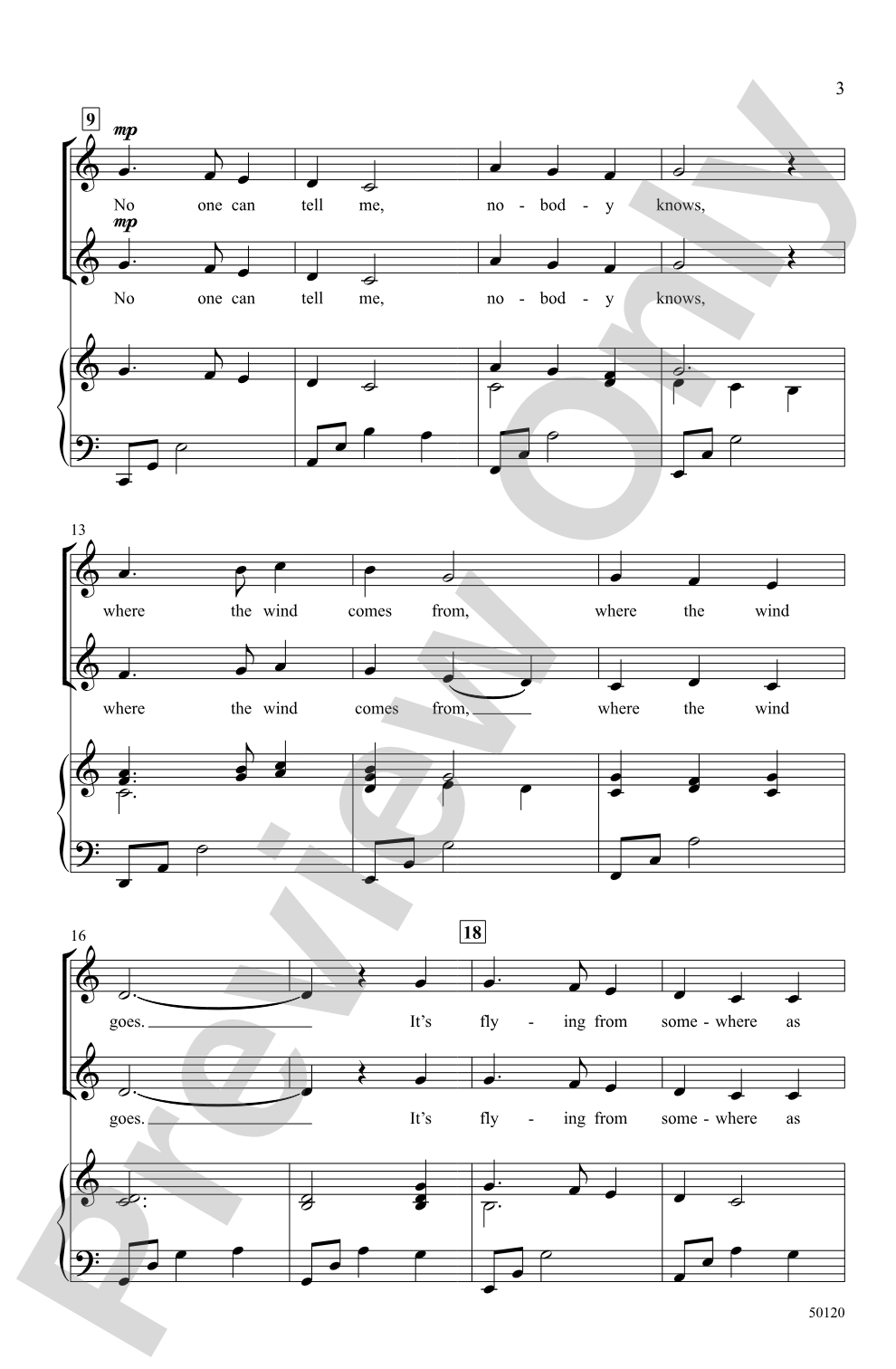
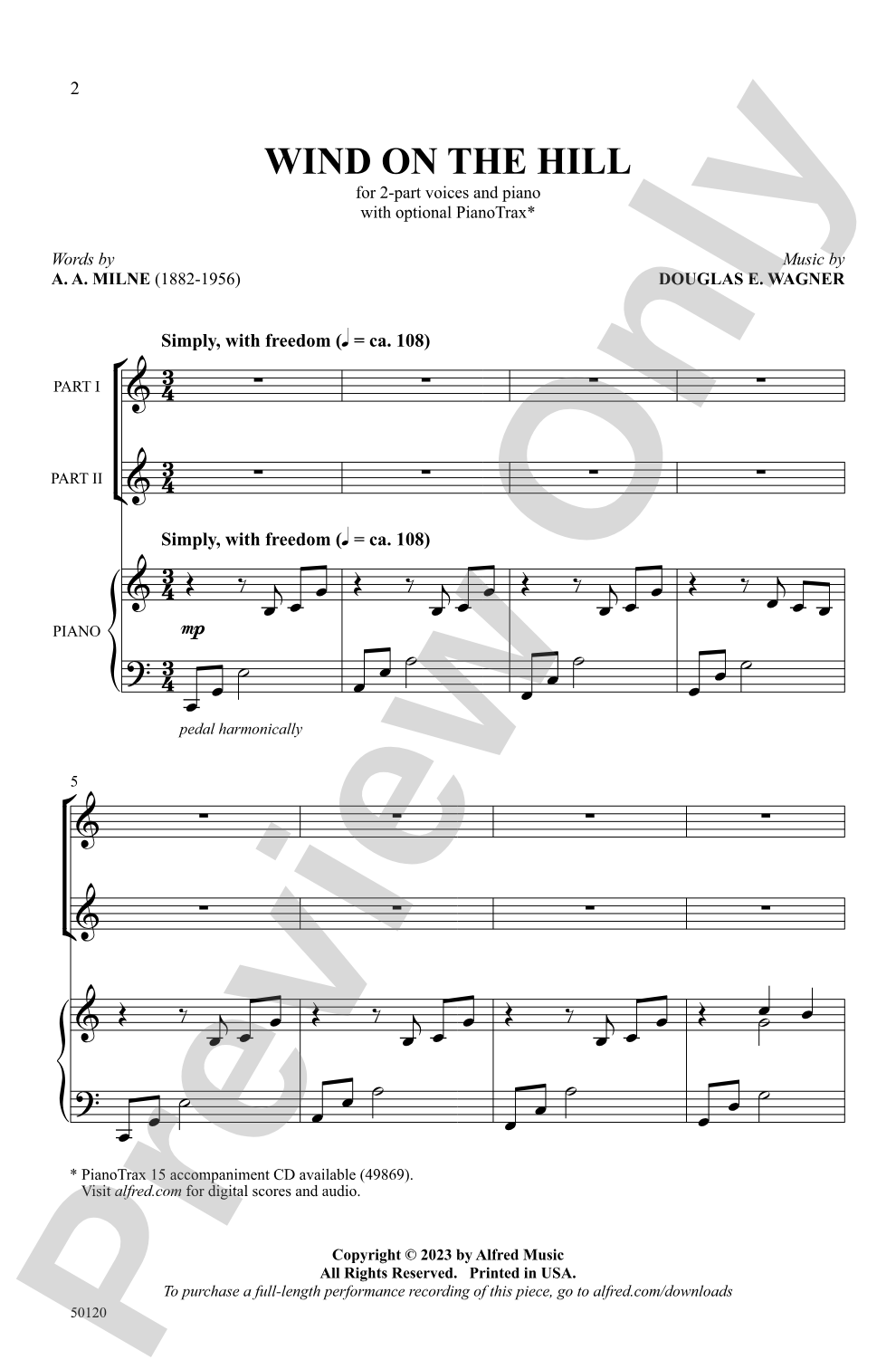
Wind on the Hill Sheet Music Preview

Wind on the Hill: 2-Part Choral Octavo

Words by A. A. Milne, music by Douglas E. Wagner

Item: 00-PO-0006998

Digital Download
$2.05

Minimum order quantity: 20 copies

One moment…

Description
Winnie-the-Pooh author A. A. Milne considers the wind through a child's eyes. We feel its presence and experience its effects, but cannot see it or change its direction. This curious sense of wonder is captured in a delightful musical interpretation for 2-part voices of any age. Elegant in its simplicity.

Wind on the Hill: 2-Part Choral Octavo isn't in MakeMusic Cloud just yet...but it could be. Let us know you'd like to see it, and you'll help shape what comes next. In the meantime, start a free trial and dive into thousands of interactive titles your students can play along with today.

Sample Audio
0:00
0:00
Sample Video
Additional Details
Series: Alfred Choral Designs
Publisher: Alfred Music
Page Count: 8
SKU: 00-PO-0006998

More about this title

About the Composer: Douglas E. Wagner

Douglas E. Wagner

Douglas E. Wagner grew up in Chicago and earned degrees in music from Butler University before spending three decades as a high school music director and administrator. His long tenure in the classroom shaped his instinct for what works with young singers and ensembles across skill levels.

Since 1973, Wagner has composed and arranged more than 3,500 works for choirs, bands, orchestras, handbells, organ, piano, and voice. His music has been performed in concert halls across the United States and internationally, reaching an estimated seventeen million performances. He now lives in Indianapolis and devotes himself full time to composition.

Why we love this

Wagner's gift for setting text shines here. He captures Milne's whimsical observation about the invisible wind with music that feels both simple and deeply satisfying, never talking down to singers or audiences. The piece moves easily through a concert program, yet leaves a lasting impression.

What to expect

Lighthearted wonder meets quiet reflection. The music moves gently, like air itself, inviting singers and listeners into a child's curious observation of something both present and impossible to hold. There's warmth in the simplicity and poetry in the restraint.

Who it's for

Any choir working with treble or mixed 2-part voicing can perform this piece. It suits younger singers developing part independence, school choirs seeking concert and festival repertoire, and adult community choirs valuing literary text and elegant writing.

How to get the most out of it

  • Shape the melodic line with gentle, natural phrasing rather than mechanical phrase breaks. Let the text breathing guide your singers.
  • Balance the two parts so they blend as a unified sound. Avoid letting one part dominate; this piece thrives on vocal blend.
  • Explore the recorded accompaniment available separately to help singers internalize the harmonic context during rehearsal.

How to use it

Program this as a concert opener or closer where you want to establish an introspective, imaginative mood. It pairs well with other works drawn from children's literature or poetry, and its brevity makes it ideal for festival competitions where you need a change of pace from more dramatic or complex selections.

Skills your students will build

  • Sustaining legit tone across two-part harmony
  • Phrasing and text interpretation in secular choral writing
  • Part independence and blend in simplified voicing
  • Responding to literary imagery through musical expression

You May Also Like