
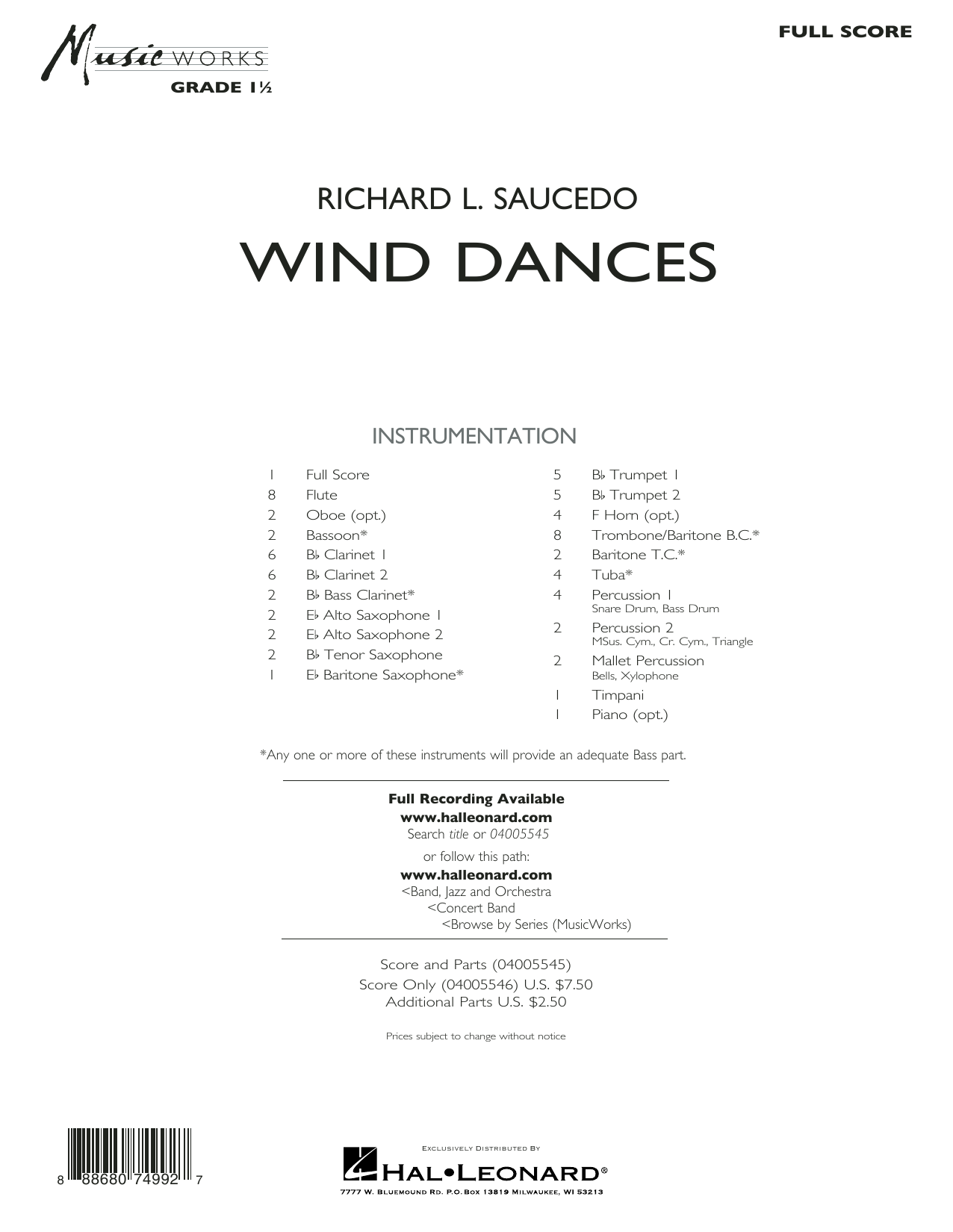

Wind Dances: Concert Band Conductor Score & Parts
By Richard L. Saucedo
Grade: 1
Item: 35-PK00412654
$45.00
Pickup currently not available
Buy Extra Parts (Digital PDF Download)
| Product | Price | Quantity |
|---|---|---|
| Wind Dances - Conductor Score (Full Score) | $10.00 | |
| Wind Dances - Flute | $6.00 | |
| Wind Dances - Oboe | $6.00 | |
| Wind Dances - Bassoon | $6.00 | |
| Wind Dances - Bb Clarinet 1 | $6.00 | |
| Wind Dances - Bb Clarinet 2 | $6.00 | |
| Wind Dances - Bb Bass Clarinet | $6.00 | |
| Wind Dances - Eb Alto Saxophone 1 | $6.00 | |
| Wind Dances - Eb Alto Saxophone 2 | $6.00 | |
| Wind Dances - Bb Tenor Saxophone | $6.00 | |
| Wind Dances - Eb Baritone Saxophone | $6.00 | |
| Wind Dances - Bb Trumpet 1 | $6.00 | |
| Wind Dances - Bb Trumpet 2 | $6.00 | |
| Wind Dances - F Horn | $6.00 | |
| Wind Dances - Trombone/Baritone B.C. | $6.00 | |
| Wind Dances - Baritone T.C. | $6.00 | |
| Wind Dances - Tuba | $6.00 | |
| Wind Dances - Percussion 1 | $6.00 | |
| Wind Dances - Percussion 2 | $6.00 | |
| Wind Dances - Mallet Percussion | $6.00 | |
| Wind Dances - Timpani | $6.00 | |
| Wind Dances - Piano | $6.00 |
Parts Added to Cart!
Description
Focusing on a single syncopated pattern, "Wind Dances" is a terrific teaching piece that also has musical depth and merit. With an energetic drive throughout and active parts for all players, this will quickly become a favorite. Dur: 2:25


Wind Dances: Concert Band Conductor Score & Parts isn't in MakeMusic Cloud just yet...but it could be. Let us know you'd like to see it, and you'll help shape what comes next. In the meantime, start a free trial and dive into thousands of interactive titles your students can play along with today.
Request This Title
Tell us you want it.
Start Your Free Trial
Explore everything that's ready to play right now.
Sample Audio
No sample audio found.
Sample Video
No sample videos found.
Additional Details
Publisher:
Hal Leonard
SKU:
35-PK00412654
More about this title
About the Composer: Richard L. Saucedo

Richard L. Saucedo spent 31 years as Director of Bands and Performing Arts Chairman at Carmel High School in Indiana, where he built a program that consistently earned state, regional, and national recognition across concert, jazz, and marching ensembles. His Carmel Wind Symphony performed at the Music for All National Concert Band Festival three times and claimed the Indiana State Champion title in 2013, while the Carmel Marching Greyhounds finished in the top ten at BOA Grand Nationals for 17 consecutive years, capturing national championships in 2005 and 2012.
Saucedo was recognized as Indiana's Bandmaster of the Year in 1999 and Outstanding Music Educator in 2010, earning induction into the Music for All Hall of Fame (2015) and the Drum Corps International Hall of Fame (2022). Beyond his high school leadership, he has served as brass arranger and composer for the Cavaliers Drum and Bugle Corps, contributing to five DCI world championships, and currently works as music ensemble coordinator for the Blue Devils. His freelance composing and arranging spans marching bands, concert bands, orchestras, and choral ensembles.
Why we love this
Saucedo nails the balance between pedagogical clarity and genuine musical interest. A single syncopated pattern provides the perfect teaching anchor for Grade 1 students, yet the energetic momentum and full engagement of the ensemble keeps it from feeling like a drill piece. Your students will play it with visible enthusiasm.
What to expect
Bright, propulsive energy with an infectious groove. The syncopated writing creates rhythmic sophistication without overwhelming younger players, and the active orchestration means everyone gets a moment to contribute. It's the kind of piece that stays in your ears after rehearsal ends.
Who it's for
Grade 1 concert bands seeking a piece with real teaching value and musical substance. Directors want material that develops fundamental skills without sacrificing the joy of playing something genuinely enjoyable. This fits that need exactly.
How to get the most out of it
- Establish the syncopated pattern in sectionals before the first ensemble run. Have each section clap and speak the rhythm independently, then layer them together so students understand how their part locks into the whole.
- Keep the tempo steady and driving. This piece relies on rhythmic precision and forward motion, so conductor clarity on the pulse matters more than expressive flexibility.
- Balance the parts so no single voice dominates. With active writing throughout, encourage all players to listen across the ensemble rather than just their own line.
How to use it
Open a concert with this piece to set an engaging tone and showcase the ensemble's rhythmic precision. The tight two-minute-twenty-five-second duration works equally well as a warm-up for a longer form piece or as part of a series of shorter works that span different styles and moods.
Skills your students will build
- Reading and executing syncopated rhythms in ensemble context
- Listening to sustained parts while maintaining independent rhythmic responsibility
- Maintaining tempo and pulse in an energetically driven work
- Voice independence in a texture where all parts are rhythmically active