
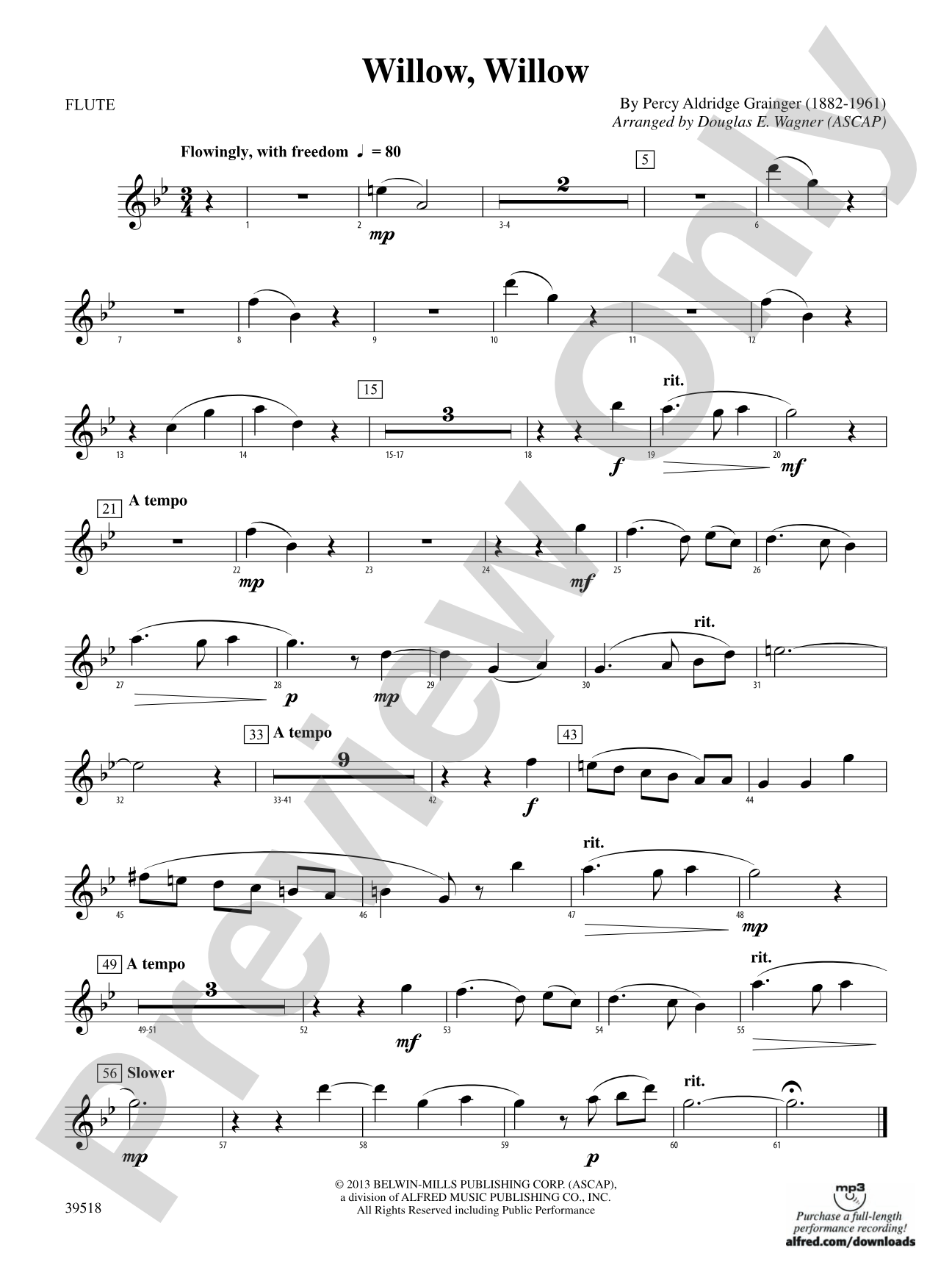

Willow, Willow: Flute
By Percy Aldridge Grainger / arr. Douglas E. Wagner
Grade: 2 (Easy)
Item: 00-PC-0015833_F1
$3.00
Pickup currently not available
Description
The first of Grainger's settings of songs and tunes from William Chappell's "Old English Popular Music," this intense musical ballad offers the listener a languid and emotionally charged adaptation of Desdemona's song from Shakespeare's Othello. (2:30) This title is available in MakeMusic Cloud.


Don't just read it, hear it, play along with it, and watch your students grow with it. In MakeMusic Cloud, Willow, Willow: Flute comes alive with professional accompaniment, adjustable tempo, and built-in practice tools that turn solo practice into real progress.
Open in the Player
Jump straight in and assign it today.
Start Your Free Trial
Open this title and explore the full library in minutes.
Sample Audio
1
Audio File
--:--
0:00
0:00
Sample Video
Additional Details
Series:
Belwin Young Band
Publisher:
Alfred Music
Page Count:
120
SKU:
00-PC-0015833_F1
More about this title
About the Composer: Percy Aldridge Grainger
Percy Aldridge Grainger (1882-1961) was an Australian-born composer and pianist whose prolific output ranged from concert works to innovative band arrangements. He held conducting and teaching positions across Europe and America, and his deep engagement with folk music research shaped his compositional voice. Grainger's arrangements of traditional melodies stand among the most performed works in the concert band repertoire, prized for their accessible scoring and emotional directness.
Grainger's approach to folk material was scholarly yet deeply musical. Rather than simply orchestrating existing tunes, he reimagined them through modern harmonic language, creating pieces that honor their origins while demanding interpretive nuance from performers. His band works remain central to music education because they demonstrate how arrangement can deepen rather than diminish a melody's power.
Why we love this
Grainger's setting transforms a quiet, haunting text into something that holds a concert audience in complete stillness. The arrangement sits perfectly at Grade 2, providing genuine musical substance without technical overload; your students will discover how restraint and sensitivity matter as much as technical facility. This is the kind of piece that teaches young musicians that emotional communication is always the real work.
What to expect
The piece unfolds like a memory or a confession, with long, breathing phrases that invite introspection. There is an ache in the harmony; minor inflections and suspended moments create an atmosphere of quiet longing. From start to finish, this is music that asks performers and listeners alike to sit with something delicate and real.
Who it's for
Directors seeking a substantial yet accessible concert piece for Grade 2 bands will find this setting both artistically rewarding and pedagogically sound. Young musicians benefit from performing music that connects to Shakespeare and art song traditions while staying within appropriate technical bounds. This work suits programs that value emotional expression and precision over flashy technique.
How to get the most out of it
- Build the opening measures with patience. The languid quality depends on restraint in early statements; resist the urge to bring full sound too quickly.
- Pay close attention to Grainger's dynamic marking choices. Each crescendo and diminuendo shapes the emotional arc; follow them precisely rather than making broad interpretive choices over them.
- Balance the melodic line against accompanying voices carefully. This piece lives in the interplay between parts, so ensure inner voices support without obscuring the primary melody.
- Allow for natural breathing space between phrases. The ballad quality requires that players listen to silence as actively as they listen to sound.
How to use it
This piece works beautifully as a concert opener or as a reflective moment between more energetic works. Its 2:30 duration and emotional weight make it ideal for thematic programming around Shakespeare, art song, or folk traditions. Consider pairing it with other Grainger settings or contrasting it with contemporary concert band works to highlight the richness of the genre.
Skills your students will build
- Sustaining long, shaped phrases with consistent tone and intonation
- Balancing dynamics across the full ensemble while maintaining clarity of line
- Responding to subtle harmonic language and finding emotional expression within restraint
- Listening to and supporting inner voices with awareness of the overall texture