
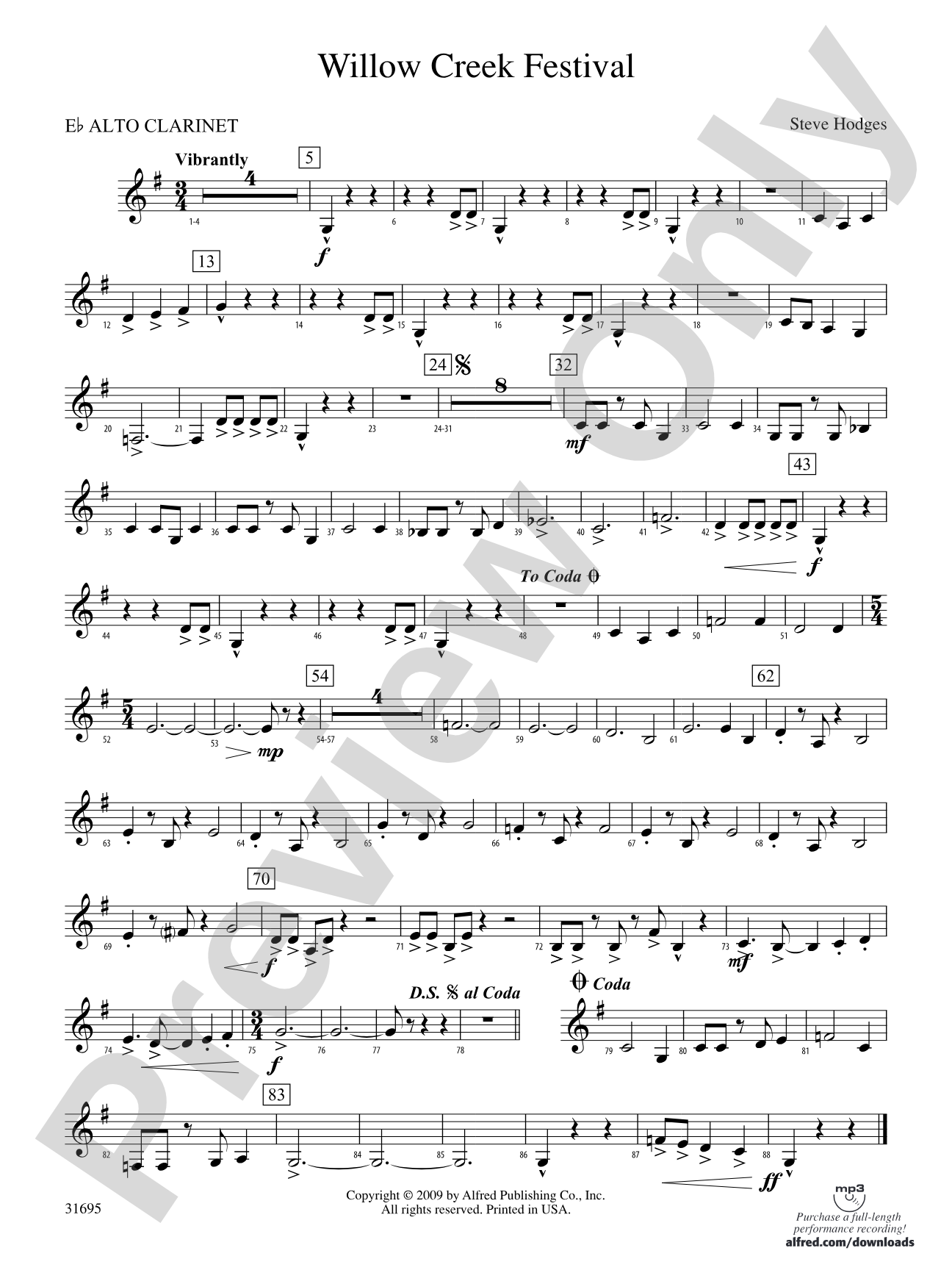

Willow Creek Festival: (wp) E-flat Alto Clarinet
By Steve Hodges
Grade: 2 (Medium Easy)
Item: 00-PC-0001796_wpAC1
$3.00
Pickup currently not available
Description
Beginning with an energetic fanfare, Willow Creek Festival is an upbeat piece that moves along smoothly in triple meter. The main theme is presented by the clarinets and saxophones and then again by the trumpets and flutes. A repetition of the introduction provides a transition to a contrasting section in 5/4 time which features a memorable melody in the relative minor key. With varied percussion colors, active rhythmic patterns and an effective countermelody, an excellent contrast is achieved. The main theme returns and flows into an exciting variation of the initial fanfare, bringing the piece to a dynamic conclusion.


Don't just read it, hear it, play along with it, and watch your students grow with it. In MakeMusic Cloud, Willow Creek Festival: (wp) E-flat Alto Clarinet comes alive with professional accompaniment, adjustable tempo, and built-in practice tools that turn solo practice into real progress.
Open in the Player
Jump straight in and assign it today.
Start Your Free Trial
Open this title and explore the full library in minutes.
Sample Audio
1
Audio File
--:--
0:00
0:00
Sample Video
No sample videos found.
Additional Details
Series:
Challenger Band Series
Publisher:
Alfred Music
Page Count:
124
SKU:
00-PC-0001796_wpAC1
More about this title
About the Composer: Steve Hodges

Steve Hodges brings four decades of public school band and choral directing experience to his compositional work. He holds degrees from Western Oregon University (B.S.) and Central Washington University (M.A. in Music Education), grounding his writing in deep understanding of what students and conductors need in the rehearsal room.
Since 1986, Hodges has published over 120 concert band compositions through Alfred Music, along with choral arrangements for Staff Music and Shawnee Press. His works have appeared at festivals and state music conventions across North America, been featured on TBS and ESPN broadcasts, and earned commissions from honor bands and schools throughout the United States and Canada. He is an ASCAP member and continues to engage with music in his Oregon community.
Why we love this
This piece tackles metric modulation in a way that feels organic rather than academic. The shift to 5/4 arrives naturally as a contrasting section with its own melodic integrity, making it an ideal teaching vehicle for bands ready to explore meters beyond the basic 2/4 and 4/4. Hodges balances accessibility with genuine musical substance, delivering a concert piece that sounds and feels accomplished without making unrealistic demands on young players.
What to expect
Willow Creek Festival opens with bright, ceremonial energy before settling into a groove that feels both accessible and genuinely musical. The mid-piece shift to 5/4 time introduces an introspective minor-key moment that contrasts beautifully with the surrounding material, giving the overall arc real shape and emotional range. By the final variation of the fanfare, the piece builds toward a satisfying, dynamic conclusion that leaves audiences with a memorable impression.
Who it's for
Concert bands at the Grade 2 level who have solid fundamentals in place and are ready to explore metrical variety. This works equally well for honor bands, festival performances, or concert contexts where you need a piece that sounds polished without excessive technical difficulty.
How to get the most out of it
- Articulate the opening fanfare with crisp precision so the energy translates clearly before the main theme enters. Young players often blur fanfares if the conductor doesn't establish exact clarity in marking and release.
- Let the clarinets and saxophones own the main theme as a cohesive unit. Balance their sound carefully so neither overshadows the other when they present the primary melodic statement.
- Prepare the 5/4 section by conducting it in a way that lets the relative minor feel fresh and distinct. Consider a brief tempo check before the transition so players hear the new metric framework clearly.
- Shape the countermelody with slightly more volume than the main line so it reads distinctly to the audience. Contest judges and concert listeners will appreciate hearing both voices equally.
How to use it
Program this as an opening or second piece on a concert where you want to establish energy and musicianship early. It also works excellently as a festival or contest selection because it demonstrates metric sophistication and orchestrational awareness without requiring students to struggle with technical passages. The 124-page conductor score and parts set gives you everything needed for immediate rehearsal.
Skills your students will build
- Reading and performing in mixed meters (3/4 and 5/4)
- Melodic balance between paired sections (clarinets with saxophones, trumpets with flutes)
- Articulation clarity in fanfare figures
- Maintaining tempo and pulse through metric modulation
- Listening for countermelody and secondary lines
- Dynamic contrast and shaping across full-band variations